Author Archives: bookshelfbattle

Disco Werewolf – Chapter 3

DISCO_WEREWOLF_1

For those who had never been inside before, stepping into Sweet Johnny Sugarshine’s Electrostatic Groove Lounge was like landing on another plant.  The sights, the sounds, everything tantalized the senses.  The dance floor was made of thousands of individual squares, each one blinking a different color of the rainbow.  A disco ball hovered from the ceiling, bathing the room in a glow of twinkly lights.

Dancers in the gawdiest outfits moved to the beat.  Spins, turns, flips, they were all trying to outdo each other.  At the bar, booze flowed freely, with no one caring if anyone was overserved.

The house DJ took to the microphone to make an announcement.  “Good evening all you cats and kittens!  If you’re having a good time, let me hear you make some noise!”

The dancers roared with excitement.

“Now, clear the floor if you please, because it’s time to say hello to your host with the most,” the DJ said.  “He’s held many titles in his life.  Some call him the King of Swing or the Emcee of Funk.  Others, the Sultan of Soul.  But today, you know him best as the Duke of Disco…the one, the only…Sweet Johnny Sugarshine!”

Throughout the club, men stood behind massive cameras, recording all the action.

Poof!  A cloud of smoke erupted in the center of the dance floor.  This bought some time for a trap door to open that allowed the club’s proprietor to rise up on a moving platform.  Once the smoke cleared, it was as if he had magically appeared out of thin air.

Sweet Johnny Sugarshine was a dashing man in his early 30s.  From head to toe, his suit was golden, with the chains around his neck to match. His afro stood tall above his head and he had a smile so wide that it was hard to stay sad in its presence.

“Well, hello there my babies,” the host said into a microphone.

“Hello Johnny!” the dancers replied in unison.

“I hope you’re all having a good time in my Electrostatic Groove Lounge,” Sweet Johnny said.  “I wouldn’t have let you in had I not seen something special in each and everyone of you.”

“Wooo!” the dancers answered.

“You know, it’s funny,” Sweet Johnny said.  “About six months ago, the local cable access station came to me and said, “Johnny baby, we got to do something for all the people who will just never be hip enough to get down in your fly pad, you dig?”

Sweet Johnny strutted about the floor.  “And so I said, ‘Sure I dig.  What are we gonna do?’  And the cable people, and by the way, babies, if you haven’t hooked your television up to cable yet then you need to do so because let me tell you, being able to see cinema quality movies in the comfort of your own home is a real gas but let’s not get off track.  The cable people said, ‘Hell, Johnny baby, we’re gonna give you your own show.’”

“Wooo!” went the crowd.

Sweet Johnny looked directly into one of the cameras.  “So, to all your wallflowers at home, go on.  Get out of your Barcalounger and get some pep in your step, because it’s time for the festivities Sweet Johnny Sugarshine’s Disco Power Hour to commence!”

Across the club, the spotlight hit a main stage.  A group of musicians wearing bright colors played their instruments.  A breathtakingly gorgeous woman took stepped up to the microphone.  Her dress was white and covered with flashy gems.  Her eyelashes were long, her blonde hair stacked high on her head and she was revealing a staggering amount of cleavage.

“Ladies and gentlemen,” Sweet Johnny said.  “Put your hands together and give it up for Boo Boo Larue and the Starlight Crew.  They’re here all week and right now they’re going to lay down their latest hot track.  Don’t you dare put your finger on it because if you do, it’s going to be scalded. That’s how hot it is.  Here’s Boo Boo with Love Another.”

              Boo Boo’s lips pressed out the lyrics:

Lover!  I never thought I’d love again.

              ‘Till I met you, my friend.

              You’re the best lover that I ever knew.

              Woo, ah-ooo.


              While all the action was broadcast live throughout the Tri-State area, Sweet Johnny switched off his microphone and moseyed on over to the bar.  There, his signature gin and tonic was already waiting for him.  It was on the rocks, just the way he liked it.


Moments later, a tall man, slender man in platform shoes bellied up to the bar.  He wore a silk, floral-patterned shirt, opened at the top to reveal a lush patch of rugged chest hair.  A golden medallion rested prominently on the patch.  His hide was covered by a pair of baby blue bell bottom jeans which were held up by a wide, white belt.  His golden hair was done up in a gravity defying perm.


Was the man happy or sad?  No one could tell his mood as his eyes were hidden away behind a pair of smoky colored shades.  He did carry an air of depression about him though, which was surprising, as he was in the company of two bodacious babes.


The bartender brought the man his usual – a pink cosmopolitan with a tiny little umbrella sticking out of it.  He sat and sipped in silence as the ladies ran their hands over his chest hair.

Five minutes passed.  Boo Boo moved on to another song while the patrons danced the night away.  Finally, Sweet Johnny cut the tension.  “Boogiedown Barry.  Are you seriously going to sit there like the saddest sack of turnips to ever fall off the back of the truck and ignore the Duke of Disco all evening?”


Barry scoffed.  “Ha.  Duke of Disco.  I’ve seen you dance, Johnny.  You’ve got two-left feet and all the rhythm of a rampaging rhino.  If anyone should be the Duke of Disco, it should be me.”


“Oh, here we go,” Sweet Johnny said.  “The green-eyed monster rears its ugly head once again.”


“You think I’m jealous?”  Barry asked.

Sweet Johnny swirled a swizzle stick around the inside of his glass.  “I know you are, daddio.  I can read it all over your face like a cheap dime store romance novel, baby.  Why don’t you take a deep breath, exhale all your resentments and let them go, before they eat you alive?”

Barry laughed.  “That’s rich.  You talk like a big man, but we both know you’d be nothing without me.”

“You think so?”  Sweet Johnny asked.

“I know so,” Barry replied.  “This club was nothing before I came along.  I could have danced anywhere, but I chose to dance here.  I liked your digs.  I thought it had a special savoir-faire, a certain je ne sais quoi.  But my moves brought the people out, Johnny.  If it weren’t for me, this place would have never gotten through its first year.”

Sweet Johnny sighed.  He reached over and rubbed Barry’s shoulder.  “You’re not wrong, hep cat, and for you’re the many funky dance moves you busted on my floor, I will be forever grateful, but you and my old man are cut from the same cloth.”

“Please,” Barry said.  “I’m nothing like that square.”

“You don’t think so?”  Sweet Johnny asked.  “Let me lay the straight skinny down on your head, you broke ass hustler.  There was a time when anyone who was anyone wanted to be caught alive inside the Dandy Haberdashery.  Jazz was all the rage but music fans are a fickle lot and once rock and roll took over, my old man refused to change with the times.  He kept trying to push Jazz on a public that was buying until he ended up in the poorhouse and he was just like you, ragging on me for being a sell-out.”

“You are a sell-out,” Barry said.  “You sold me out to a damn, dirty werewolf.”

Sweet Johnny held up a single finger.  “Rule number one of show business, baby.  Give the people what they want.  You hear the people ask for something, be the one who gives it to them and they’ll love you.  Give them something else and you’ll be tossed out into the trash can like yesterday’s rotten meatloaf.”

“What are you saying?” Barry asked.  “That I’m rotten meatloaf?”

“I’m saying that if the people wanted Boogiedown Barry, I’d give them Boogiedown Barry.  But they don’t want Boogiedown Barry no more baby.  They want Disco Werewolf.  The sooner you get that fact through your thick head, the better.”

“I hate that werewolf,” Barry said.

Sweet Johnny pulled a pack of smokes out of his jacket.  He offered one to Barry, who passed.  He took one for himself and lit up.  “Hate is a strong word.  And besides, doesn’t the world already have more than enough hate to go around already?”

“It could always use a little more,” Barry said.  “What about the dance competitions?  Those were my idea.  Those got people coming here.  Every geek off the street thinking they would come here, shake a leg, and be the next newly discovered star.”

“Those were your idea,” Sweet Johnny said.  “And I thank you.  I also never told you to stop competing in them.”

Barry downed his drink, pounded the glass down on the bar, then ordered another. “Bah! Like I could ever beat Disco Werewolf!”

“You need to stop letting Disco Werewolf live inside your head, dude,” Sweet Johnny said.  “Stop comparing yourself to that sexy dance monster and be your own man.”

“I can’t,” Barry said as he slurped his new drink.  “Disco Werewolf has ruined my life.”

Sweet Johnny shook his head in disgust.  “Fame is a fickle mistress, Barry.  Today she loves one cat, tomorrow another.  Hell, last decade, every red-blooded American male wanted to nail Elizabeth Taylor to the wall and now?  That old crone can’t give it away.  You think she sits around her big house, drinking and lamenting because everyone wants to stick it to Faye Dunaway now?”

Barry glared at Sweet Johnny, who instantly nodded in agreement.  “OK.  Bad example.  But you get the gist.  The glamour life is a great big game and we’re all players, baby.  When the game’s going your way, life is sweet than candy.  But when it all starts to go south, life is as bitter as a dill pickle.  At that point, you can either reinvent yourself and come back as something that all the other players want, or you can right off into the sunset like a sad yet, dignified cowboy, confident that you did all you can do in this life and you’ve got nothing left to prove.  Or you can just do what you’re doing right now and be a big crybaby about it.”

Without skipping a beat, Barry instantly replied, “Waah.”

“Whatever,” Sweet Johnny said.  “Don’t hate the werewolf, baby.  Hate the game.”

“I’ll hate that werewolf as much as I damn well please,” Barry said.  “He ruined my life.”

“I give up,” Sweet Johnny said.  “You have literally not comprehended a single word I have said.  Just count your blessings, Barry.  Look at you.  You got your looks.  You got your style.  You got your fine ladies.  At least Disco Werewolf can’t take that away from you.”

A howl came from somewhere high up in the rafters.  “Ahh-woo!  Arr, arr, ahh-wooo!”

The dancers went absolutely bonkers, totally out of control with excitement and anticipation.  The ladies pulled their hands away from Barry’s chest.

The DJ took to the microphone.  “Uh, oh, cats and kittens.  Did you hear that?”

Another howl.  “Ahh-wooo!”

“Disco Werewolf has entered the building,” the DJ said.  “I repeat, ‘Disco Werewolf has entered the building!’”

“Oh my God!” gasped the first of Barry’s galpals.  “Is Disco Werewolf really here?”

One more howl.  “Ahh-woo!”

The second lady grabbed the first lady’s hand.  “Come on!  We’ve got to find him!”

“Oh!” the first lady cried.  “I hope he’ll dance with me!”

And with that, the ladies bolted.  Barry flashed Sweet Johnny an I told you so face.

Sweet Johnny sipped his drink.  “Alright, baby.  I stand corrected.”

The Duke of Disco reached into his pocket, pulled out a few bills, and left them on the bar as a tip.  He then pointed at the sad sack.  “Even so, Boogiedown Barry, you got more pussy in your life than most men don’t get in a hundred lifetimes, so this funk you’re in is all on you.  Get your head on right and you’ll be feeling dynamite and out of sight.”

“Yeah,” Barry said.  “Whatever you say, Sultan of Something or Other.”

“Now, if you’ll excuse me,” Barry said as he straightened his color.  “I must mingle with my public.

Sweet Johnny didn’t get very far into his mingle when he was approached by a young lady holding a notebook and pen.  She was dressed way too conservatively for such a swinging establishment.  It wasn’t like she was dressed like a Grandma on her way to church or anything.  She just wore a simple striped polo shirt and a pair of tan khaki pants.

“Mr. Sugarshine?  Can I have a word?”

“Oh Lord,” Sweet Johnny said.  “Not you again.”

Tagged

Disco Werewolf – Chapter 2

DISCO_WEREWOLF_1

A long, luxurious stretch Rolls Royce limo pulled up across the street from the disco.  The vehicle was all kinds of tacky, from the purple paint job to the golden grill.  The window in the backseat rolled down.

The occupant was listening to the radio.  The sound traveled through the night air.

“Awoo, baby!” the disc jockey said.  “You’re listening to WNITE, New York’s number one station to listen to the disco tunes that make your body swoon, so get off your seat and dance to the beat.  As always, I’m Toe Tappin’ Teddy and I’m making my way through the top charts tonight.  By the way, we just got word at the studio that the one, the only, the incomparable Disco Werewolf has just made his way into Sweet Johnny Sugarshine’s Electrostatic Groove Lounge so if you’re one of the handful of lucky ones admitted inside, be sure to feast your peepers on that fuzzy dance machine, because I’m told when it comes to cutting a rug, there’s no one better than DW.  Awoo!”

The limo door open.  Out poured three foxy mamas.  The trio had been named after three of the occupant’s favorite jewels.  Ruby, Emerald, and Diamond – a black girl, an Asian girl, and a blonde girl, respectively.  All wore scantily clad outfits featuring skirts hiked high, leaving little to the imagination.

Whoever the occupant of the back seat was, he wasn’t very tall.  His purple hat, which featured a yellow feather sticking out of the zebra striped band, barely cleared the edge of the window.  A diamond tipped cane popped into view.

The occupant’s voice was high-pitched and squeaky.  “Bitches, do you understand the mission parameters?”

“Sure enough, Daddy,” Ruby said.

“Good,” the occupant said.  “Go on, then.  Do Daddy proud.”

The ladies turned heads as they sashayed up to Ecstasy.  Ruby pulled a plastic bag filled with white powder out of her purse and handed it to the doorwoman. “Big Daddy sends his regards.”

Ecstasy looked to her left, then right.  Seeing no cops in the vicinity, she grabbed the bag and stuffed it into her bra.  “Tell Big Daddy I’m much obliged.”

The doorwoman lifted the velvet rope and allowed the trio to enter, incurring the wrath of everyone waiting in line.

“Pipe down, you dirty animals!” Ecstasy shouted.  “Trust me.  If you’re ever good enough to go inside, I will let you know.  But rest assured, I never will because none of you will ever be worthy.”

Ecstasy looked at Bruno.  “We are going to get loose as a mother goose tonight.”

“Errm,” Bruno said.

“I might even let you do that thing.”

“Errm.”

“Right,” Ecstasy said. “Not in front of the riff raff.”

Back across the street, Big Daddy chilled and listening to his radio.

“Coming up next, it’s the hit single Love Me Freaky by everyone’s favorite disco kings from across the pond, the Vagabonds,” Teddy said.  “These British boys tore up the charts for years only to completely drop off the scene six months ago.  Where are they?  Your guess is good as mine, baby.  Perhaps they’re cloistered off somewhere, working extra hard on their next album, turning it into a surefire masterpiece.  Then again, if I were a betting man, I’d say one of the boys is holed up with a bimbo somewhere and can’t be bothered to entertain us anymore.  Oh well, if you see one of these lads, tell them Toe Tappin’ Teddy sure does miss them.  Until then, here’s Love Me Freaky by the Vagabonds.”

The end of a cigar peaked out of the limo’s window.  The end glowed red as it was puffed upon.  Smoke exhaled out into the air as the music played:

Love me…at your own pace!

              Love me…and repopulate the human race.

              Love me girl, your love’s so sneaky.

              Come on baby, and love me freaky!

Tagged

Disco Werewolf – Chapter 1

DISCO_WEREWOLF_1

Out front, the hot neon pink and yellow sign read “Sweet Johnny’s Electrostatic Groove Lounge.”  The line to get in stretched back for an entire city block.  Ecstasy Sublime, the notorious drag queen turned doorwoman, was notoriously picky when it came to selecting entrants.  After all, dancing the night away in the Big Apple’s premiere discotheque was considered by many (rightly or wrongly) to be a life changing experience.  Ergo, the honor couldn’t be bestowed upon just anyone.

Ecstasy wore a shiny, sparkly dress adorned with thousands of glittering sequins.  Her red wig stood a full two feet above her head and her makeup left her cheeks looking full and rosy.  Alas, there simply wasn’t a thing she could do about her Adam’s apple.

“I am so sorry, darling, but you simply are not on tonight’s list.”

“Well,” said a young man in his late teens with long hair.  “Check again.”

The doorwoman sighed.  “Sweetie, I can play the check it again game all night but truth be told, only the people who pique Mr. Sugarshine’s interest are allowed in the club and look at you.  You haven’t even had enough time on this earth to do anything remotely interesting, let alone appear as the tiniest blip on the Emcee of Funk’s radar.”

Ecstasy looked up and to the left, taking in the stoic face of the club’s bouncer, Bruno, who was six foot five and three hundred pounds of solid muscle, all stuffed into a black t-shirt and jeans.

“Oh dear,” the doorwoman said as she turned back just in time to see the lad’s face scrunch up.  The kid was choking back his own tears, trying but failing at the task of maintaining a manly façade.

“Tough love,” Ecstasy said.  “This is the part of my job that I hate with the passion of a thousand red hot fiery sons.  I really do.  I’m sorry, honey. Do you need a tissue?”

“No,” the young man said.  “It’s just, we’ve been waiting here for hours, you could have posted a sign or something.”

“Waiting in line for hours to be rejected at the door of Sweet Johnny’s Electrostatic Groove Lounge is one of the greatest experiences a New Yorker will ever achieve, child,” Ecstasy said.  “You’re not even a real New Yorker if you haven’t been told to get lost at the door at least three times so, let me help you with your first.”

Ecstasy put her hand on the youngster’s arm.  “Get lost, buttercup.”

The young man’s face turned red with anger.  “No!  I’m not going anywhere!”

A pretty blonde girl tugged on the kid’s arm.  She wore a little black dress, with blue eyeshadow.  “Come on, Derrick.  We tried.  Let’s go get pancakes.”

“Oh, yes,” Ecstasy said.  “Do go get pancakes, Derrick.  And don’t even think about coming back until you’re somehow relevant to the cultural zeitgeist of our fair city or at the very least, until you’ve done something about that hair.”

“What?” asked Derrick as he grabbed his locks.  “What’s wrong with my hair?”

“Nothing,” the girl said.

“No, Wendy,” Derrick said.  “I want to know.”

“It’s what they do,” Wendy said.  “They dump on everyone trying to get in, right?”

“It’s true,” Ecstasy said.  “I’m such a catty bitch, aren’t I, Bruno dear?”

Bruno was a man of few words.  “Errm.”

“Oh, my stars,” Ecstasy said.  “It would appear that Bruno is losing his patience, so if would skedaddle dear, I have to inform more people how they have failed themselves and how they might improve.”

The drag queen held the back of her hand across her forehead, pretending as though she might faint.  “Zounds, I say! A doorwoman’s work is never done!”

Wendy laughed.  Derrick wasn’t in the mood for humor.  He pulled out his wallet, retrieved two green portraits of Ulysses S. Grant and handed them over.  Ecstasy looked at them.  She handed one to Bruno, then folded the other and tucked it into her tissue stuffed bra.

“Thank you, doll,” Ecstasy said.  “Now be on your way.”

Derrick gasped.  “What?  But I just gave you…”

“I know,” Ecstasy said.  “And gratuities are always so humbly appreciated but seriously, kid, stop darkening my doorstep.”

“Fine,” Derrick said as he held out his hand.  “Just give it back.”

Ecstasy held her hand up to her ear.  “I beg your pardon?  I seem to have developed a nasty case of selective hearing loss.”

“I want my money back!”  Derrick griped.

“Huh?” Ecstasy asked.

A sound coming from high above the street broke the tension.  “Ahhwoo!”

Ecstasy clutched her tacky costume jewelry.  “Heavens to Betsy! Could it be…”

Bruno grabbed one of the two spotlights that had been shining into the air and pointed it at the top of the building across the street.  In doing so, he illuminated a character who was seven feet tall.  He wore a white leisure suit, a black shirt with a popped collar.

Also, he was a damn werewolf.

“Arr…arr..arrwooo!”

The line cheered as the beast, with all the grace of a ballerina,  leapt ten stories downard, only to land on his feet, completely unscathed.  As he crossed the street, he did a few twists and turns.  Fans hooted, hooted and hollered.  Cameras flashed.  An adoring female voice cried out from the crowd, “I love you, Disco Werewolf!”

Disco Werewolf pointed to the vicinity of where the voice came from, winked, then right there in the street, he cocked his hip to one side, pointed a finger in the air, and struck a pose.  The crowd ate it up.

When he was done hamming it up for the masses, the lewd and lascivious Lycan moseyed on over to Ecstasy and came to a complete stop.

“Disco Werewolf!” Ecstasy cried.  “Look at you!  You’re fun!  You’re funky!  You’re astounding and you absolutely ooze gallons of fabulosity from each and every one of your pores.  Tell me your secret, darling.  How did you become so stunningly spectacular?”

The furry man of the hour cocked backed his head and howled into the moonlight.  “Awoooooo!”

The line erupted with a chorus of “Yeah!” and “Woo hoo!”  Another female voice shouted, “Disco Werewolf!  I want to have your baby!”

“I understand,” Ecstasy said.  “A maestro never reveals the inner workings of his concerto.  I guess you’ll just have to remain a mystery, and a downright sexy one of that.”

Disco Werewolf growled.

“Are you on the list?”  Ecstasy asked.  “What kind of a question is that?  You are beyond the list, baby.  You’ve got a standing invitation from Mr. Sugarshine every night of the week.  You know that.  Go on in and get down with your bad self.”

Derrick was displeased.  “Wait!  I’ve been out here all night and I can’t get in, but this guy can just waltz right in and…”

Ecstasy held up her hand in a stop motion.  “And he can do whatever he pleases, as is the want of a Disco Werewolf.”

The drag queen looked into the monster’s yellow eyes.  “Don’t mind the lowly rabble, DW darling.  They know not what they say or what they do.”

Disco Werewolf barked.  He surveyed the line.  He stretched out a pointer finger.  He pointed at a blonde, a brunette, a redhead, a couple of black girls, a couple of Asian girls.  His finger moved about, selecting one girl after the next until it wavered in front of Wendy.

“No!”  Derrick said.  “Don’t you do it.”

Disco Werewolf pointed at Derrick’s girlfriend.

“Right then,” Ecstasy said as she lifted up the velvet rope.  “Come along, ladies.  It’s your lucky night.  If Disco Werewolf says you’re the bee’s knees, then who is a tired old mother hen like yours truly to argue?”

The hotties were beside themselves with excitement as they abandoned the line and rushed in.  Meanwhile, a look of confusion overtook Wendy’s face.  She looked at the club, then at Derrick, the club, then Derrick.

“Time’s a wastin,’” Ecstasy said.

“Really, Wendy?”  Derrick asked.

“I’m sorry!”  Wendy said.  “But it’s Disco Werewolf!”

Wendy hightailed it inside.  Disco Werewolf blew kisses to the crowd then followed.  Ecstasy put the rope down just in time to keep Derrick from entering.

“Hey!”  Derrick said.  “Come on!  My girlfriend is in there!”

“I’m sorry, hun,” Ecstasy said.  “But there are a lot of men’s girlfriends in there.”

Tagged

Disco Werewolf – Prologue

DISCO_WEREWOLF_1

New York City – 1979

“Are we going to do this or what?”

In a dark, dank alley behind Sweet Johnny Sugarshine’s Electrostatic Groove Lounge, Private First-Class Steven W. Sykes, honorably discharged, felt the cold gritty pavement press into his knees as he looked up at the sizable bulge taking up space in the crotch of a pair of jeans that belonged to his longtime friend and army buddy, Rick Danfield.

“Yeah,” Sykes said as he took a deep breath, held it, then exhaled.  “Here we go.”

The moonlight glistened off of the gooey product that Danfield had applied ever so liberally to his curly hair.  “Come on, man.  This thing ain’t gonna suck itself.”

Sykes pushed his sunglasses up, leaving them perched on his forehead, sitting atop an American flag bandana he used to keep his long, brown hair out of his eyes.  “No…you got me there.  It certainly isn’t going to do that. Nope.  No siree Bob.”

Try as he might, Sykes just was not able to move his hand, mouth, or any other body party anywhere near his pal’s member.

“Jesus Christ, Sy-ko,” Danfield said.

“Don’t call me that!” Sykes barked.

“Whatever, man,” Danfield replied.

“I never deserved that nickname,” Sykes said.  “I served my country with honor and distinction in the war.  I was in complete control of my mental faculties the entire time.”

“Who cares?” Danfield asked.  “It was ‘Nam, brother.  Everyone did some crazy shit.  You mean to tell me you were able to walk around the jungle with an ear necklace  for four years but slurping the old salamander is where you draw the line?”

Sykes pointed a finger up at Danfield.  “I did not cut those ears off!”

“Whatever,” Danfield said.

“I found those ears!” Sykes said.  “I was holding them until I could return them to their rightful owners!”

“I’m not judging, man,” Danfield said.

“There’s nothing to judge,” Sykes said.  “Uncle Sam asked me to give Charlie hell and that’s what I did.”

“Fine,” Danfield said.  “But the fact remains that I’ve yet to find a steady chick, and you’ve yet to find a steady chick, so we might as well help each other out until our chick ships come in, ya dig?”

“It’s ridiculous that we’re both still single!”  Sykes said.  “Our fathers sailed to Normandy and cock punched Hitler and when they came home, they were swimming in poon, but we get forced to fight a war over the economy of a faraway Asian country where everyone is trading rocks for chickens and all the cooze says, ‘Oh no!  No hot snapper for you, baby killer!’”

“I ain’t kill no baby,” Danfield said.

“I didn’t kill any babies either!”  Sykes said.

“Check it out, man,” Danfield said.  “The country’s startin’ to pull its shit together.  Jimmy Carter done went and pardoned all the draft dodgers.”

“And those cowardly sons of bitches are pulling down more trim than we are!”  Sykes said.

“Everyone’s startin’ to heal,” Danfield said.  “Startin’ to forgive.  Only a matter of time before the public starts looking at us with the respect we deserve.”

“I’m not asking for much,” Sykes asked.  “I’m just tired of being treated like a criminal for doing what my country told me to do.”

“Aren’t we all?” Danfield asked.  “But hey man, can I give you some free advice?”

“If it will delay me getting a mouth full of man meat, sure.”

“Look at yourself, brother,” Danfield said.  “You got your fatigues on.  You got that bandana.  Everybody’s trying to forget ‘Nam and you’re a walking reminder of it.”

“I’m proud of my service, Rick.”

“You should be.  I’m proud of mine.  But you’re more than a soldier, Steve.  And a’int no lady gonna give you the time of day if you keep walkin’ around, lookin’ like a billboard for the least popular war in American history.”

“Fair point,” Steve said.  “But wait, why should I listen to you?  What do you know about scoring with babes?  You’re out here trying to get your sausage gargled by a man.”

“So?”

“So, that’s pretty gay.”

“What’s gay about it?”

Sykes shot his buddy a look as if to silently say, “Really?”

              “I’m all about the pussy,” Danfield said.  “But I’ve been thinking, what if all the gay dudes are onto something?  Would it be so bad to try it and then if I like it, I’ll go all in and if I don’t, no harm done.”

“No harm done?” Sykes asked.  “But then you’d be gay!”

“What?” Danfield asked.  “A fella gets his pickle smooched one time and that automatically makes him gay?”

“Of course, it does!” Sykes said.

“If a man writes one sentence, is he a professional writer?” Danfield inquired.

“Well,” Sykes answered.  “No, I suppose not.”

“If a man bangs a drum, does that get him a spot in an orchestra?”

“No.”

“If a man runs a single mile, does he take home a gold medal from the Olympics?”

“OK,” Sykes said.  “I see what you’re saying.  We’re young.  We’re in our prime.  We should be trying new things.  Sampling the smorgasbord of life, as it were.”

“Exactly,” Danfield said.  “Now, enough talk, man.  Get to work already.”

“You got it,” Sykes said as he smacked his lips together.  “I’m…uh…going in.  Going in for the big suck-a-roo.  Here I come and…hey, wait!”

“What now?”

“What if you don’t like it?”  Sykes asked.

“Then I will have learned I don’t like it and I’ll never do gay shit ever again,”  Danfield said.

Sykes nodded.  “OK.  That makes sense.  I’m sorry.”

“Nothing to be sorry about.”

“I’m just nervous, you know?”

Danfield patted his friend on the head.  “It’s cool.  Just let it happen.”

“Alright,” Sykes said.  “This…this’ll be fine, right?”

“Totally fine.”

“It’s not going to traumatize me at all,” Sykes said.

“I don’t see why it would,” Danfield said.

“OK,” Sykes said.  “Here I come…no big deal.”

“Just like chewing on a hot dog.”

“Right,” Sykes said.  “I love hot dogs.”

“Who doesn’t love hot dogs?” Danfield asked.

“Not this guy,” Sykes said, pointing to himself.  Ever so timidly, he moved his face closer to the bulge before abruptly backing away.  “Wait!”

Danfield rolled his eyes.  “Man!  If you don’t wanna do it, then just say so!”

“It’s not that!”  Sykes said.  “It’s just…we promised we’d do this for each other.”

“Yeah.”

“But what if me sucking your dick teaches you that you’re not gay, then am I still going to get my dick sucked?”  Sykes asked.

Danfield blew a contemptuous raspberry.  “Pbbbht!  Hell no.  You can’t ask a straight man to suck your dick.”

Sykes stood up and threw up his hands.  “I’m sorry bud.  I wanted to do this for you but I was promised a certain level of reciprocity and if there’s no guarantee that I’m going to get it, then…”

“Shit, Steve,” Danfield said.  “Do you want me to go first?”

Sykes thought about the question, then shook his head in the negative.  “No, because then if it turns out I’m not gay, I’m going to feel bad when I realize I’m too straight to suck your dick, you hear me?”

“I get it,” Danfield said.  “Maybe this experiment was ill-advised.”

“Nah, buddy,” Sykes said as he wrapped an arm around his friend.  “I just think we need to find some bonafide, legit gay guyswho would just like to slurp our poles for the joy of doing so, with no preconceived promises of reciprocity and…”

Grrrrr.

              “Rick?”

“Yeah?”

“Was that you?”

“I didn’t say anything.”

The pair headed for the street when the sound came again.  Grrr.

              “You hungry?”  Sykes asked.

“No.”

“Then, what in the…”

Grrr.

              From out of the darkness, two yellow eyes appeared.  They glowed.  It was sheer chaos.  The soldiers had no clue what was going on.  One claw grabbed Sykes.  The other grabbed Danfield.  Their heads were knocked together, causing them to lose consciousness.

Tagged , , , ,

Disco Werewolf Begins

I’ve been in a funk all year, 3.5 readers.  I’m hoping for a day when I can really sit and concentrate, put in all my hours on crafting books.

In the meantime, I need stories that have that special ability to flow out of my brain, through my fingers and onto the keyboard.

I’ve been starting new books and getting stuck all year until recently, for some reason, the next story that has apparently chosen to use me as its vessel appears to be:

DISCO_WEREWOLF_1

Tagged , , , , ,

Text of The Star from Tales of Space and Time by H.G. Wells

universe-2742113_1280
It was on the first day of the New Year that the announcement was made, almost simultaneously from three observatories, that the motion of the planet Neptune, the outermost of all the planets that wheel about the sun, had become very erratic. Ogilvy had already called attention to a suspected retardation in its velocity in December. Such a piece of news was scarcely calculated to interest a world the greater portion of whose inhabitants were unaware of the existence of the planet Neptune, nor outside the astronomical profession did the subsequent discovery of a faint remote speck of light in the region of the perturbed planet cause any very great excitement. Scientific people, however, found the intelligence remarkable enough, even before it became known that the new body was rapidly growing larger and brighter, that its motion was quite different from the orderly progress of the planets, and that the deflection of Neptune and its satellite was becoming now of an unprecedented kind.

      Few people without a training in science can realise the huge isolation of the solar system. The sun with its specks of planets, its dust of planetoids, and its impalpable comets, swims in a vacant immensity that almost defeats the imagination. Beyond the orbit of Neptune there is space, vacant so far as human observation has penetrated, without warmth or light or sound, blank emptiness, for twenty million times a million miles. That is the smallest estimate of the distance to be traversed before the very nearest of the stars is attained. And, saving a few comets more unsubstantial than the thinnest flame, no matter had ever to human knowledge crossed this gulf of space, until early in the twentieth century this strange wanderer appeared. A vast mass of matter it was, bulky, heavy, rushing without warning out of the black mystery of the sky into the radiance of the sun. By the second day it was clearly visible to any decent instrument, as a speck with a barely sensible diameter, in the constellation Leo near Regulus. In a little while an opera glass could attain it.

      On the third day of the new year the newspaper readers of two hemispheres were made aware for the first time of the real importance of this unusual apparition in the heavens. ‘A Planetary Collision,’ one London paper headed the news, and proclaimed Duchaine’s opinion that this strange new planet would probably collide with Neptune. The leader writers enlarged upon the topic; so that in most of the capitals of the world, on January 3rd, there was an expectation, however vague of some imminent phenomenon in the sky; and as the night followed the sunset round the globe, thousands of men turned their eyes skyward to see–the old familiar stars just as they had always been.

      Until it was dawn in London and Pollux setting and the stars overhead grown pale. The Winter’s dawn it was, a sickly filtering accumulation of daylight, and the light of gas and candles shone yellow in the windows to show where people were astir. But the yawning policeman saw the thing, the busy crowds in the markets stopped agape, workmen going to their work betimes, milkmen, the drivers of news-carts, dissipation going home jaded and pale, homeless wanderers, sentinels on their beats, and in the country, labourers trudging afield, poachers slinking home, all over the dusky quickening country it could be seen–and out at sea by seamen watching for the day–a great white star, come suddenly into the westward sky!

      Brighter it was than any star in our skies; brighter than the evening star at its brightest. It still glowed out white and large, no mere twinkling spot of light, but a small round clear shining disc, an hour after the day had come. And where science has not reached, men stared and feared, telling one another of the wars and pestilences that are foreshadowed by these fiery signs in the Heavens. Sturdy Boers, dusky Hottentots, Gold Coast Negroes, Frenchmen, Spaniards, Portuguese, stood in the warmth of the sunrise watching the setting of this strange new star.

      And in a hundred observatories there had been suppressed excitement, rising almost to shouting pitch, as the two remote bodies had rushed together; and a hurrying to and fro, to gather photographic apparatus and spectroscope, and this appliance and that, to record this novel astonishing sight, the destruction of a world. For it was a world, a sister planet of our earth, far greater than our earth indeed, that had so suddenly flashed into flaming death. Neptune it was, had been struck, fairly and squarely, by the strange planet from outer space and the heat of the concussion had incontinently turned two solid globes into one vast mass of incandescence. Round the world that day, two hours before the dawn, went the pallid great white star, fading only as it sank westward and the sun mounted above it. Everywhere men marvelled at it, but of all those who saw it none could have marvelled more than those sailors, habitual watchers of the stars, who far away at sea had heard nothing of its advent and saw it now rise like a pigmy moon and climb zenithward and hang overhead and sink westward with the passing of the night.

      And when next it rose over Europe everywhere were crowds of watchers on hilly slopes, on house-roofs, in open spaces, staring eastward for the rising of the great new star. It rose with a white glow in front of it, like the glare of a white fire, and those who had seen it come into existence the night before cried out at the sight of it. “It is larger,” they cried. “It is brighter!” And, indeed the moon a quarter full and sinking in the west was in its apparent size beyond comparison, but scarcely in all its breadth had it as much brightness now as the little circle of the strange new star.
      ‘It is brighter!’ cried the people clustering in the streets. But in the dim observatories the watchers held their breath and peered at one another. ‘_It is nearer_,’ they said. ‘_Nearer!_’
      And voice after voice repeated, ‘It is nearer,’ and the clicking telegraph took that up, and it trembled along telephone wires, and in a thousand cities grimy compositors fingered the type. ‘It is nearer.’ Men writing in offices, struck with a strange realisation, flung down their pens, men talking in a thousand places suddenly came upon a grotesque possibility in those words, ‘It is nearer.’ It hurried along wakening streets, it was shouted down the frost-stilled ways of quiet villages; men who had read these things from the throbbing tape stood in yellow-lit doorways shouting the news to the passersby. ‘It is nearer.’ Pretty women, flushed and glittering, heard the news told jestingly between the dances, and feigned an intelligent interest they did not feel. ‘Nearer! Indeed. How curious! How very, very clever people must be to find out things like that!’
      Lonely tramps faring through the wintry night murmured those words to comfort themselves–looking skyward. ‘It has need to be nearer, for the night’s as cold as charity. Don’t seem much warmth from it if it _is_ nearer, all the same.’
      ‘What is a new star to me?’ cried the weeping woman kneeling beside her dead.

      The schoolboy, rising early for his examination work, puzzled it out for himself–with the great white star shining broad and bright through the frost-flowers of his window. ‘Centrifugal, centripetal,’ he said, with his chin on his fist. ‘Stop a planet in its flight, rob it of its centrifugal force, what then? Centripetal has it, and down it falls into the sun! And this–!

      ‘Do _we_ come in the way? I wonder–‘

      The light of that day went the way of its brethren, and with the later watches of the frosty darkness rose the strange star again. And it was now so bright that the waxing moon seemed but a pale yellow ghost of itself, hanging huge in the sunset. In a South African City a great man had married, and the streets were alight to welcome his return with his bride. ‘Even the skies have illuminated,’ said the flatterer. Under Capricorn, two negro lovers, daring the wild beasts and evil spirits, for love of one another, crouched together in a cane brake where the fire-flies hovered. ‘That is our star,’ they whispered, and felt strangely comforted by the sweet brilliance of its light.

      The master mathematician sat in his private room and pushed the papers from him. His calculations were already finished. In a small white phial there still remained a little of the drug that had kept him awake and active for four long nights. Each day, serene, explicit, patient as ever, he had given his lecture to his students, and then had come back at once to this momentous calculation. His face was grave, a little drawn and hectic from his drugged activity. For some time he seemed lost in thought. Then he went to the window, and the blind went up with a click. Half way up the sky, over the clustering roofs, chimneys and steeples of the city, hung the star.

      He looked at it as one might look into the eyes of a brave enemy. ‘You may kill me,’ he said after a silence. ‘But I can hold you–and all the universe for that matter–in the grip of this little brain. I would not change. Even now.’

      He looked at the little phial. ‘There will be no need of sleep again,’ he said. The next day at noon–punctual to the minute, he entered his lecture theatre, put his hat on the end of the table as his habit was, and carefully selected a large piece of chalk. It was a joke among his students that he could not lecture without that piece of chalk to fumble in his fingers, and once he had been stricken to impotence by their hiding his supply. He came and looked under his grey eyebrows at the rising tiers of young fresh faces, and spoke with his accustomed studied commonness of phrasing. ‘Circumstances have arisen–circumstances beyond my control,’ he said and paused, ‘which will debar me from completing the course I had designed. It would seem, gentlemen, if I may put the thing clearly and briefly, that–Man has lived in vain.’

      The students glanced at one another. Had they heard aright? Mad? Raised eyebrows and grinning lips there were, but one or two faces remained intent upon his calm grey-fringed face. ‘It will be interesting,’ he was saying, ‘to devote this morning to an exposition, so far as I can make it clear to you, of the calculations that have led me to this conclusion. Let us assume–‘

      He turned towards the blackboard, meditating a diagram in the way that was usual to him. ‘What was that about ‘lived in vain?’ whispered one student to another. ‘Listen,’ said the other, nodding towards the lecturer.

      And presently they began to understand.

      That night the star rose later, for its proper eastward motion had carried it some way across Leo towards Virgo, and its brightness was so great that the sky became a luminous blue as it rose, and every star was hidden in its turn, save only Jupiter near the zenith, Capella, Aldebaran, Sirius and the pointers of the Bear. It was very white and beautiful. In many parts of the world that night a pallid halo encircled it about. It was perceptibly larger; in the clear refractive sky of the tropics it seemed as if it were nearly a quarter the size of the moon. The frost was still on the ground in England, but the world was as brightly lit as if it were midsummer moonlight. One could see to read quite ordinary print by that cold clear light, and in the cities the lamps burnt yellow and wan.

      And everywhere the world was awake that night, and throughout Christendom a sombre murmur hung in the keen air over the country side like the belling of bees in the heather, and this murmurous tumult grew to a clangour in the cities. It was the tolling of the bells in a million belfry towers and steeples, summoning the people to sleep no more, to sin no more, but to gather in their churches and pray. And overhead, growing larger and brighter as the earth rolled on its way and the night passed, rose the dazzling star.

      And the streets and houses were alight in all the cities, the shipyards glared, and whatever roads led to high country were lit and crowded all night long. And in all the seas about the civilised lands, ships with throbbing engines, and ships with bellying sails, crowded with men and living creatures, were standing out to ocean and the north. For already the warning of the master mathematician had been telegraphed all over the world, and translated into a hundred tongues. The new planet and Neptune, locked in a fiery embrace, were whirling headlong, ever faster and faster towards the sun. Already every second this blazing mass flew a hundred miles, and every second its terrific velocity increased. As it flew now, indeed, it must pass a hundred million of miles wide of the earth and scarcely affect it. But near its destined path, as yet only slightly perturbed, spun the mighty planet Jupiter and his moons sweeping splendid round the sun. Every moment now the attraction between the fiery star and the greatest of the planets grew stronger. And the result of that attraction? Inevitably Jupiter would be deflected from its orbit into an elliptical path, and the burning star, swung by his attraction wide of its sunward rush, would ‘describe a curved path’ and perhaps collide with, and certainly pass very close to, our earth. ‘Earthquakes, volcanic outbreaks, cyclones, sea wa ves, floods, and a steady rise in temperature to I know not what limit’–so prophesied the master mathematician.

      And overhead, to carry out his words, lonely and cold and livid, blazed the star of the coming doom.

      To many who stared at it that night until their eyes ached, it seemed that it was visibly approaching. And that night, too, the weather changed, and the frost that had gripped all Central Europe and France and England softened towards a thaw.

      But you must not imagine because I have spoken of people praying through the night and people going aboard ships and people fleeing toward mountainous country that the whole world was already in a terror because of the star. As a matter of fact, use and wont still ruled the world, and save for the talk of idle moments and the splendour of the night, nine human beings out of ten were still busy at their common occupations. In all the cities the shops, save one here and there, opened and closed at their proper hours, the doctor and the undertaker plied their trades, the workers gathered in the factories, soldiers drilled, scholars studied, lovers sought one another, thieves lurked and fled, politicians planned their schemes. The presses of the newspapers roared through the night, and many a priest of this church and that would not open his holy building to further what he considered a foolish panic. The newspapers insisted on the lesson of the year 1000; for then, too, people had anticipated the end. The star was no star–mere gas–a comet; and were it a star it could not possibly strike the earth. There was no precedent for such a thing. Common sense was sturdy everywhere, scornful, jesting, a little inclined to persecute the obdurate fearful. That night, at seven-fifteen by Greenwich time, the star would be at its nearest to Jupiter. Then the world would see the turn things would take. The master mathematician’s grim warnings were treated by many as so much mere elaborate self-advertisement. Common sense at last, a little heated by argument, signified its unalterable convictions by going to bed. So, too, barbarism and savagery, already tired of the novelty, went about their nightly business, and save for a howling dog here and there, the beast world left the star unheeded.

      And yet, when at last the watchers in the European States saw the star rise, an hour later it is true, but no larger than it had been the night before, there were still plenty awake to laugh at the master mathematician–to take the danger as if it had passed.

      But hereafter the laughter ceased. The star grew–it grew with a terrible steadiness hour after hour, a little larger each hour, a little nearer the midnight zenith, and brighter and brighter, until it had turned night into a second day. Had it come straight to the earth instead of in a curved path, had it lost no velocity to Jupiter, it must have leapt the intervening gulf in a day, but as it was it took five days altogether to come by our planet. The next night it had become a third the size of the moon before it set to English eyes, and the thaw was assured. It rose over America near the size of the moon, but blinding white to look at, and _hot_; and a breath of hot wind blew now with its rising and gathering strength, and in Virginia, and Brazil, and down the St. Lawrence valley, it shone intermittently through a driving reek of thunder-clouds, flickering violet lightning, and hail unprecedented. In Manitoba was a thaw and devastating floods. And upon all the mountains of the earth the snow and ice began to melt that night, and all the rivers coming out of high country flowed thick and turbid, and soon–in their upper reaches–with swirling trees and the bodies of beasts and men. They rose steadily, steadily in the ghostly brilliance, and came trickling over their banks at last, behind the flying population of their valleys.

      And along the coast of Argentina and up the South Atlantic the tides were higher than had ever been in the memory of man, and the storms drove the waters in many cases scores of miles inland, drowning whole cities. And so great grew the heat during the night that the rising of the sun was like the coming of a shadow. The earthquakes began and grew until all down America from the Arctic Circle to Cape Horn, hillsides were sliding, fissures were opening, and houses and walls crumbling to destruction. The whole side of Cotopaxi slipped out in one vast convulsion, and a tumult of lava poured out so high and broad and swift and liquid that in one day it reached the sea.

      So the star, with the wan moon in its wake, marched across the Pacific, trailed the thunderstorms like the hem of a robe, and the growing tidal wave that toiled behind it, frothing and eager, poured over island and island and swept them clear of men. Until that wave came at last–in a blinding light and with the breath of a furnace, swift and terrible it came–a wall of water, fifty feet high, roaring hungrily, upon the long coasts of Asia, and swept inland across the plains of China. For a space the star, hotter now and larger and brighter than the sun in its strength, showed with pitiless brilliance the wide and populous country; towns and villages with their pagodas and trees, roads, wide cultivated fields, millions of sleepless people staring in helpless terror at the incandescent sky; and then, low and growing, came the murmur of the flood. And thus it was with millions of men that night; a flight nowhither, with limbs heavy with heat and breath fierce and scant, and the flood like a wall swift and white behind. And then death.

      China was lit glowing white, but over Japan and Java and all the islands of Eastern Asia the great star was a ball of dull red fire because of the steam and smoke and ashes the volcanoes were spouting forth to salute its coming. Above was the lava, hot gases and ash, and below the seething floods, and the whole earth swayed and rumbled with the earthquake shocks. Soon the immemorial snows of Thibet and the Himalaya were melting and pouring down by ten million deepening converging channels upon the plains of Burmah and Hindostan. The tangled summits of the Indian jungles were aflame in a thousand places, and below the hurrying waters around the stems were dark objects that still struggled feebly and reflected the blood-red tongues of fire. And in a rudderless confusion a multitude of men and women fled down the broad river-ways to that one last hope of men–the open sea.

      Larger grew the star, and larger, hotter, and brighter with a terrible swiftness now. The tropical ocean had lost its phosphorescence, and the whirling steam rose in ghostly wreaths from the black waves that plunged incessantly, speckled with storm-tossed ships.

      And then came a wonder. It seemed to those who in Europe watched for the rising of the star that the world must have ceased its rotation. In a thousand open spaces of down and upland the people who had fled thither from the floods and the falling houses and sliding slopes of hill watched for that rising in vain. Hour followed hour through a terrible suspense, and the star rose not. Once again men set their eyes upon the old constellations they had counted lost to them forever. In England it was hot and clear overhead, though the ground quivered perpetually, but in the tropics, Sirius and Capella and Aldebaran showed through a veil of steam. And when at last the great star rose near ten hours late, the sun rose close upon it, and in the centre of its white heart was a disc of black.

      Over Asia it was the star had begun to fall behind the movement of the sky, and then suddenly, as it hung over India, its light had been veiled. All the plain of India from the mouth of the Indus to the mouths of the Ganges was a shallow waste of shining water that night, out of which rose temples and palaces, mounds and hills, black with people. Every minaret was a clustering mass of people, who fell one by one into the turbid waters, as heat and terror overcame them. The whole land seemed a-wailing and suddenly there swept a shadow across that furnace of despair, and a breath of cold wind, and a gathering of clouds, out of the cooling air. Men looking up, near blinded, at the star, saw that a black disc was creeping across the light. It was the moon, coming between the star and the earth. And even as men cried to God at this respite, out of the East with a strange inexplicable swiftness sprang the sun. And then star, sun and moon rushed together across the heavens.

      So it was that presently, to the European watchers, star and sun rose close upon each other, drove headlong for a space and then slower, and at last came to rest, star and sun merged into one glare of flame at the zenith of the sky. The moon no longer eclipsed the star but was lost to sight in the brilliance of the sky. And though those who were still alive regarded it for the most part with that dull stupidity that hunger, fatigue, heat and despair engender, there were still men who could perceive the meaning of these signs. Star and earth had been at their nearest, had swung about one another, and the star had passed. Already it was receding, swifter and swifter, in the last stage of its headlong journey downward into the sun.

      And then the clouds gathered, blotting out the vision of the sky, the thunder and lightning wove a garment round the world; all over the earth was such a downpour of rain as men had never before seen, and where the volcanoes flared red against the cloud canopy there descended torrents of mud. Everywhere the waters were pouring off the land, leaving mud-silted ruins, and the earth littered like a storm-worn beach with all that had floated, and the dead bodies of the men and brutes, its children. For days the water streamed off the land, sweeping away soil and trees and houses in the way, and piling huge dykes and scooping out Titanic gullies over the country side. Those were the days of darkness that followed the star and the heat. All through them, and for many weeks and months, the earthquakes continued.

      But the star had passed, and men, hunger-driven and gathering courage only slowly, might creep back to their ruined cities, buried granaries, and sodden fields. Such few ships as had escaped the storms of that time came stunned and shattered and sounding their way cautiously through the new marks and shoals of once familiar ports. And as the storms subsided men perceived that everywhere the days were hotter than of yore, and the sun larger, and the moon, shrunk to a third of its former size, took now fourscore days between its new and new.

      But of the new brotherhood that grew presently among men, of the saving of laws and books and machines, of the strange change that had come over Iceland and Greenland and the shores of Baffin’s Bay, so that the sailors coming there presently found them green and gracious, and could scarce believe their eyes, this story does not tell. Nor of the movement of mankind now that the earth was hotter, northward and southward towards the poles of the earth. It concerns itself only with the coming and the passing of the Star.

      The Martian astronomers–for there are astronomers on Mars, although they are very different beings from men–were naturally profoundly interested by these things. They saw them from their own standpoint of course. ‘Considering the mass and temperature of the missile that was flung through our solar system into the sun,’ one wrote, ‘it is astonishing what a little damage the earth, which it missed so narrowly, has sustained. All the familiar continental markings and the masses of the seas remain intact, and indeed the only difference seems to be a shrinkage of the white discoloration (supposed to be frozen water) round either pole.’ Which only shows how small the vastest of human catastrophes may seem, at a distance of a few million miles.
Tagged , , , ,

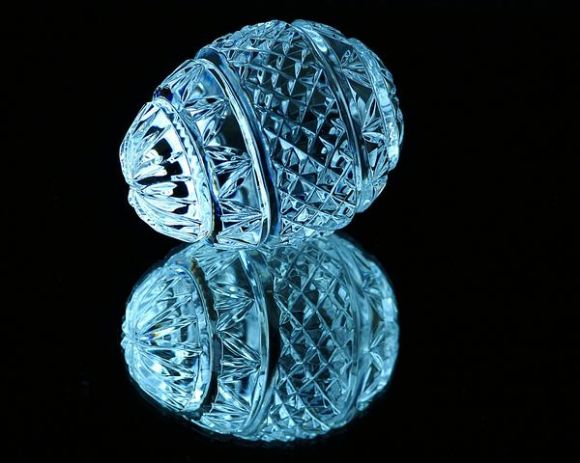
Text of The Crystal Egg from Tales of Space and Time by H.G. Wells

crystal-82296__480

There was, until a year ago, a little and very grimy-looking shop near Seven Dials, over which, in weather-worn yellow lettering, the name of “C. Cave, Naturalist and Dealer in Antiquities,” was inscribed. The contents of its window were curiously variegated. They comprised some elephant tusks and an imperfect set of chessmen, beads and weapons, a box of eyes, two skulls of tigers and one human, several moth-eaten stuffed monkeys (one holding a lamp), an old-fashioned cabinet, a flyblown ostrich egg or so, some fishing-tackle, and an extraordinarily dirty, empty glass fish-tank. There was also, at the moment the story begins, a mass of crystal, worked into the shape of an egg and brilliantly polished. And at that two people, who stood outside the window, were looking, one of them a tall, thin clergyman, the other a black-bearded young man of dusky complexion and unobtrusive costume. The dusky young man spoke with eager gesticulation, and seemed anxious for his companion to purchase the article.

While they were there, Mr. Cave came into his shop, his beard still wagging with the bread and butter of his tea. When he saw these men and the object of their regard, his countenance fell. He glanced guiltily over his shoulder, and softly shut the door. He was a little old man, with pale face and peculiar watery blue eyes; his hair was a dirty grey, and he wore a shabby blue frock coat, an ancient silk hat, and carpet slippers very much down at heel. He remained watching the two men as they talked. The clergyman went deep into his trouser pocket, examined a handful of money, and showed his teeth in an agreeable smile. Mr. Cave seemed still more depressed when they came into the shop.

The clergyman, without any ceremony, asked the price of the crystal egg. Mr. Cave glanced nervously towards the door leading into the parlour, and said five pounds. The clergyman protested that the price was high, to his companion as well as to Mr. Cave—it was, indeed, very much more than Mr. Cave had intended to ask, when he had stocked the article—and an attempt at bargaining ensued. Mr. Cave stepped to the shop-door, and held it open. “Five pounds is my price,” he said, as though he wished to save himself the trouble of unprofitable discussion. As he did so, the upper portion of a woman’s face appeared above the blind in the glass upper panel of the door leading into the parlour, and stared curiously at the two customers. “Five pounds is my price,” said Mr. Cave, with a quiver in his voice.

The swarthy young man had so far remained a spectator, watching Cave keenly. Now he spoke. “Give him five pounds,” he said. The clergyman glanced at him to see if he were in earnest, and, when he looked at Mr. Cave again, he saw that the latter’s face was white. “It’s a lot of money,” said the clergyman, and, diving into his pocket, began counting his resources. He had little more than thirty shillings, and he appealed to his companion, with whom he seemed to be on terms of considerable intimacy. This gave Mr. Cave an opportunity of collecting his thoughts, and he began to explain in an agitated manner that the crystal was not, as a matter of fact, entirely free for sale. His two customers were naturally surprised at this, and inquired why he had not thought of that before he began to bargain. Mr. Cave became confused, but he stuck to his story, that the crystal was not in the market that afternoon, that a probable purchaser of it had already appeared. The two, treating this as an attempt to raise the price still further, made as if they would leave the shop. But at this point the parlour door opened, and the owner of the dark fringe and the little eyes appeared.

She was a coarse-featured, corpulent woman, younger and very much larger than Mr. Cave; she walked heavily, and her face was flushed. “That crystal is for sale,” she said. “And five pounds is a good enough price for it. I can’t think what you’re about, Cave, not to take the gentleman’s offer!”

Mr. Cave, greatly perturbed by the irruption, looked angrily at her over the rims of his spectacles, and, without excessive assurance, asserted his right to manage his business in his own way. An altercation began. The two customers watched the scene with interest and some amusement, occasionally assisting Mrs. Cave with suggestions. Mr. Cave, hard driven, persisted in a confused and impossible story of an enquiry for the crystal that morning, and his agitation became painful. But he stuck to his point with extraordinary persistence. It was the young Oriental who ended this curious controversy. He proposed that they should call again in the course of two days—so as to give the alleged enquirer a fair chance. “And then we must insist,” said the clergyman, “Five pounds.” Mrs. Cave took it on herself to apologise for her husband, explaining that he was sometimes “a little odd,” and as the two customers left, the couple prepared for a free discussion of the incident in all its bearings.

Mrs. Cave talked to her husband with singular directness. The poor little man, quivering with emotion, muddled himself between his stories, maintaining on the one hand that he had another customer in view, and on the other asserting that the crystal was honestly worth ten guineas. “Why did you ask five pounds?” said his wife. “Do let me manage my business my own way!” said Mr. Cave.

Mr. Cave had living with him a step-daughter and a step-son, and at supper that night the transaction was re-discussed. None of them had a high opinion of Mr. Cave’s business methods, and this action seemed a culminating folly.

“It’s my opinion he’s refused that crystal before,” said the step-son, a loose-limbed lout of eighteen.

“But Five Pounds!” said the step-daughter, an argumentative young woman of six-and-twenty.

Mr. Cave’s answers were wretched; he could only mumble weak assertions that he knew his own business best. They drove him from his half-eaten supper into the shop, to close it for the night, his ears aflame and tears of vexation behind his spectacles. “Why had he left the crystal in the window so long? The folly of it!” That was the trouble closest in his mind. For a time he could see no way of evading sale.

After supper his step-daughter and step-son smartened themselves up and went out and his wife retired upstairs to reflect upon the business aspects of the crystal, over a little sugar and lemon and so forth in hot water. Mr. Cave went into the shop, and stayed there until late, ostensibly to make ornamental rockeries for goldfish cases but really for a private purpose that will be better explained later. The next day Mrs. Cave found that the crystal had been removed from the window, and was lying behind some second-hand books on angling. She replaced it in a conspicuous position. But she did not argue further about it, as a nervous headache disinclined her from debate. Mr. Cave was always disinclined. The day passed disagreeably, Mr. Cave was, if anything, more absent-minded than usual, and uncommonly irritable withal. In the afternoon, when his wife was taking her customary sleep, he removed the crystal from the window again.

The next day Mr. Cave had to deliver a consignment of dog-fish at one of the hospital schools, where they were needed for dissection. In his absence Mrs. Cave’s mind reverted to the topic of the crystal, and the methods of expenditure suitable to a windfall of five pounds. She had already devised some very agreeable expedients, among others a dress of green silk for herself and a trip to Richmond, when a jangling of the front door bell summoned her into the shop. The customer was an examination coach who came to complain of the non-delivery of certain frogs asked for the previous day. Mrs. Cave did not approve of this particular branch of Mr. Cave’s business, and the gentleman, who had called in a somewhat aggressive mood, retired after a brief exchange of words—entirely civil so far as he was concerned. Mrs. Cave’s eye then naturally turned to the window; for the sight of the crystal was an assurance of the five pounds and of her dreams. What was her surprise to find it gone!

She went to the place behind the locker on the counter, where she had discovered it the day before. It was not there; and she immediately began an eager search about the shop.

When Mr. Cave returned from his business with the dog-fish, about a quarter to two in the afternoon, he found the shop in some confusion, and his wife, extremely exasperated and on her knees behind the counter, routing among his taxidermic material. Her face came up hot and angry over the counter, as the jangling bell announced his return, and she forthwith accused him of “hiding it.”

“Hid what?” asked Mr. Cave.

“The crystal!”

At that Mr. Cave, apparently much surprised, rushed to the window. “Isn’t it here?” he said. “Great Heavens! what has become of it?”

Just then, Mr. Cave’s step-son re-entered the shop from the inner room—he had come home a minute or so before Mr. Cave—and he was blaspheming freely. He was apprenticed to a second-hand furniture dealer down the road, but he had his meals at home, and he was naturally annoyed to find no dinner ready.

But, when he heard of the loss of the crystal, he forgot his meal, and his anger was diverted from his mother to his step-father. Their first idea, of course, was that he had hidden it. But Mr. Cave stoutly denied all knowledge of its fate—freely offering his bedabbled affidavit in the matter—and at last was worked up to the point of accusing, first, his wife and then his step-son of having taken it with a view to a private sale. So began an exceedingly acrimonious and emotional discussion, which ended for Mrs. Cave in a peculiar nervous condition midway between hysterics and amuck, and caused the step-son to be half-an-hour late at the furniture establishment in the afternoon. Mr. Cave took refuge from his wife’s emotions in the shop.

In the evening the matter was resumed, with less passion and in a judicial spirit, under the presidency of the step-daughter. The supper passed unhappily and culminated in a painful scene. Mr. Cave gave way at last to extreme exasperation, and went out banging the front door violently. The rest of the family, having discussed him with the freedom his absence warranted, hunted the house from garret to cellar, hoping to light upon the crystal.

The next day the two customers called again. They were received by Mrs. Cave almost in tears. It transpired that no one could imagine all that she had stood from Cave at various times in her married pilgrimage…. She also gave a garbled account of the disappearance. The clergyman and the Oriental laughed silently at one another, and said it was very extraordinary. As Mrs. Cave seemed disposed to give them the complete history of her life they made to leave the shop. Thereupon Mrs. Cave, still clinging to hope, asked for the clergyman’s address, so that, if she could get anything out of Cave, she might communicate it. The address was duly given, but apparently was afterwards mislaid. Mrs. Cave can remember nothing about it.

In the evening of that day, the Caves seem to have exhausted their emotions, and Mr. Cave, who had been out in the afternoon, supped in a gloomy isolation that contrasted pleasantly with the impassioned controversy of the previous days. For some time matters were very badly strained in the Cave household, but neither crystal nor customer reappeared.

Now, without mincing the matter, we must admit that Mr. Cave was a liar. He knew perfectly well where the crystal was. It was in the rooms of Mr. Jacoby Wace, Assistant Demonstrator at St. Catherine’s Hospital, Westbourne Street. It stood on the sideboard partially covered by a black velvet cloth, and beside a decanter of American whisky. It is from Mr. Wace, indeed, that the particulars upon which this narrative is based were derived. Cave had taken off the thing to the hospital hidden in the dog-fish sack, and there had pressed the young investigator to keep it for him. Mr. Wace was a little dubious at first. His relationship to Cave was peculiar. He had a taste for singular characters, and he had more than once invited the old man to smoke and drink in his rooms, and to unfold his rather amusing views of life in general and of his wife in particular. Mr. Wace had encountered Mrs. Cave, too, on occasions when Mr. Cave was not at home to attend to him. He knew the constant interference to which Cave was subjected, and having weighed the story judicially, he decided to give the crystal a refuge. Mr. Cave promised to explain the reasons for his remarkable affection for the crystal more fully on a later occasion, but he spoke distinctly of seeing visions therein. He called on Mr. Wace the same evening.

He told a complicated story. The crystal he said had come into his possession with other oddments at the forced sale of another curiosity dealer’s effects, and not knowing what its value might be, he had ticketed it at ten shillings. It had hung upon his hands at that price for some months, and he was thinking of “reducing the figure,” when he made a singular discovery.

At that time his health was very bad—and it must be borne in mind that, throughout all this experience, his physical condition was one of ebb—and he was in considerable distress by reason of the negligence, the positive ill-treatment even, he received from his wife and step-children. His wife was vain, extravagant, unfeeling, and had a growing taste for private drinking; his step-daughter was mean and over-reaching; and his step-son had conceived a violent dislike for him, and lost no chance of showing it. The requirements of his business pressed heavily upon him, and Mr. Wace does not think that he was altogether free from occasional intemperance. He had begun life in a comfortable position, he was a man of fair education, and he suffered, for weeks at a stretch, from melancholia and insomnia. Afraid to disturb his family, he would slip quietly from his wife’s side, when his thoughts became intolerable, and wander about the house. And about three o’clock one morning, late in August, chance directed him into the shop.

The dirty little place was impenetrably black except in one spot, where he perceived an unusual glow of light. Approaching this, he discovered it to be the crystal egg, which was standing on the corner of the counter towards the window. A thin ray smote through a crack in the shutters, impinged upon the object, and seemed as it were to fill its entire interior.

It occurred to Mr. Cave that this was not in accordance with the laws of optics as he had known them in his younger days. He could understand the rays being refracted by the crystal and coming to a focus in its interior, but this diffusion jarred with his physical conceptions. He approached the crystal nearly, peering into it and round it, with a transient revival of the scientific curiosity that in his youth had determined his choice of a calling. He was surprised to find the light not steady, but writhing within the substance of the egg, as though that object was a hollow sphere of some luminous vapour. In moving about to get different points of view, he suddenly found that he had come between it and the ray, and that the crystal none the less remained luminous. Greatly astonished, he lifted it out of the light ray and carried it to the darkest part of the shop. It remained bright for some four or five minutes, when it slowly faded and went out. He placed it in the thin streak of daylight, and its luminousness was almost immediately restored.

So far, at least, Mr. Wace was able to verify the remarkable story of Mr. Cave. He has himself repeatedly held this crystal in a ray of light (which had to be of a less diameter than one millimetre). And in a perfect darkness, such as could be produced by velvet wrapping, the crystal did undoubtedly appear very faintly phosphorescent. It would seem, however, that the luminousness was of some exceptional sort, and not equally visible to all eyes; for Mr. Harbinger—whose name will be familiar to the scientific reader in connection with the Pasteur Institute—was quite unable to see any light whatever. And Mr. Wace’s own capacity for its appreciation was out of comparison inferior to that of Mr. Cave’s. Even with Mr. Cave the power varied very considerably: his vision was most vivid during states of extreme weakness and fatigue.

Now, from the outset this light in the crystal exercised a curious fascination upon Mr. Cave. And it says more for his loneliness of soul than a volume of pathetic writing could do, that he told no human being of his curious observations. He seems to have been living in such an atmosphere of petty spite that to admit the existence of a pleasure would have been to risk the loss of it. He found that as the dawn advanced, and the amount of diffused light increased, the crystal became to all appearance non-luminous. And for some time he was unable to see anything in it, except at night-time, in dark corners of the shop.

But the use of an old velvet cloth, which he used as a background for a collection of minerals, occurred to him, and by doubling this, and putting it over his head and hands, he was able to get a sight of the luminous movement within the crystal even in the daytime. He was very cautious lest he should be thus discovered by his wife, and he practised this occupation only in the afternoons, while she was asleep upstairs, and then circumspectly in a hollow under the counter. And one day, turning the crystal about in his hands, he saw something. It came and went like a flash, but it gave him the impression that the object had for a moment opened to him the view of a wide and spacious and strange country; and, turning it about, he did, just as the light faded, see the same vision again.

Now, it would be tedious and unnecessary to state all the phases of Mr. Cave’s discovery from this point. Suffice that the effect was this: the crystal, being peered into at an angle of about 137 degrees from the direction of the illuminating ray, gave a clear and consistent picture of a wide and peculiar countryside. It was not dream-like at all: it produced a definite impression of reality, and the better the light the more real and solid it seemed. It was a moving picture: that is to say, certain objects moved in it, but slowly in an orderly manner like real things, and, according as the direction of the lighting and vision changed, the picture changed also. It must, indeed, have been like looking through an oval glass at a view, and turning the glass about to get at different aspects.

Mr. Cave’s statements, Mr. Wace assures me, were extremely circumstantial, and entirely free from any of that emotional quality that taints hallucinatory impressions. But it must be remembered that all the efforts of Mr. Wace to see any similar clarity in the faint opalescence of the crystal were wholly unsuccessful, try as he would. The difference in intensity of the impressions received by the two men was very great, and it is quite conceivable that what was a view to Mr. Cave was a mere blurred nebulosity to Mr. Wace.

The view, as Mr. Cave described it, was invariably of an extensive plain, and he seemed always to be looking at it from a considerable height, as if from a tower or a mast. To the east and to the west the plain was bounded at a remote distance by vast reddish cliffs, which reminded him of those he had seen in some picture; but what the picture was Mr. Wace was unable to ascertain. These cliffs passed north and south—he could tell the points of the compass by the stars that were visible of a night—receding in an almost illimitable perspective and fading into the mists of the distance before they met. He was nearer the eastern set of cliffs, on the occasion of his first vision the sun was rising over them, and black against the sunlight and pale against their shadow appeared a multitude of soaring forms that Mr. Cave regarded as birds. A vast range of buildings spread below him; he seemed to be looking down upon them; and, as they approached the blurred and refracted edge of the picture, they became indistinct. There were also trees curious in shape, and in colouring, a deep mossy green and an exquisite grey, beside a wide and shining canal. And something great and brilliantly coloured flew across the picture. But the first time Mr. Cave saw these pictures he saw only in flashes, his hands shook, his head moved, the vision came and went, and grew foggy and indistinct. And at first he had the greatest difficulty in finding the picture again once the direction of it was lost.

His next clear vision, which came about a week after the first, the interval having yielded nothing but tantalising glimpses and some useful experience, showed him the view down the length of the valley. The view was different, but he had a curious persuasion, which his subsequent observations abundantly confirmed, that he was regarding this strange world from exactly the same spot, although he was looking in a different direction. The long façade of the great building, whose roof he had looked down upon before, was now receding in perspective. He recognised the roof. In the front of the façade was a terrace of massive proportions and extraordinary length, and down the middle of the terrace, at certain intervals, stood huge but very graceful masts, bearing small shiny objects which reflected the setting sun. The import of these small objects did not occur to Mr. Cave until some time after, as he was describing the scene to Mr. Wace. The terrace overhung a thicket of the most luxuriant and graceful vegetation, and beyond this was a wide grassy lawn on which certain broad creatures, in form like beetles but enormously larger, reposed. Beyond this again was a richly decorated causeway of pinkish stone; and beyond that, and lined with dense red weeds, and passing up the valley exactly parallel with the distant cliffs, was a broad and mirror-like expanse of water. The air seemed full of squadrons of great birds, maneuvring in stately curves; and across the river was a multitude of splendid buildings, richly coloured and glittering with metallic tracery and facets, among a forest of moss-like and lichenous trees. And suddenly something flapped repeatedly across the vision, like the fluttering of a jewelled fan or the beating of a wing, and a face, or rather the upper part of a face with very large eyes, came as it were close to his own and as if on the other side of the crystal. Mr. Cave was so startled and so impressed by the absolute reality of these eyes, that he drew his head back from the crystal to look behind it. He had become so absorbed in watching that he was quite surprised to find himself in the cool darkness of his little shop, with its familiar odour of methyl, mustiness, and decay. And, as he blinked about him, the glowing crystal faded, and went out.

Such were the first general impressions of Mr. Cave. The story is curiously direct and circumstantial. From the outset, when the valley first flashed momentarily on his senses, his imagination was strangely affected, and, as he began to appreciate the details of the scene he saw, his wonder rose to the point of a passion. He went about his business listless and distraught, thinking only of the time when he should be able to return to his watching. And then a few weeks after his first sight of the valley came the two customers, the stress and excitement of their offer, and the narrow escape of the crystal from sale, as I have already told.

Now, while the thing was Mr. Cave’s secret, it remained a mere wonder, a thing to creep to covertly and peep at, as a child might peep upon a forbidden garden. But Mr. Wace has, for a young scientific investigator, a particularly lucid and consecutive habit of mind. Directly the crystal and its story came to him, and he had satisfied himself, by seeing the phosphorescence with his own eyes, that there really was a certain evidence for Mr. Cave’s statements, he proceeded to develop the matter systematically. Mr. Cave was only too eager to come and feast his eyes on this wonderland he saw, and he came every night from half-past eight until half-past ten, and sometimes, in Mr. Wace’s absence, during the day. On Sunday afternoons, also, he came. From the outset Mr. Wace made copious notes, and it was due to his scientific method that the relation between the direction from which the initiating ray entered the crystal and the orientation of the picture were proved. And, by covering the crystal in a box perforated only with a small aperture to admit the exciting ray, and by substituting black holland for his buff blinds, he greatly improved the conditions of the observations; so that in a little while they were able to survey the valley in any direction they desired.

So having cleared the way, we may give a brief account of this visionary world within the crystal. The things were in all cases seen by Mr. Cave, and the method of working was invariably for him to watch the crystal and report what he saw, while Mr. Wace (who as a science student had learnt the trick of writing in the dark) wrote a brief note of his report. When the crystal faded, it was put into its box in the proper position and the electric light turned on. Mr. Wace asked questions, and suggested observations to clear up difficult points. Nothing, indeed, could have been less visionary and more matter-of-fact.

The attention of Mr. Cave had been speedily directed to the bird-like creatures he had seen so abundantly present in each of his earlier visions. His first impression was soon corrected, and he considered for a time that they might represent a diurnal species of bat. Then he thought, grotesquely enough, that they might be cherubs. Their heads were round, and curiously human, and it was the eyes of one of them that had so startled him on his second observation. They had broad, silvery wings, not feathered, but glistening almost as brilliantly as new-killed fish and with the same subtle play of colour, and these wings were not built on the plan of bird-wing or bat, Mr. Wace learned, but supported by curved ribs radiating from the body. (A sort of butterfly wing with curved ribs seems best to express their appearance.) The body was small, but fitted with two bunches of prehensile organs, like long tentacles, immediately under the mouth. Incredible as it appeared to Mr. Wace, the persuasion at last became irresistible, that it was these creatures which owned the great quasi-human buildings and the magnificent garden that made the broad valley so splendid. And Mr. Cave perceived that the buildings, with other peculiarities, had no doors, but that the great circular windows, which opened freely, gave the creatures egress and entrance. They would alight upon their tentacles, fold their wings to a smallness almost rod-like, and hop into the interior. But among them was a multitude of smaller-winged creatures, like great dragon-flies and moths and flying beetles, and across the greensward brilliantly-coloured gigantic ground-beetles crawled lazily to and fro. Moreover, on the causeways and terraces, large-headed creatures similar to the greater winged flies, but wingless, were visible, hopping busily upon their hand-like tangle of tentacles.

Allusion has already been made to the glittering objects upon masts that stood upon the terrace of the nearer building. It dawned upon Mr. Cave, after regarding one of these masts very fixedly on one particularly vivid day, that the glittering object there was a crystal exactly like that into which he peered. And a still more careful scrutiny convinced him that each one in a vista of nearly twenty carried a similar object.

Occasionally one of the large flying creatures would flutter up to one, and, folding its wings and coiling a number of its tentacles about the mast, would regard the crystal fixedly for a space,—sometimes for as long as fifteen minutes. And a series of observations, made at the suggestion of Mr. Wace, convinced both watchers that, so far as this visionary world was concerned, the crystal into which they peered actually stood at the summit of the endmost mast on the terrace, and that on one occasion at least one of these inhabitants of this other world had looked into Mr. Cave’s face while he was making these observations.

So much for the essential facts of this very singular story. Unless we dismiss it all as the ingenious fabrication of Mr. Wace, we have to believe one of two things: either that Mr. Cave’s crystal was in two worlds at once, and that, while it was carried about in one, it remained stationary in the other, which seems altogether absurd; or else that it had some peculiar relation of sympathy with another and exactly similar crystal in this other world, so that what was seen in the interior of the one in this world was, under suitable conditions, visible to an observer in the corresponding crystal in the other world; and vice versa. At present, indeed, we do not know of any way in which two crystals could so come en rapport, but nowadays we know enough to understand that the thing is not altogether impossible. This view of the crystals as en rapport was the supposition that occurred to Mr. Wace, and to me at least it seems extremely plausible….

And where was this other world? On this, also, the alert intelligence of Mr. Wace speedily threw light. After sunset, the sky darkened rapidly—there was a very brief twilight interval indeed—and the stars shone out. They were recognisably the same as those we see, arranged in the same constellations. Mr. Cave recognised the Bear, the Pleiades, Aldebaran, and Sirius: so that the other world must be somewhere in the solar system, and, at the utmost, only a few hundreds of millions of miles from our own. Following up this clue, Mr. Wace learned that the midnight sky was a darker blue even than our midwinter sky, and that the sun seemed a little smaller. And there were two small moons! “like our moon but smaller, and quite differently marked” one of which moved so rapidly that its motion was clearly visible as one regarded it. These moons were never high in the sky, but vanished as they rose: that is, every time they revolved they were eclipsed because they were so near their primary planet. And all this answers quite completely, although Mr. Cave did not know it, to what must be the condition of things on Mars.

Indeed, it seems an exceedingly plausible conclusion that peering into this crystal Mr. Cave did actually see the planet Mars and its inhabitants. And, if that be the case, then the evening star that shone so brilliantly in the sky of that distant vision, was neither more nor less than our own familiar earth.

For a time the Martians—if they were Martians—do not seem to have known of Mr. Cave’s inspection. Once or twice one would come to peer, and go away very shortly to some other mast, as though the vision was unsatisfactory. During this time Mr. Cave was able to watch the proceedings of these winged people without being disturbed by their attentions, and, although his report is necessarily vague and fragmentary, it is nevertheless very suggestive. Imagine the impression of humanity a Martian observer would get who, after a difficult process of preparation and with considerable fatigue to the eyes, was able to peer at London from the steeple of St. Martin’s Church for stretches, at longest, of four minutes at a time. Mr. Cave was unable to ascertain if the winged Martians were the same as the Martians who hopped about the causeways and terraces, and if the latter could put on wings at will. He several times saw certain clumsy bipeds, dimly suggestive of apes, white and partially translucent, feeding among certain of the lichenous trees, and once some of these fled before one of the hopping, round-headed Martians. The latter caught one in its tentacles, and then the picture faded suddenly and left Mr. Cave most tantalisingly in the dark. On another occasion a vast thing, that Mr. Cave thought at first was some gigantic insect, appeared advancing along the causeway beside the canal with extraordinary rapidity. As this drew nearer Mr. Cave perceived that it was a mechanism of shining metals and of extraordinary complexity. And then, when he looked again, it had passed out of sight.

After a time Mr. Wace aspired to attract the attention of the Martians, and the next time that the strange eyes of one of them appeared close to the crystal Mr. Cave cried out and sprang away, and they immediately turned on the light and began to gesticulate in a manner suggestive of signalling. But when at last Mr. Cave examined the crystal again the Martian had departed.

Thus far these observations had progressed in early November, and then Mr. Cave, feeling that the suspicions of his family about the crystal were allayed, began to take it to and fro with him in order that, as occasion arose in the daytime or night, he might comfort himself with what was fast becoming the most real thing in his existence.

In December Mr. Wace’s work in connection with a forthcoming examination became heavy, the sittings were reluctantly suspended for a week, and for ten or eleven days—he is not quite sure which—he saw nothing of Cave. He then grew anxious to resume these investigations, and, the stress of his seasonal labours being abated, he went down to Seven Dials. At the corner he noticed a shutter before a bird fancier’s window, and then another at a cobbler’s. Mr. Cave’s shop was closed.

He rapped and the door was opened by the step-son in black. He at once called Mrs. Cave, who was, Mr. Wace could not but observe, in cheap but ample widow’s weeds of the most imposing pattern. Without any very great surprise Mr. Wace learnt that Cave was dead and already buried. She was in tears, and her voice was a little thick. She had just returned from Highgate. Her mind seemed occupied with her own prospects and the honourable details of the obsequies, but Mr. Wace was at last able to learn the particulars of Cave’s death. He had been found dead in his shop in the early morning, the day after his last visit to Mr. Wace, and the crystal had been clasped in his stone-cold hands. His face was smiling, said Mrs. Cave, and the velvet cloth from the minerals lay on the floor at his feet. He must have been dead five or six hours when he was found.

This came as a great shock to Wace, and he began to reproach himself bitterly for having neglected the plain symptoms of the old man’s ill-health. But his chief thought was of the crystal. He approached that topic in a gingerly manner, because he knew Mrs. Cave’s peculiarities. He was dumbfounded to learn that it was sold.

Mrs. Cave’s first impulse, directly Cave’s body had been taken upstairs, had been to write to the mad clergyman who had offered five pounds for the crystal, informing him of its recovery; but after a violent hunt in which her daughter joined her, they were convinced of the loss of his address. As they were without the means required to mourn and bury Cave in the elaborate style the dignity of an old Seven Dials inhabitant demands, they had appealed to a friendly fellow-tradesman in Great Portland Street. He had very kindly taken over a portion of the stock at a valuation. The valuation was his own and the crystal egg was included in one of the lots. Mr. Wace, after a few suitable consolatory observations, a little off-handedly proffered perhaps, hurried at once to Great Portland Street. But there he learned that the crystal egg had already been sold to a tall, dark man in grey. And there the material facts in this curious, and to me at least very suggestive, story come abruptly to an end. The Great Portland Street dealer did not know who the tall dark man in grey was, nor had he observed him with sufficient attention to describe him minutely. He did not even know which way this person had gone after leaving the shop. For a time Mr. Wace remained in the shop, trying the dealer’s patience with hopeless questions, venting his own exasperation. And at last, realising abruptly that the whole thing had passed out of his hands, had vanished like a vision of the night, he returned to his own rooms, a little astonished to find the notes he had made still tangible and visible upon his untidy table.

His annoyance and disappointment were naturally very great. He made a second call (equally ineffectual) upon the Great Portland Street dealer, and he resorted to advertisements in such periodicals as were likely to come into the hands of a bric-a-brac collector. He also wrote letters to The Daily Chronicle and Nature, but both those periodicals, suspecting a hoax, asked him to reconsider his action before they printed, and he was advised that such a strange story, unfortunately so bare of supporting evidence, might imperil his reputation as an investigator. Moreover, the calls of his proper work were urgent. So that after a month or so, save for an occasional reminder to certain dealers, he had reluctantly to abandon the quest for the crystal egg, and from that day to this it remains undiscovered. Occasionally, however, he tells me, and I can quite believe him, he has bursts of zeal, in which he abandons his more urgent occupation and resumes the search.

Whether or not it will remain lost for ever, with the material and origin of it, are things equally speculative at the present time. If the present purchaser is a collector, one would have expected the enquiries of Mr. Wace to have reached him through the dealers. He has been able to discover Mr. Cave’s clergyman and “Oriental”—no other than the Rev. James Parker and the young Prince of Bosso-Kuni in Java. I am obliged to them for certain particulars. The object of the Prince was simply curiosity—and extravagance. He was so eager to buy, because Cave was so oddly reluctant to sell. It is just as possible that the buyer in the second instance was simply a casual purchaser and not a collector at all, and the crystal egg, for all I know, may at the present moment be within a mile of me, decorating a drawing-room or serving as a paper-weight—its remarkable functions all unknown. Indeed, it is partly with the idea of such a possibility that I have thrown this narrative into a form that will give it a chance of being read by the ordinary consumer of fiction.

My own ideas in the matter are practically identical with those of Mr. Wace. I believe the crystal on the mast in Mars and the crystal egg of Mr. Cave’s to be in some physical, but at present quite inexplicable, way en rapport, and we both believe further that the terrestrial crystal must have been—possibly at some remote date—sent hither from that planet, in order to give the Martians a near view of our affairs. Possibly the fellows to the crystals in the other masts are also on our globe. No theory of hallucination suffices for the facts.

Tagged , , , ,

Movie Trailer – Once Upon a Time in Hollywood (2019)

A first look at Quentin Tarantino’s 9th (rumored to be his second to last) film.  Looks good.  Bonus points for a rendition of Bruce Lee in the cast.

Tagged , ,

Text of George Washington’s Farewell Address – 1796

FunDraw-dot-com-Winkin-George

Friends and Citizens:

The period for a new election of a citizen to administer the executive government of the United States being not far distant, and the time actually arrived when your thoughts must be employed in designating the person who is to be clothed with that important trust, it appears to me proper, especially as it may conduce to a more distinct expression of the public voice, that I should now apprise you of the resolution I have formed, to decline being considered among the number of those out of whom a choice is to be made.

I beg you, at the same time, to do me the justice to be assured that this resolution has not been taken without a strict regard to all the considerations appertaining to the relation which binds a dutiful citizen to his country; and that in withdrawing the tender of service, which silence in my situation might imply, I am influenced by no diminution of zeal for your future interest, no deficiency of grateful respect for your past kindness, but am supported by a full conviction that the step is compatible with both.

The acceptance of, and continuance hitherto in, the office to which your suffrages have twice called me have been a uniform sacrifice of inclination to the opinion of duty and to a deference for what appeared to be your desire. I constantly hoped that it would have been much earlier in my power, consistently with motives which I was not at liberty to disregard, to return to that retirement from which I had been reluctantly drawn. The strength of my inclination to do this, previous to the last election, had even led to the preparation of an address to declare it to you; but mature reflection on the then perplexed and critical posture of our affairs with foreign nations, and the unanimous advice of persons entitled to my confidence, impelled me to abandon the idea.

I rejoice that the state of your concerns, external as well as internal, no longer renders the pursuit of inclination incompatible with the sentiment of duty or propriety, and am persuaded, whatever partiality may be retained for my services, that, in the present circumstances of our country, you will not disapprove my determination to retire.

The impressions with which I first undertook the arduous trust were explained on the proper occasion. In the discharge of this trust, I will only say that I have, with good intentions, contributed towards the organization and administration of the government the best exertions of which a very fallible judgment was capable. Not unconscious in the outset of the inferiority of my qualifications, experience in my own eyes, perhaps still more in the eyes of others, has strengthened the motives to diffidence of myself; and every day the increasing weight of years admonishes me more and more that the shade of retirement is as necessary to me as it will be welcome. Satisfied that if any circumstances have given peculiar value to my services, they were temporary, I have the consolation to believe that, while choice and prudence invite me to quit the political scene, patriotism does not forbid it.

In looking forward to the moment which is intended to terminate the career of my public life, my feelings do not permit me to suspend the deep acknowledgment of that debt of gratitude which I owe to my beloved country for the many honors it has conferred upon me; still more for the steadfast confidence with which it has supported me; and for the opportunities I have thence enjoyed of manifesting my inviolable attachment, by services faithful and persevering, though in usefulness unequal to my zeal. If benefits have resulted to our country from these services, let it always be remembered to your praise, and as an instructive example in our annals, that under circumstances in which the passions, agitated in every direction, were liable to mislead, amidst appearances sometimes dubious, vicissitudes of fortune often discouraging, in situations in which not unfrequently want of success has countenanced the spirit of criticism, the constancy of your support was the essential prop of the efforts, and a guarantee of the plans by which they were effected. Profoundly penetrated with this idea, I shall carry it with me to my grave, as a strong incitement to unceasing vows that heaven may continue to you the choicest tokens of its beneficence; that your union and brotherly affection may be perpetual; that the free Constitution, which is the work of your hands, may be sacredly maintained; that its administration in every department may be stamped with wisdom and virtue; that, in fine, the happiness of the people of these States, under the auspices of liberty, may be made complete by so careful a preservation and so prudent a use of this blessing as will acquire to them the glory of recommending it to the applause, the affection, and adoption of every nation which is yet a stranger to it.

Here, perhaps, I ought to stop. But a solicitude for your welfare, which cannot end but with my life, and the apprehension of danger, natural to that solicitude, urge me, on an occasion like the present, to offer to your solemn contemplation, and to recommend to your frequent review, some sentiments which are the result of much reflection, of no inconsiderable observation, and which appear to me all-important to the permanency of your felicity as a people. These will be offered to you with the more freedom, as you can only see in them the disinterested warnings of a parting friend, who can possibly have no personal motive to bias his counsel. Nor can I forget, as an encouragement to it, your indulgent reception of my sentiments on a former and not dissimilar occasion.

Interwoven as is the love of liberty with every ligament of your hearts, no recommendation of mine is necessary to fortify or confirm the attachment.

The unity of government which constitutes you one people is also now dear to you. It is justly so, for it is a main pillar in the edifice of your real independence, the support of your tranquility at home, your peace abroad; of your safety; of your prosperity; of that very liberty which you so highly prize. But as it is easy to foresee that, from different causes and from different quarters, much pains will be taken, many artifices employed to weaken in your minds the conviction of this truth; as this is the point in your political fortress against which the batteries of internal and external enemies will be most constantly and actively (though often covertly and insidiously) directed, it is of infinite moment that you should properly estimate the immense value of your national union to your collective and individual happiness; that you should cherish a cordial, habitual, and immovable attachment to it; accustoming yourselves to think and speak of it as of the palladium of your political safety and prosperity; watching for its preservation with jealous anxiety; discountenancing whatever may suggest even a suspicion that it can in any event be abandoned; and indignantly frowning upon the first dawning of every attempt to alienate any portion of our country from the rest, or to enfeeble the sacred ties which now link together the various parts.

For this you have every inducement of sympathy and interest. Citizens, by birth or choice, of a common country, that country has a right to concentrate your affections. The name of American, which belongs to you in your national capacity, must always exalt the just pride of patriotism more than any appellation derived from local discriminations. With slight shades of difference, you have the same religion, manners, habits, and political principles. You have in a common cause fought and triumphed together; the independence and liberty you possess are the work of joint counsels, and joint efforts of common dangers, sufferings, and successes.

But these considerations, however powerfully they address themselves to your sensibility, are greatly outweighed by those which apply more immediately to your interest. Here every portion of our country finds the most commanding motives for carefully guarding and preserving the union of the whole.

The North, in an unrestrained intercourse with the South, protected by the equal laws of a common government, finds in the productions of the latter great additional resources of maritime and commercial enterprise and precious materials of manufacturing industry. The South, in the same intercourse, benefiting by the agency of the North, sees its agriculture grow and its commerce expand. Turning partly into its own channels the seamen of the North, it finds its particular navigation invigorated; and, while it contributes, in different ways, to nourish and increase the general mass of the national navigation, it looks forward to the protection of a maritime strength, to which itself is unequally adapted. The East, in a like intercourse with the West, already finds, and in the progressive improvement of interior communications by land and water, will more and more find a valuable vent for the commodities which it brings from abroad, or manufactures at home. The West derives from the East supplies requisite to its growth and comfort, and, what is perhaps of still greater consequence, it must of necessity owe the secure enjoyment of indispensable outlets for its own productions to the weight, influence, and the future maritime strength of the Atlantic side of the Union, directed by an indissoluble community of interest as one nation. Any other tenure by which the West can hold this essential advantage, whether derived from its own separate strength, or from an apostate and unnatural connection with any foreign power, must be intrinsically precarious.

While, then, every part of our country thus feels an immediate and particular interest in union, all the parts combined cannot fail to find in the united mass of means and efforts greater strength, greater resource, proportionably greater security from external danger, a less frequent interruption of their peace by foreign nations; and, what is of inestimable value, they must derive from union an exemption from those broils and wars between themselves, which so frequently afflict neighboring countries not tied together by the same governments, which their own rival ships alone would be sufficient to produce, but which opposite foreign alliances, attachments, and intrigues would stimulate and embitter. Hence, likewise, they will avoid the necessity of those overgrown military establishments which, under any form of government, are inauspicious to liberty, and which are to be regarded as particularly hostile to republican liberty. In this sense it is that your union ought to be considered as a main prop of your liberty, and that the love of the one ought to endear to you the preservation of the other.

These considerations speak a persuasive language to every reflecting and virtuous mind, and exhibit the continuance of the Union as a primary object of patriotic desire. Is there a doubt whether a common government can embrace so large a sphere? Let experience solve it. To listen to mere speculation in such a case were criminal. We are authorized to hope that a proper organization of the whole with the auxiliary agency of governments for the respective subdivisions, will afford a happy issue to the experiment. It is well worth a fair and full experiment. With such powerful and obvious motives to union, affecting all parts of our country, while experience shall not have demonstrated its impracticability, there will always be reason to distrust the patriotism of those who in any quarter may endeavor to weaken its bands.

In contemplating the causes which may disturb our Union, it occurs as matter of serious concern that any ground should have been furnished for characterizing parties by geographical discriminations, Northern and Southern, Atlantic and Western; whence designing men may endeavor to excite a belief that there is a real difference of local interests and views. One of the expedients of party to acquire influence within particular districts is to misrepresent the opinions and aims of other districts. You cannot shield yourselves too much against the jealousies and heartburnings which spring from these misrepresentations; they tend to render alien to each other those who ought to be bound together by fraternal affection. The inhabitants of our Western country have lately had a useful lesson on this head; they have seen, in the negotiation by the Executive, and in the unanimous ratification by the Senate, of the treaty with Spain, and in the universal satisfaction at that event, throughout the United States, a decisive proof how unfounded were the suspicions propagated among them of a policy in the General Government and in the Atlantic States unfriendly to their interests in regard to the Mississippi; they have been witnesses to the formation of two treaties, that with Great Britain, and that with Spain, which secure to them everything they could desire, in respect to our foreign relations, towards confirming their prosperity. Will it not be their wisdom to rely for the preservation of these advantages on the Union by which they were procured ? Will they not henceforth be deaf to those advisers, if such there are, who would sever them from their brethren and connect them with aliens?

To the efficacy and permanency of your Union, a government for the whole is indispensable. No alliance, however strict, between the parts can be an adequate substitute; they must inevitably experience the infractions and interruptions which all alliances in all times have experienced. Sensible of this momentous truth, you have improved upon your first essay, by the adoption of a constitution of government better calculated than your former for an intimate union, and for the efficacious management of your common concerns. This government, the offspring of our own choice, uninfluenced and unawed, adopted upon full investigation and mature deliberation, completely free in its principles, in the distribution of its powers, uniting security with energy, and containing within itself a provision for its own amendment, has a just claim to your confidence and your support. Respect for its authority, compliance with its laws, acquiescence in its measures, are duties enjoined by the fundamental maxims of true liberty. The basis of our political systems is the right of the people to make and to alter their constitutions of government. But the Constitution which at any time exists, till changed by an explicit and authentic act of the whole people, is sacredly obligatory upon all. The very idea of the power and the right of the people to establish government presupposes the duty of every individual to obey the established government.

All obstructions to the execution of the laws, all combinations and associations, under whatever plausible character, with the real design to direct, control, counteract, or awe the regular deliberation and action of the constituted authorities, are destructive of this fundamental principle, and of fatal tendency. They serve to organize faction, to give it an artificial and extraordinary force; to put, in the place of the delegated will of the nation the will of a party, often a small but artful and enterprising minority of the community; and, according to the alternate triumphs of different parties, to make the public administration the mirror of the ill-concerted and incongruous projects of faction, rather than the organ of consistent and wholesome plans digested by common counsels and modified by mutual interests.

However combinations or associations of the above description may now and then answer popular ends, they are likely, in the course of time and things, to become potent engines, by which cunning, ambitious, and unprincipled men will be enabled to subvert the power of the people and to usurp for themselves the reins of government, destroying afterwards the very engines which have lifted them to unjust dominion.

Towards the preservation of your government, and the permanency of your present happy state, it is requisite, not only that you steadily discountenance irregular oppositions to its acknowledged authority, but also that you resist with care the spirit of innovation upon its principles, however specious the pretexts. One method of assault may be to effect, in the forms of the Constitution, alterations which will impair the energy of the system, and thus to undermine what cannot be directly overthrown. In all the changes to which you may be invited, remember that time and habit are at least as necessary to fix the true character of governments as of other human institutions; that experience is the surest standard by which to test the real tendency of the existing constitution of a country; that facility in changes, upon the credit of mere hypothesis and opinion, exposes to perpetual change, from the endless variety of hypothesis and opinion; and remember, especially, that for the efficient management of your common interests, in a country so extensive as ours, a government of as much vigor as is consistent with the perfect security of liberty is indispensable. Liberty itself will find in such a government, with powers properly distributed and adjusted, its surest guardian. It is, indeed, little else than a name, where the government is too feeble to withstand the enterprises of faction, to confine each member of the society within the limits prescribed by the laws, and to maintain all in the secure and tranquil enjoyment of the rights of person and property.

I have already intimated to you the danger of parties in the State, with particular reference to the founding of them on geographical discriminations. Let me now take a more comprehensive view, and warn you in the most solemn manner against the baneful effects of the spirit of party generally.

This spirit, unfortunately, is inseparable from our nature, having its root in the strongest passions of the human mind. It exists under different shapes in all governments, more or less stifled, controlled, or repressed; but, in those of the popular form, it is seen in its greatest rankness, and is truly their worst enemy.

The alternate domination of one faction over another, sharpened by the spirit of revenge, natural to party dissension, which in different ages and countries has perpetrated the most horrid enormities, is itself a frightful despotism. But this leads at length to a more formal and permanent despotism. The disorders and miseries which result gradually incline the minds of men to seek security and repose in the absolute power of an individual; and sooner or later the chief of some prevailing faction, more able or more fortunate than his competitors, turns this disposition to the purposes of his own elevation, on the ruins of public liberty.

Without looking forward to an extremity of this kind (which nevertheless ought not to be entirely out of sight), the common and continual mischiefs of the spirit of party are sufficient to make it the interest and duty of a wise people to discourage and restrain it.

It serves always to distract the public councils and enfeeble the public administration. It agitates the community with ill-founded jealousies and false alarms, kindles the animosity of one part against another, foments occasionally riot and insurrection. It opens the door to foreign influence and corruption, which finds a facilitated access to the government itself through the channels of party passions. Thus the policy and the will of one country are subjected to the policy and will of another.

There is an opinion that parties in free countries are useful checks upon the administration of the government and serve to keep alive the spirit of liberty. This within certain limits is probably true; and in governments of a monarchical cast, patriotism may look with indulgence, if not with favor, upon the spirit of party. But in those of the popular character, in governments purely elective, it is a spirit not to be encouraged. From their natural tendency, it is certain there will always be enough of that spirit for every salutary purpose. And there being constant danger of excess, the effort ought to be by force of public opinion, to mitigate and assuage it. A fire not to be quenched, it demands a uniform vigilance to prevent its bursting into a flame, lest, instead of warming, it should consume.

It is important, likewise, that the habits of thinking in a free country should inspire caution in those entrusted with its administration, to confine themselves within their respective constitutional spheres, avoiding in the exercise of the powers of one department to encroach upon another. The spirit of encroachment tends to consolidate the powers of all the departments in one, and thus to create, whatever the form of government, a real despotism. A just estimate of that love of power, and proneness to abuse it, which predominates in the human heart, is sufficient to satisfy us of the truth of this position. The necessity of reciprocal checks in the exercise of political power, by dividing and distributing it into different depositaries, and constituting each the guardian of the public weal against invasions by the others, has been evinced by experiments ancient and modern; some of them in our country and under our own eyes. To preserve them must be as necessary as to institute them. If, in the opinion of the people, the distribution or modification of the constitutional powers be in any particular wrong, let it be corrected by an amendment in the way which the Constitution designates. But let there be no change by usurpation; for though this, in one instance, may be the instrument of good, it is the customary weapon by which free governments are destroyed. The precedent must always greatly overbalance in permanent evil any partial or transient benefit, which the use can at any time yield.

Of all the dispositions and habits which lead to political prosperity, religion and morality are indispensable supports. In vain would that man claim the tribute of patriotism, who should labor to subvert these great pillars of human happiness, these firmest props of the duties of men and citizens. The mere politician, equally with the pious man, ought to respect and to cherish them. A volume could not trace all their connections with private and public felicity. Let it simply be asked: Where is the security for property, for reputation, for life, if the sense of religious obligation desert the oaths which are the instruments of investigation in courts of justice ? And let us with caution indulge the supposition that morality can be maintained without religion. Whatever may be conceded to the influence of refined education on minds of peculiar structure, reason and experience both forbid us to expect that national morality can prevail in exclusion of religious principle.

It is substantially true that virtue or morality is a necessary spring of popular government. The rule, indeed, extends with more or less force to every species of free government. Who that is a sincere friend to it can look with indifference upon attempts to shake the foundation of the fabric?

Promote then, as an object of primary importance, institutions for the general diffusion of knowledge. In proportion as the structure of a government gives force to public opinion, it is essential that public opinion should be enlightened.

As a very important source of strength and security, cherish public credit. One method of preserving it is to use it as sparingly as possible, avoiding occasions of expense by cultivating peace, but remembering also that timely disbursements to prepare for danger frequently prevent much greater disbursements to repel it, avoiding likewise the accumulation of debt, not only by shunning occasions of expense, but by vigorous exertion in time of peace to discharge the debts which unavoidable wars may have occasioned, not ungenerously throwing upon posterity the burden which we ourselves ought to bear. The execution of these maxims belongs to your representatives, but it is necessary that public opinion should co-operate. To facilitate to them the performance of their duty, it is essential that you should practically bear in mind that towards the payment of debts there must be revenue; that to have revenue there must be taxes; that no taxes can be devised which are not more or less inconvenient and unpleasant; that the intrinsic embarrassment, inseparable from the selection of the proper objects (which is always a choice of difficulties), ought to be a decisive motive for a candid construction of the conduct of the government in making it, and for a spirit of acquiescence in the measures for obtaining revenue, which the public exigencies may at any time dictate.

Observe good faith and justice towards all nations; cultivate peace and harmony with all. Religion and morality enjoin this conduct; and can it be, that good policy does not equally enjoin it – It will be worthy of a free, enlightened, and at no distant period, a great nation, to give to mankind the magnanimous and too novel example of a people always guided by an exalted justice and benevolence. Who can doubt that, in the course of time and things, the fruits of such a plan would richly repay any temporary advantages which might be lost by a steady adherence to it ? Can it be that Providence has not connected the permanent felicity of a nation with its virtue ? The experiment, at least, is recommended by every sentiment which ennobles human nature. Alas! is it rendered impossible by its vices?

In the execution of such a plan, nothing is more essential than that permanent, inveterate antipathies against particular nations, and passionate attachments for others, should be excluded; and that, in place of them, just and amicable feelings towards all should be cultivated. The nation which indulges towards another a habitual hatred or a habitual fondness is in some degree a slave. It is a slave to its animosity or to its affection, either of which is sufficient to lead it astray from its duty and its interest. Antipathy in one nation against another disposes each more readily to offer insult and injury, to lay hold of slight causes of umbrage, and to be haughty and intractable, when accidental or trifling occasions of dispute occur. Hence, frequent collisions, obstinate, envenomed, and bloody contests. The nation, prompted by ill-will and resentment, sometimes impels to war the government, contrary to the best calculations of policy. The government sometimes participates in the national propensity, and adopts through passion what reason would reject; at other times it makes the animosity of the nation subservient to projects of hostility instigated by pride, ambition, and other sinister and pernicious motives. The peace often, sometimes perhaps the liberty, of nations, has been the victim.

So likewise, a passionate attachment of one nation for another produces a variety of evils. Sympathy for the favorite nation, facilitating the illusion of an imaginary common interest in cases where no real common interest exists, and infusing into one the enmities of the other, betrays the former into a participation in the quarrels and wars of the latter without adequate inducement or justification. It leads also to concessions to the favorite nation of privileges denied to others which is apt doubly to injure the nation making the concessions; by unnecessarily parting with what ought to have been retained, and by exciting jealousy, ill-will, and a disposition to retaliate, in the parties from whom equal privileges are withheld. And it gives to ambitious, corrupted, or deluded citizens (who devote themselves to the favorite nation), facility to betray or sacrifice the interests of their own country, without odium, sometimes even with popularity; gilding, with the appearances of a virtuous sense of obligation, a commendable deference for public opinion, or a laudable zeal for public good, the base or foolish compliances of ambition, corruption, or infatuation.

As avenues to foreign influence in innumerable ways, such attachments are particularly alarming to the truly enlightened and independent patriot. How many opportunities do they afford to tamper with domestic factions, to practice the arts of seduction, to mislead public opinion, to influence or awe the public councils. Such an attachment of a small or weak towards a great and powerful nation dooms the former to be the satellite of the latter.

Against the insidious wiles of foreign influence (I conjure you to believe me, fellow-citizens) the jealousy of a free people ought to be constantly awake, since history and experience prove that foreign influence is one of the most baneful foes of republican government. But that jealousy to be useful must be impartial; else it becomes the instrument of the very influence to be avoided, instead of a defense against it. Excessive partiality for one foreign nation and excessive dislike of another cause those whom they actuate to see danger only on one side, and serve to veil and even second the arts of influence on the other. Real patriots who may resist the intrigues of the favorite are liable to become suspected and odious, while its tools and dupes usurp the applause and confidence of the people, to surrender their interests.

The great rule of conduct for us in regard to foreign nations is in extending our commercial relations, to have with them as little political connection as possible. So far as we have already formed engagements, let them be fulfilled with perfect good faith. Here let us stop. Europe has a set of primary interests which to us have none; or a very remote relation. Hence she must be engaged in frequent controversies, the causes of which are essentially foreign to our concerns. Hence, therefore, it must be unwise in us to implicate ourselves by artificial ties in the ordinary vicissitudes of her politics, or the ordinary combinations and collisions of her friendships or enmities.

Our detached and distant situation invites and enables us to pursue a different course. If we remain one people under an efficient government. the period is not far off when we may defy material injury from external annoyance; when we may take such an attitude as will cause the neutrality we may at any time resolve upon to be scrupulously respected; when belligerent nations, under the impossibility of making acquisitions upon us, will not lightly hazard the giving us provocation; when we may choose peace or war, as our interest, guided by justice, shall counsel.

Why forego the advantages of so peculiar a situation? Why quit our own to stand upon foreign ground? Why, by interweaving our destiny with that of any part of Europe, entangle our peace and prosperity in the toils of European ambition, rivalship, interest, humor or caprice?

It is our true policy to steer clear of permanent alliances with any portion of the foreign world; so far, I mean, as we are now at liberty to do it; for let me not be understood as capable of patronizing infidelity to existing engagements. I hold the maxim no less applicable to public than to private affairs, that honesty is always the best policy. I repeat it, therefore, let those engagements be observed in their genuine sense. But, in my opinion, it is unnecessary and would be unwise to extend them.

Taking care always to keep ourselves by suitable establishments on a respectable defensive posture, we may safely trust to temporary alliances for extraordinary emergencies.

Harmony, liberal intercourse with all nations, are recommended by policy, humanity, and interest. But even our commercial policy should hold an equal and impartial hand; neither seeking nor granting exclusive favors or preferences; consulting the natural course of things; diffusing and diversifying by gentle means the streams of commerce, but forcing nothing; establishing (with powers so disposed, in order to give trade a stable course, to define the rights of our merchants, and to enable the government to support them) conventional rules of intercourse, the best that present circumstances and mutual opinion will permit, but temporary, and liable to be from time to time abandoned or varied, as experience and circumstances shall dictate; constantly keeping in view that it is folly in one nation to look for disinterested favors from another; that it must pay with a portion of its independence for whatever it may accept under that character; that, by such acceptance, it may place itself in the condition of having given equivalents for nominal favors, and yet of being reproached with ingratitude for not giving more. There can be no greater error than to expect or calculate upon real favors from nation to nation. It is an illusion, which experience must cure, which a just pride ought to discard.

In offering to you, my countrymen, these counsels of an old and affectionate friend, I dare not hope they will make the strong and lasting impression I could wish; that they will control the usual current of the passions, or prevent our nation from running the course which has hitherto marked the destiny of nations. But, if I may even flatter myself that they may be productive of some partial benefit, some occasional good; that they may now and then recur to moderate the fury of party spirit, to warn against the mischiefs of foreign intrigue, to guard against the impostures of pretended patriotism; this hope will be a full recompense for the solicitude for your welfare, by which they have been dictated.

How far in the discharge of my official duties I have been guided by the principles which have been delineated, the public records and other evidences of my conduct must witness to you and to the world. To myself, the assurance of my own conscience is, that I have at least believed myself to be guided by them.

In relation to the still subsisting war in Europe, my proclamation of the twenty-second of April, I793, is the index of my plan. Sanctioned by your approving voice, and by that of your representatives in both houses of Congress, the spirit of that measure has continually governed me, uninfluenced by any attempts to deter or divert me from it.

After deliberate examination, with the aid of the best lights I could obtain, I was well satisfied that our country, under all the circumstances of the case, had a right to take, and was bound in duty and interest to take, a neutral position. Having taken it, I determined, as far as should depend upon me, to maintain it, with moderation, perseverance, and firmness.

The considerations which respect the right to hold this conduct, it is not necessary on this occasion to detail. I will only observe that, according to my understanding of the matter, that right, so far from being denied by any of the belligerent powers, has been virtually admitted by all.

The duty of holding a neutral conduct may be inferred, without anything more, from the obligation which justice and humanity impose on every nation, in cases in which it is free to act, to maintain inviolate the relations of peace and amity towards other nations.

The inducements of interest for observing that conduct will best be referred to your own reflections and experience. With me a predominant motive has been to endeavor to gain time to our country to settle and mature its yet recent institutions, and to progress without interruption to that degree of strength and consistency which is necessary to give it, humanly speaking, the command of its own fortunes.

Though, in reviewing the incidents of my administration, I am unconscious of intentional error, I am nevertheless too sensible of my defects not to think it probable that I may have committed many errors. Whatever they may be, I fervently beseech the Almighty to avert or mitigate the evils to which they may tend. I shall also carry with me the hope that my country will never cease to view them with indulgence; and that, after forty five years of my life dedicated to its service with an upright zeal, the faults of incompetent abilities will be consigned to oblivion, as myself must soon be to the mansions of rest.

Relying on its kindness in this as in other things, and actuated by that fervent love towards it, which is so natural to a man who views in it the native soil of himself and his progenitors for several generations, I anticipate with pleasing expectation that retreat in which I promise myself to realize, without alloy, the sweet enjoyment of partaking, in the midst of my fellow-citizens, the benign influence of good laws under a free government, the ever-favorite object of my heart, and the happy reward, as I trust, of our mutual cares, labors, and dangers.

Tagged , ,

Movie Review – Mary Poppins Returns (2018)

Supercalafraga-whatever, 3.5 readers.

BQB here with a review of Mary Poppins Returns.

I’m going to let you in on a terrible secret, 3.5 readers.  I’ve never seen the original Mary Poppins.  I know, terrible.  I’ve seen bits and pieces over the years but it was before my time and no one from my time was nostalgic enough to share it with me.

Even so, I felt I had enough of the gist to get this new rendition going into it.

Truth be told, I liked this movie but it does feel like a throwback to yesteryear – its style, its music, its open embrace of imagination without feeling a need to explain the how or the why.  To me, it’s all exhilarating though in reading the reviews, I don’t think the critics got the point.

You see, Mary Poppins has never made sense.  She is a stoic nanny who floats down from the sky to help the Banks family whenever they are in need.  This time around, the Banks children from the previous film are all grown up and they are frantically trying to locate stock certificates that will prevent their cherished family home from being foreclosed upon by an evil team of lawyers and bankers, headed by Colin Firth.

Aren’t bankers the worst?  You enter into a contract with them out of your own free will and they loan you money that allows you to strike out on your own but when you don’t hold up your end of the bargain, it’s ok to just think of them as miserable SOBs and really, how dare they decide to not just allow you to keep the money you agreed to pay back?

Sorry.  I digressed, and apparently I’m the only one with grave concerns about the plight of the Great North American Banker.

Anyway, like I said, Mary Poppins is nonsensical.  She gets the kids to behave and clean up after themselves so the adults can tend to the hard tasks of adulting.  She doesn’t age.  She can do magical things.  Despite her love of methodical organization, she can also cheer the children up with highly choreographed song and dance routines featuring casts of cartoon characters.  I mean, WTF?

Long ago, cartoons were full of nonsense.  Adults made them to entertain kids but it was felt that little to no explanation was necessary vis a vis the how and the why of things.

At some point, the world changed.  We want to know the details.  We aren’t satisfied without the backstory.  And to the film’s credit, it flies in the face of this trend.

No, you’re not going to find out anything about Mary.  Who the hell is she?  Is there an army of nannies in the sky?  Do they all train in a magic nanny academy?  Do they have a leader?  Do they have an enemy?  What is the source of their power?  How do they fly?  What the hell?  Were they bitten by radioactive spiders or something?

In a world where we are bogged down with the deets, it felt nice to just indulge in some frivolous tomfoolery.  That, to me, is the cool thing about this movie.  Mary is a walking contradiction.  She pushes the kids to grow up and take responsibility.  Meanwhile, she pushes the adults to chill out and to comfort themselves by letting go to the imagination they lost long ago as they came of age.

There’s a scene early on where Mary and kids escape into a magic bath tub only to come out in an underwater world full of cartoon sea creatures.  There’s no explanation.  No how or why.  As a viewer of modern cinema, you’ll wait for the twenty minute piece of dialogue where the powers of being able to transport children to a cartoon world are explained.  Don’t hold your breath because you won’t get it and that’s ok.  It’s a good thing.

STATUS: Shelf-worthy.


Tagged , ,