
FIND THIS ZOMBIE AUTHOR ON:
Today’s guest is Luke Duffy, author of The Dead Walk the Earth and When There’s No More Room in Hell series of books, which detail the journeys of soldiers as they fight undead hordes.
Have you ever read a zombie book written by a guy who’s skilled at jumping out of perfectly good airplanes? Having grown up in Northern England, Luke joined the Parachute Regiment at the age of eighteen. Further, he has worked in Iraq on the Private Security Circuit.
His first book, Running the Gauntlet: The Private War in Iraq, detailing his memoirs from his time on the circuit, was published in 2011.
Following that non-fiction work, he turned his attention to zombie lore.
Luke, thanks for taking a minute to talk with me today, and thank you for your service.
NOTE: BOLD=BQB; ITALICS=LUKE
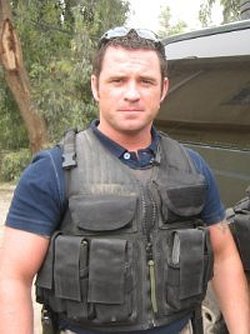
Q. I’m just going to say it. Look at you. Soldier. Private security. 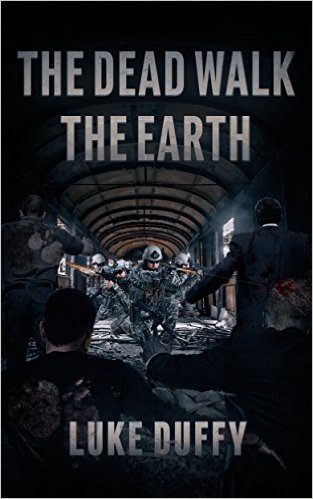 You’re a badass. As a layman, I’d think that having such vast military experience would inform one’s writing. Do you find that’s the case? Do you draw on your experience when writing your books?
A. Absolutely. I read a few apocalyptic books before I decided to write my own. Some were great, others were awful. But one thing I found that the majority of them had in common was that most authors lacked any real experience in military matters. Don’t get me wrong, there were some great efforts out there, well researched and thought out, but there was always something missing. The mark was never quite hit. Only someone who has experienced being shot at, blown up, or felt those familiar sensations of dread and retrospect when preparing for a fight, can write a realistic battle scene. I’ve always tried to make the action as close to real as possible, and my own experiences have helped, a lot. I like to draw the reader into the pages, making them imagine what it is like to come under fire and wonder whether they would make it out. As a reader, it’s important to feel part of the story.
Also, most of my characters are actually based on real people that I have known over the years.
Q. You started out with non-fiction and then moved on to fiction. What drew you into the world of zombies?
A. In a few short words; Dawn of the Dead. I’m talking about the original. I watched it when I was about six or seven, and from there, I was hooked. It wasn’t so much the action and the zombies themselves, but more to do with the collapse of society and the slow death of humanity. Even as a kid the words ‘what if?’ rattled around inside my head. The end of civilisation has always fascinated me, regardless of the cause. But what could be more exciting, terrifying, and total, as the dead returning to life and hunting the living?
I like to imagine how different people, from various rungs of the social ladder, would react to a global crisis such as a zombie plague. I think true, true colours would quickly come to light, and I think the whole ‘good and bad’ thing would be turned on its head in many cases. I couldn’t imagine Bob Geldof and Bono still wanting to save the world, hugging plague victims and shaking hands with zombies. I think they would barricade themselves into their mansions and drop from the radar.
Q. Here’s a question I’ve thrown at a lot of writers this month. How do you find the time to write? I ask because I’m rather unfocused and if a good show comes on TV, there goes my writing for the day. So obviously, I respect a guy who has served in the military and in private security and yet still finds the time to write. Do you have any advice for aspiring scribes on how to balance work and writing?
A. My best piece of advice would be to create a routine. Finding the time and motivation to start writing, even if I’m half way through a book and on a roll, can be extremely hard. Sometimes I need to give myself a serious kick up the arse to get myself down behind my computer. Like you said, distractions can have a severe effect on you. So, what I do is ensure that I get myself into a routine. If I’m working away, most of my writing is done in the evening, which can be a real pain because my energy and enthusiasm is sapped by then.
When I’m home in the UK, it’s a little easier. I get up, have a coffee and a smoke, check the news, as well as the usual morning stuff that a man does. Then, come ten o’clock, I get to work and do at least four hours writing each day. After that, the world is my lobster and I don’t feel guilty, having the fact hanging over my head that I jacked on my work for the day because Susanna Reid was looking particularly hot on morning television and I became side-tracked.
Q. The description of The Dead Walk the Earth states, “Eight soldiers, accustomed to operating below the radar, carrying out the dirty work of a modern democracy, become trapped within the carnage of a new and terrifying world. Deniable and completely expendable. That is how their government considers them, and as the dead begin to walk, Stan and his men must fight to survive.”
“Deniable and expendable.” OK. So obviously, I enjoy being alive, so I’m not asking you to get into “If I tell you I have to kill you” territory (sorry, bad joke there) but generally speaking, is being “deniable and expendable” a fate that soldiers often find themselves facing?
A. Depends on the type of soldier and the operations being conducted. There’s no such thing as a clean government, and they all need someone to get their hands extremely dirty on their behalf, from time to time. I’ll not go into too much detail, but deniable operatives do exist. No, not like xXx and Mission Impossible. They’re just beyond fantasy. Deniable operators could be the man next door, or the guy driving your taxi. Shaved heads, huge muscles, and wearing Oakley sun glasses in the dark… don’t help.
I suppose that all soldiers are expendable, to a degree. Or at least they are viewed that way by the people who send them to war. No politician, no matter how sincerely they claim to have, has ever lost sleep or shed a tear over the men and women of their country being brought home in bags. Tony Blair and George Bush; they saw their military as mere pawns to be moved about on their own paths towards personal glory and gain.
Don’t get me wrong, I was part of the invasion of Iraq. I was amongst the first troops into Kosovo during the liberation in 99. I battled in Sierra Leone during their civil war, and I patrolled the streets of Northern Ireland before the peace process. I enjoyed the lot, but I never lost sight of the fact that not a single member of the government cared how many of my friends lost their lives.
Since joining the private circuit in Iraq, I’ve seen the attrition rate first-hand, and watched as countless friends were killed. Yes, we were in it for the money, but we were also doing a job on behalf of the US and UK governments, helping to rebuild the Iraqi infrastructure. But before long, the media stopped reporting the deaths and the government leaders forgot about us. All the while, the deaths of British and American private military soared. Expendable.
Q. Hypothetically, would today’s modern military be able to take on a zombie outbreak? Not that I spend a lot of time worrying about such a scenario, but I’d be interested to hear your take on it.
A. It depends on society as a whole, I suppose. In my books, the concept of the dead returning to life (zombies) has never been imagined. There are no books, movies, computer games, or folk tales about such creatures. So, when the dead begin to rise, it’s complete confusion, terror, and chaos. No one knows how to deal with the problem. On the one hand, some see the threat for what it is, and insist that immediate action be taken. However, on the other hand, there are the ‘bleeding hearts’ and ‘do-gooders’, bleating that even the dead are people and have rights.
Governments hesitate, fearing backlash should they act with what can be viewed as brutality and inhumanity towards the infected (yes, I believe that even on the brink of an apocalypse, the politicians would still worry about their image and future votes).
People struggle to come to terms with the outbreak. Families cannot imagine that the monsters staggering towards them are no longer their dad, mum, sister, brother, uncle – twice removed… etc.
Then there are the legal complications to consider. Most people out there follow the rules. They avoid confrontation and shy away from violence. Inflicting pain and suffering is not a desire that most human beings carry. Many would hesitate, because we have all been brought up to understand that killing is wrong, both in a legal and moral sense. Suddenly being told that it is perfectly okay to smash your neighbor’s head in with a hammer, isn’t going to have any great and immediate effect. Most people would simply lock their doors and hide. Even I would hesitate, and I don’t like my neighbors.
Morality and human emotions play huge parts in the downfall, and only when it is too late, do people realize the extent of the catastrophe and put down their delusions of decency and respect, but by then, it’s too late.
However, in reality, I believe that the military would soon have the outbreak under control. No doubt, they would all be rounded up and sent to work in Starbucks, maybe even become Labour Party members.
Q. Any plans for further zombie books in the future? Or perhaps other monsters? I read a post on your blog that made me think you find technology as infuriating as I do. That me think – soldiers vs. killer robots has some potential.
A. I take it that you’ve never watched Terminator?
Seriously though, yes, I find technology infuriating. In my opinion, it causes more trouble than its worth, even though I have found myself reliant upon it.
I have one more book to write in the current series, and then I intend to get a couple of kids’ books written that I have in mind. Yes, it’s a dramatic shift from people being eaten alive and copious amounts of profanities and violence, but I’ve had these stories in my head for some time, so I will be hanging up my zombie hat for a while. I may return in the future, if the demand is high enough and I have some new ideas, but for now, I need to step away from the genre.
Q. Luke, thanks for stopping by. Before I go, do you have any last minute advice that might help me survive the East Randomtown Zombie apocalypse?
A. Get away from the cities. Find a place that is remote. The dead are stupid, and lazy. Can you imagine them walking up mountains or fording rivers? High-ground, preferably open with good all round visibility, would be your best bet. Dense forests are also good, but they can be a double edged sword; they can’t see you, but you can’t see them, either. I wouldn’t like to have to bug-out from a wooded area during the dark hours, surrounded by zombies
If you’re stuck in an urban area, stock up, stay out of sight, and keep quiet. Remember, a barricade can never be too big, no matter how valuable that antique chest of drawers is. Trust no one, and lock your heart away in a sealed box. There’s no room for easy emotion and sentimentality in the zombie apocalypse world. Finally, make a note of all the people close by who have pets, because when the time comes, cats and dogs make good eating.
 Bookshelf Battle
As usual, you have conducted another great interview with a terrific author 🙂 I think it is awesome that Dawn of the Dead (1978) inspired him to write zombie fiction 🙂 Speaking of which, Dawn of the Dead is actually my number one favorite horror film of all time and believe me, I have more than a ton of favorites in that genre 🙂 Aside from Romero, I love the work of John Carpenter and David Cronenberg to name but a few. Speaking of Cronenberg, I watched the Criterion edition of The Brood (1979) yesterday. A great horror film 🙂 If you want a sypnosis, you can IMDB it and If you look at Cronenberg’s filmography, you will also notice that he directed the 1986 version of The Fly which is fantastic 🙂 Anyway, keep up the great work as always 🙂
Reblogged this on Bookshelf Battle and commented:
Holy Crap, 3.5 readers. Look at this guy. I wish I looked this good in kevlar. Makes me wish I’d reached for the cookie dough ice cream less and the barbells a little more. Oh well. Too late. Where’s my ice cream?
Luke Duffy, who has been a soldier and a private security contractor, was cool enough to talk to me about the zombie books he’s written.
Yup. I know. This guy finds time to write. I constantly whine about the little time I have to write. Maybe if I whined less.
Folks, when the zombies come, I’ll be hiding behind this guy.
[…] Check out BQB’s interview with Luke Duffy here. […]