Bookshelf Q. Battler here with a review of The Woman in Gold.
Based on real events, the film follows the story of Maria Altmann (Helen Mirren) and Randol Schoenberg (Ryan Reynolds) in an underdog against the odds quest to return a famous painting once stolen by Nazi’s from Maria’s family.
The year is 1998 and Maria is an elderly boutique owner in California. Young Randol (Randy) is the son of an old friend of Maria’s. Randy’s a newly minted lawyer and having a rough go of it. His practice just went under, he and his wife (played by Katie Holmes) just have a newborn baby, and he’s just managed to secure a position with a big time law firm.
It all begins with some polite free advice – Maria consults Randy about what to do in light of the fact that the Austrian government has been making an effort to return artwork stolen by the Nazi regime to their rightful owners.
The painting in question? The much admired “Woman in Gold” painted by artist Gustav Klimt. Over the years, it moved from Nazi hands to a public art gallery and has become beloved by the country as “the Austrian Mona Lisa.”
The Woman in Gold – Movieclips Trailers
But to Maria, it’s a picture of her dear Aunt Adele.
The movie switches back and forth from past to present. Randy and Maria take on a government that doesn’t want to return the painting. In the past, young Maria once lived a happy life in a prominent Jewish family, where her father played the cello and there was much singing and dancing by all.
Alas, the Nazis come to power, roll into Austria, and Jewish people are robbed blind, their homes stripped of possessions. Nazis takeover Maria’s home and haul off all the artwork inside, including the portrait of Adele.
They’re forced to undergo all manner of humiliations, often cheered on by onlooking non-Jewish Austrians.
Maria’s family had worked hard for what they had and the Nazis took it all. So many decades later, for the elderly Maria, the fight for the painting’s return isn’t so much about the painting itself, or about the money (its worth at the time was 150 million), it’s a desire for the Austrian government to admit it did wrong – that Austrians welcomed the Nazis into the country with open arms and openly supported the mistreatment of Jewish citizens.
In the past, we see young Maria and her husband make a heroic and daring escape out of the country, after which they make their way to America. For the rest of her life, Maria feels resentment at those who turned Austria into a place she had to leave. She also feels guilt for leaving her family behind, and is angry at those who made her do so.
In the more recent past, the late 90’s, we see Randy go from viewing the case as a nuisance, then a chance to make some loot when he realizes how much its worth, and finally a chance to right a past wrong. Randy puts his career on the line and loses everything in pursuit of the case. Meanwhile, Maria goes from wanting to pursue the case to wanting to forget it all.
It becomes an international and complicated case as Randy battles the Austrian government in Austria, and later before the U.S. Supreme Court.
Do they win? Well…that’s a spoiler in gold, isn’t it? Ha ha ha.
This was an interesting and enjoyable film. It’s not getting a lot of press. It’s a film I like to call “Oscar-ish.” Hollywood often makes Oscarish films, movies about serious subjects and give actors a chance to flex their serious role chops but for whatever reason, they don’t end up in the Oscar running. That’s not to say this film won’t, though it is rather early in the season.
It’s also a story that needed to be told. I’m often amazed that even after so many WWII movies, even today there are stories that are still emerging. Maria’s family had worked hard for what they had, contributed to their society and the thanks they received was the government and their fellow citizens cheering on the Nazis in their anti-Jewish reign of terror.
I’m a man. I have problems. Are you a woman? Yes, I know you also have problems. But I can only write about what I know.
There are some man problems I know all too well. There are other man problems I know nothing about.
SPOILERS AHEAD
DON DRAPER
On one side of the spectrum, there’s Don Draper of Mad Men fame (aka Jon Hamm).
Don has problems. He has more women than he knows what to do with. He cheats on all of them constantly and when one of them gets fed up, another soon arrives, fully aware of the cad’s ne’er-do-well-lifestyle but willing to give it a go anyway. Maybe she’ll be the one to change him.
In short, Don has some problems I wouldn’t mind having.
Oh AMC. First, you fill my Sunday nights with zombies and murderous drifters. Then, you replace them with ennui laden 1960’s era ad executives. Is there no middle ground with you?
Don lives in a world I know nothing about. In fact, though I’ve never received the memo, I’m getting a sneaking suspicion that I most likely never will.
It’s a world where Don, as recently as Sunday’s final season premiere, walks into a diner, propositions a waitress, and within seconds they are engaging in flagrante delicto in a back alley.
Not for nothing, but I’m fairly certain had I tried to pull a stunt like that, I’d be tazed and pepper sprayed unmercifully.
Oh wait, it’s the 1960’s. She would have just cracked my skull with a rolling pin.
Don’s problems? Which one of these women do I go out with tonight? Which one of these women will I go out with and not tell the others about? Which one of these women that I used to go out with do I miss and want to see again? And how soon can I make another deal with my charm so I can grab some more money that I can use, naturally, to impress more women? Not that I need money to get women because, hey, look at me, but the extra cash doesn’t hurt.
Of course, Don is full of inner turmoil. He had a harsh childhood. He grew up poor – an unwanted urchin in a house of ill repute. When he becomes an adult, he hits it big, gets a taste of the good life and he becomes trapped in a paradox – life is short so he feels the urge to drink and get busy as often as possible. However, deep in his soul he realizes that no amount of cavorting can replace the love and stability of a loyal woman and along the way, he loses two wives to his bad habits.
I’m just going to throw it out there. Toss me January Jones and I’m a happy camper. Sorry everyone, no carousing for me. I have to get home to January.
Yep. Mad Men would be very boring if I were the star.
Don has problems. I’ll never know any of them. Stop being so depressed Don. Trade lives me with anytime.
LOUIS CK
At the other side of the man-a-verse spectrum is…”Louis Louis Louis Louis.” (You have to sing the theme song.)
Oh Louis. I know many of your problems so well. Not all of them, but many. I truly feel your pain.
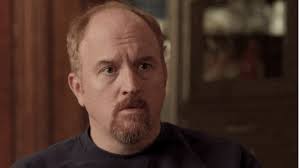
Louis, when I see the expression of utter defeat on your mug, I can feel your misery, because I make the same face a hundred times a day. It looks like this:
I know that look.
Do you know what that look is called? It is the “I’m trying as hard as I can and nothing is going my way!” look. Defeat. Surrender. “OK world. You got me.”
Poor Louis. All he wants is to be happy and yet that long sought after emotion evades him at every turn.
And contrary to what everyone in his world thinks, it’s not for a lack of trying.
Don Draper? Sure, he feels the occasional pang of sadness when he misses his kids, but he quickly dulls the pain with the next short skirted secretary to walk by.
Louis? He loves his kids. He wants to do right by them. He only sees them a couple days a week and you can tell that weighs on him terribly – that the collapse of his marriage and the subsequent inability to not be with his children daily is a failure that haunts and suffocates him. He holds the time he has with them sacred and doesn’t let anything interfere.
Love? Louis wants to find it. Do you remember Seinfeld? That other show about a comedian? Jerry had a bevy of beauties, a new one to be mocked or offended by Jerry, George, Elaine, and Kramer every week.
For the most part, Louis dates average women. He doesn’t shoot for the stars. You can’t accuse the guy of swinging for the fences because he’s staying in his league. And yet, things inevitably go south for him anyway.
He takes a woman to a diner. A group of unruly teenagers harass and threaten him. Louis does the right thing – he lets it go. Are insults worth getting in a physical fight over? No. But his date thinks less of him and won’t see him again. It isn’t easy being a man. Even in today’s allegedly equal, liberated, forward thinking world, a man who turns the other cheek in the face of a threat is considered a wuss.
On another date, a potential love interest informs Louis that she has children. Stand-up guy that he is, Louis tells her not to worry – he also has kids. Quickly, the woman turns sour and skeedaddles. She wanted a man who would be accepting of her children but in an ironic twist, thought less of a man with kids of his own.
There’s Pam, who constantly harangues Louis with one putdown after another. She dumps him and later tries to come back, fully expecting that Louis will welcome her with open arms. She’s shocked to learn he’s in a relationship with Amia, as if the idea that ugly old Louis found someone else is impossible to believe.
Speaking of Amia, she’s Louis’ perfect soulmate but of course, she has to move back to her native Hungary.
Sure, occasionally a hot woman will show an interest in Louis, but even then, it doesn’t end well. A supermodel-esque blonde in attendance at one of Louis’ shows invites the comedian back to her place. In a freak accident, Louis unintentionally elbows her in the eye, causing her permanent damage and a hefty lawsuit that he can ill afford.
Luck is not on Louis’ side. Have you ever heard the expression, “Anything bad that can happen will, and at the worst possible moment?” That’s Louis’ life and I have more in common with a man like Louis than I ever will with Don “I wonder which model I’ll get jiggy with today” Draper.
Thought of as a loser by his ex-wife, a dufus by his kids, and a real mensch by his friends – Louis is that reliable guy that everyone instantly calls when they need help, but the favor is rarely returned when he needs something. Worse, no matter how far out of his way he goes for people, they still end up looking at him like a chump.
Bald. Paunchy. Not very good looking at all. Louis is the champion of defeated males everywhere – those who have resigned themselves to a fate where’d they’d be happy if a woman smiles at them. “Well life, how much crap are you going to spoon feed me today? Whatever. Bring it on. I’m ready for it.”
We Louis types are in awe of a Don Draper and fail to even comprehend how his lifestyle even exists.
We live on the same planet and yet, Louis CKs and Don Drapers live in completely different worlds.
So, what are you? A Don Draper or a Louis CK?
I’m going to go out on a limb here and guess that since you’re reading a book blog with 3.5 readers, you probably trend more toward Louis.
Don’t be insulted. So do most men, even though we hate to admit it.
Or, Hollywood is Sorry for Pushing Crap on You, But It’s Kind of Your Fault.
In 1989, Michael Keaton starred as the first Batman to not suck. That role made his career. I’d argue that it didn’t really define him though. He’s been in zany comedies and serious dramas, performing expertly in both.
Yet, as a former Batman who’s ditched the cowl to seek out more serious roles, one is left to wonder how much of Birdman is semi-autobiographical. Does Keaton identify with Riggan? Only Keaton could truly answer that.
Keaton plays Riggan Thomson, a big time actor who, twenty years ago, played a feathery comic book super hero in a series of Birdman films. They were special effects extravaganzas that made him a lot of money and were big at the box office.
Movieclips Trailers
Today, Riggan is trying to leave his past behind him and gain recognition as a serious actor. He’s broke, having sunk a fortune into a Broadway play adaptation of a work by author Raymond Carver. And true to the style of a play, the cameras follow the actors on and off stage, with very few cut scenes throughout the film.
Actors aren’t as happy as you’d think, there’s intense pressure, you can’t please everyone, and whatever you do, someone is criticizing you. You try to produce art (i.e. Raymond Carver) but alas, people just want fluff (i.e. Birdman). Even worse, once you “sell-out” and take a role like “Birdman,” the “true artist” community will shun you and refuse to consider your attempts at artistry, even if they are worthy of notoriety.
As consumers of entertainment, should we push for real, serious, dramatic art? Plays and movies where there’s all kinds of gut wrenching dialog to make you think? Or should we just have fun and watch Birdman fight bad guys?
Are purveyors of comic book movies making us all stupid? Are creators of heady dramas just too full of themselves?
These questions are asked, and never really answered, though the movie serves as a chronicle of one actor’s attempt to produce serious art only to be stymied at every turn.
Riggan’s foil, played by Ed Norton, is veteran broadway thespian Mike Shiner. Recruited for Riggan’s play, Shiner is a pretentious limelight hog and though he claims to be all about the art, he’s ultimately just as obnoxious as any movie star.
Meanwhile, Riggan has to deal with a snooty play review critic, who vows to shut Riggan’s play down before even seeing it, simply because she does not believe someone who stooped low enough to play a cartoon superhero is deserving of praise for attempting real art.
In other words, if the entertainment world is at war, then it’s a battle between the big blockbuster fluff eaters and the holier than thou tweed jacket wearers. Both think they’re the smartest people in the room. Neither is willing to meet the other half way.
Emma Stone, who plays Riggan’s daughter, Sam, earns her Oscar nomination with this speech:
TEXT OF SAM/EMMA STONE’S “RELEVANT SPEECH” FROM BIRDMAN
RIGGAN: It’s important to me! Alright? Maybe not to you, or your cynical friends whose only ambition is to go viral. But to me . . . To me . . this is — God. This is my career, this is my chance to do some work that actually means something.
SAM: Means something to who? You had a career before the third comic book movie, before people began to forget who was inside the bird costume. You’re doing a play based on a book that was written 60 years ago, for a thousand rich old white people whose only real concern is gonna be where they go to have their cake and coffee when it’s over. And let’s face it, Dad, it’s not for the sake of art. It’s because you want to feel relevant again. Well, there’s a whole world out there where people fight to be relevant every day. And you act like it doesn’t even exist! Things are happening in a place that you willfully ignore, a place that has already forgotten you. I mean, who are you? You hate bloggers. You make fun of Twitter. You don’t even have a Facebook page. You’re the one who doesn’t exist. You’re doing this because you’re scared to death, like the rest of us, that you don’t matter. And you know what? You’re right. You don’t. It’s not important. You’re not important. Get used to it.
Still, Sam’s right. We’re all just shouting in the wind, trying to be relevant, trying to matter. And at the end of the day, after movie goers walk out of the theater, after play watchers go out for cake, after novel readers put a book down, and after my 3.5 regular readers go on to read another blog…how relevant are we? As it turns out…not very.
Fame is fleeting and celebrities just aren’t as happy as we think.
Throughout the film, Riggan is taunted by Birdman himself – a gravelly voice that sounds more like Christian Bale’s version of Batman than Keaton’s. Birdman is the voice of commercialism, urging Riggan to abandon his efforts at serious drama and sell-out – do a reality TV show, make a Birdman comeback movie. Forget the hoity toy stuff and just rake in the dough.
And honestly, whether Birdman is right or wrong is left up to the viewer’s interpretation.
Big surprise of the film – Zach Galifianakis can actually act. He plays Riggan’s agent and rather than be that same old obliviously rude cartoon character he plays in every movie, he actually comes across as a competent, reliable professional, someone you’d actually want to represent you if you were an actor.
At one point, Shakepeare’s “Life is a Tale Told by an Idiot” speech from MacBeth is prominently featured. If you want to know more about that, you can read expert commentary from world renowned literary expert Bookshelf Q. Battler.
It’s a film that starts a dialog about what we, the entertainment consuming public, want from Hollywood. Because, as it turns out, if enough of us want it, they’ll give it to us. If we show them that high-falutin, chin-stroking, navel gazing, thought provoking dramas will make money, then Tinseltown will send them our way. Yet, if we keep buying tickets for Birdman-esque blockbusters, then we’ll get more comic book movies. It really is up to us.
And it’s also up to us to determine whether or not we should feel guilty about choosing comic book-esque movies over drama. Personally, I don’t. I’m a nerd. I love comic book movies. I love hoity toity stuff too. There’s room in the world for both. One need not cancel the other out.
And sure, the public often complains that Hollywood isn’t trying that hard, but then we pay more attention to viral videos, tweets, and gossipy nonsense than serious efforts at art. At one point in the film, Riggan’s stroll through Times Square in his underpants gets more attention through social media than his play ever does.
We all want to be relevant. We’re all clawing over each other to grab our piece of the public’s limited attention span. We’re all idiots. Can’t we all just calm down, take a deep breathe, stop crawling over each other for a few fleeting minutes of fame, and take a moment to enjoy friends, family, and the things that actually matter? At the end of the film, Riggan frets more about not spending enough time with his daughter than he does about his fizzling acting career.
Heck, had I not promised my 3.5 regular readers a year’s worth of posts, I might seriously consider packing it in myself.
Because if a guy who was paid buckets of money to dress up like a cartoon bird hero can’t be happy, then what luck do any of us have?
I predict this film will win best picture. Keaton’s had a long career and has yet to be graced with an academy award, so he’s overdue. Ironically, it’s a movie about a man trying to get past commercialism and make some serious art made by a man who’s trying to get past commercialism and make some serious art.
The Academy will no doubt love its message – “Hey, we actors aren’t as happy as you’d think, we really struggle to make you all happy!”
And finally, I’d just like to say, I think Michael Keaton is awesome. He made me laugh in movies like The Dream Team and Beetlejuice. And I remember seeing him in the first Batman and I thought, “Wow, Hollywood picked a guy that isn’t all buff and muscle-bound to play a super hero and he did an awesome job. Maybe there’s hope for us nerds.” So I hope tomorrow night is his night to walk home with a little gold man. (I mean an Oscar, not an actual little gold man).
Did you see it? What did you think? Flap your bird wings to the comment section and let me know.
First thing to understand about showbiz people is that they are, in fact, businessmen (and women).
Imagine you open a yogurt store. For the first year or two, you suffer as you try to get it off the ground. Your yogurt stinks for awhile until you find the perfect recipe. Your workers stink until you find the right employees. Your location stinks until you find the right place. Eventually, you turn a profit and become successful. You want to reinvest your profits. What do you do? Do you start a banana stand? Open a pizza shop? A drycleaner store?
No, you go with what has worked for you – you open another yogurt stand.
And that’s why you see Fast and Furious 7, Transformers 4, Spiderman Reboot, Star Wars 7 and so on. Movies and TV shows cost money and the showbiz types want to put their money in tried and true products. That’s why somewhere in the world a fabulous heart wrenching movie script is lying in a drawer somewhere, never to be produced while 95 Jump Street will be out before you know it.
Better Call Saul is an upcoming spin off of the mega-hit show Breaking Bad, starring Walter White’s hilariously sleazy lawyer Saul Goodman, played Bob Odenkirk. On Breaking Bad, Saul provided much needed comic relief to an otherwise serious show, but can he carry a whole series on his own? I have my doubts, but then again, I don’t have any doubts about the people behind Breaking Bad so if they’re behind this, then I will be too.
The latest news is that the character of Walter White will appear on the show – that the show will take place before, during, and after Breaking Bad. I am worried that if the show tanks, it might devalue the whole Breaking Bad brand. Breaking Bad is a masterpiece – you don’t make a Mona Lisa Part II.
I suppose this is one of those things where we’ll just have to wait and see.
I just finished the last episode of this season’s Fargo on FX. All I can say is, “Wow.”
When I first heard that a Fargo TV show was in the works, I hated the idea. The Fargo film is such a classic and so self-contained that it did not seem like it would be possible to improve onto it or add to it. If you haven’t seen it, you should. The movie follows a scheme by a wimpy, chronically disrespected car salesman played by William H. Macy to stage a fake kidnapping of his wife in order to extort money from his overbearing father-in-law. The kidnappers, one of them played by Steve Buscemi in what I recall to be one of the best performances of his early career, botch things up miserably and well, tragedy ensues. The evildoers are eventually rounded up by unlikely hero Margie, an exceptionally pregnant police officer. Throughout the movie, much fun is poked at the ways of the Northern Midwest, the overly polite manners of the people there, and their tendency to speak in pseudo-Scandanavian accents – “Oh yah,’ dontch’a know?”
Naturally, the Fargo TV series did capture some of the film’s themes. There’s a wimpy disrespected loser, Lester Nygaard, this time played by Martin Freeman. There’s a female police officer, played by Allison Tolman, but she doesn’t get pregnant until the end. Further homages to the film are made here and there, but for the most part, this is not an attempt to remake the movie so much as to tell another crime story set in the greater Fargo area.
The show becomes increasingly shocking – especially towards the end – the Las Vegas elevator scene and the scene where Lester sends his second wife into the shop, well, I’ll let you watch for yourself, but those scenes left my jaw scraping the floor.
I did worry that casting Key and Peele as two bumbling FBI agents might turn the whole show into a joke, but oddly enough, it did work.
Overall, a great show. FX continues to set the bar high in bringing quality entertainment.


 Bookshelf Battle