Category Archives: Books

Public Domain Horror Fiction – The Monkey’s Paw by W.W. Jacobs

Readers, if there’s one lesson you ever learn from this humble book blog, I hope it is this one:

Never make a deal with something or someone evil.

You scoff but you know it is true.  Ask a source of evil to make you win the lottery and you will…only to get hit by a bus on the way to cash in the ticket.  Evil has one of the twisted view of irony ever known.

So tonight, in bookshelfbattle.com ‘s ongoing Public Domain Horror Fiction Series, check out the short story, The Monkey’s Paw by W.W. Jacobs, first published in the early 1900’s.  Short summary – A couple and their adult son find a Monkey’s Paw from India.  Supposedly, it has the power to grant wishes.  Sadly, they learn the hard way that with their wishes comes evil irony.

https://www.gutenberg.org/files/12122/12122-h/12122-h.htm

“The other two wishes,” she replied rapidly. “We’ve only had one.”
“Was not that enough?” he demanded fiercely.
“No,” she cried, triumphantly; “we’ll have one more. Go down and get it quickly, and wish our boy alive again.”

– W.W. Jacobs, The Monkey’s Paw

Tagged , , , , , , , , , , , , , , , , , ,

The Cask of Amontillado – Thoughts, Review, Analysis

If you are one of the 3-5 people who read this blog on a regular basis (make that 6 whenever my Aunt Gertie can figure out how to turn her computer on) then you have probably become exhausted by the virtual Poe fest it has become around here as of late.

What can I say? ‘Tis the season for spookyness.  And few authors are as spooky as Edgar Allan Poe.  Don’t worry.  By Saturday it will be the season of stuffing your face full of game bird and arm twisting your loved ones into purchasing you high end electronics that will coincidentaly become outdated by next Christmas when a slightly modified version arrives.

“Buy the iPad.  No, buy the iPad 2.  No, buy the iPad 3, now with flavor crystals!”

So let’s talk about The Cask of Amontillado, Poe’s 1846 short story.  I’ve posted the full text.  If you haven’t read it yet, you should.  It’s ok.  We’ll wait.

You’re back?  OK good.  For starters, we have Montresor, a character that you might refer to as “an unreliable narrator.”  He introduces the story by informing the reader that Fortunato has irreparably insulted him.  Montresor does not describe in detail what exactly happened, so have no idea if Fortunato did indeed engage in an unspeakable, unforgivable act upon Montresor, or if Fortunato just doled out one of those insignificant slights that we all have to deal with on a daily basis.  Someone accidentally bumps into you on the street and doesn’t say excuse me, someone eats the last slice of pizza you were saving – these things just happen, and most normal people just let them go.

But most people are not Montresor.

For purposes of this blog, let’s just assume that Fortunato erased Montresor’s DVR, on which had been stored an entire season’s worth of Dancing with the Stars.  Montresor will now have to face a life where he not only a) does not know which star danced with who but also b) which stars were judged to in fact be, the better dancers.  Truly, a gruesome fate I would not wish on my worst enemy.

At a carnival in Italy, Montresor meets up with Fortunato and informs him that he has purchased a pricey wine – Amontillado.  Montresor worries that he may have been ripped off, that the wine may only be an Amontillado knock-off.  (And hey, if you ask me, if you’re buying your Amontillado off the back of a truck or from a shady character on some dark street corner instead of from a reputable, licensed and bonded Amontillado dealer, well then frankly sir, you takes your chances).

Fortunato fancies himself a wine aficionado and Montresor takes advantage of this.  Montresor drops hints that he’d love it if Fortunato would accompany him to his family catacombs (because apparently in the Europe of yesteryear, people would just have an underground area where they would store a) the bones of their dead relatives and b) booze because it stays cooler underground) to taste the wine and confirm whether or not it is actually Amontillado.  Montresor furthers adds he’ll get Luchresi to taste the Amontillado instead.  This infuriates Fortunato, as he considers Luchresi to be a rival to his own wine tasting abilities.

It’s basically the equivalent of telling Superman, “Oh no, Superman, you take a rest.  I’ll call Batman to come get the bad guy.”  Superman would totally kick the bad guy’s ass rather than be one-upped by the Caped Crusader.

Montresor leads Fortunato deep into the catacombs.  Now, all this time, Fortunato has been wearing a jingle belled jester’s hat (Poe’s heavy handed way of letting you know that you should consider Fortunato to be a fool).  Fortunato is also three sheets to the wind and drunk off his behind having spent the day at the carnival drinking anything not nailed down.  So in other words, Fortunato is in a very vulnerable state and Montresor takes advantage of this.

At one point, Fortunato does reveal his condescending side by poking fun at Montresor for not being a mason.  Fortunato says he is a mason and shows Fortunato a trowel – an ominous sign of things to come.  However, Fortunato meant the Mason organization, not an actual person that works with brick and mortar.

Montresor chains Fortunato to a wall in a small area and then walls it up with bricks.  As he does so, Fortunato states a hope that this is just a joke and then eventually says the famous line, “For the love of God, Montresor!”  In other words, he’s essentially telling Montresor to show him some pity and let him go, that this whole idea of bricking him up in a wall is pretty dang unreasonable (the understatement of the year).

When Montresor is about to put in the last brick, he calls Fortunato’s name.  Fortunato does not answer?  Why?  Who knows?  It could be Fortunato did not want to give Montresor the satisfaction, could be that he just gave up and did not want to talk anymore, could be that the exhaustion of the whole experience wore him out and he died.  The real question  – did Montresor care that Fortunato did not answer?

Montresor ends the tale by noting that Fortunato has been in the wall for 50 years untouched.

All in all, a spooktacular piece of literature by one of the horror genre’s classic masters.


Tagged , , , , , , , , , , , , , ,

Public Domain Horror Fiction – The War of the Worlds by H.G. Wells

Aliens!  Spaceships!  Intergalactic travel!  The most unbelievable part?  For me, it is that this novel was first published in 1898, a time of virtually little to none technology at all (at least compared to today’s standards) and yet the author was able to envision beings from outer space utilizing technology to attack Earth.

Thankfully, it still hasn’t happened, but it just amazes me that a person who grew up in a time of the horse and buggy could have had such a vivid imagination.

Check out Project Gutenberg’s free copy:

https://www.gutenberg.org/ebooks/36

“No one would have believed in the last years of the nineteenth century that this world was being watched keenly and closely by intelligences greater than man’s and yet as mortal as his own; that as men busied themselves about their various concerns they were scrutinised and studied, perhaps almost as narrowly as a man with a microscope might scrutinise the transient creatures that swarm and multiply in a drop of water.”  – H.H. Wells, The War of the Worlds

Tagged , , , , , , , , , , , ,

Labor Day Reads

We here at the Bookshelf Battle Institute for Excellence in Learning How to Read English Good believe that you should spend this Labor Day Weekend basking in those last few precious moments of sun before the Fall rolls around and Mother Nature makes you get out your sweaters and jackets again.  Save the reading for when the snow is piled up ten feet outside your window this Winter.

But – supposedly this is a holiday dedicated to celebrating those who labor, and has nothing to do with getting in one last day off before the weather goes South, so here are, in no particular order, some books to read if you want to learn more about the plight of the downtrodden working man:

1)  Hard Times by Charles Dickens – Oppression of the masses!  Factory workers in love!  The rich get richer!  The poor get poorer!  Workers get covered with soot and talk in cockney accents!  That’s pretty much every Charles Dickens’ novel ever written  but the plight of the poor is especially prevalent in this one.  Arguably, it’s not Dickens’ most memorable work, nor is it his best, but it’s a good piece of literature and, well – I don’t know if you need to give a SPOILER WARNING for a book that was printed in the 1800’s (I mean really, you had your chance to read it already, sheesh!) but suffice to say, Mr. Gradgrind forces all of the wit, whimsy, and dreams out of his kids, forcing them to focus on the practical.  “Stop dreaming and start making some money!” is pretty much the speech that every parent gives to a youngster sooner or later.  And it’s not necessarily bad advice (dreams are great, but paying your bills and being able to eat is good too) but Gradgrind goes a bit overboard and his son ends up a loser while his daughter ends up married to an old man twice her age.  In short, try to find a decent living and keep your dreams intact at the same time.

2) Of Mice and Men – Many of John Steinbeck’s novels are about the plight of the working man.  In this one, George and Lenny are migrant farm hands in California.  They move from farm to farm, the bumbling, dim-witted Lenny usually makes some mistake that enrages the local farm folk, forcing them to pack up and wander off to in search of a new gig.  They make it to another farm where they meet an old man and together, the three of them cook up a dream to save up their money and buy a small patch of land which would allow them to become their own bosses.  It almost pans out until – well, hey listen I’ll let you read it but take a note ladies, don’t allow enormous, musclebound dummies who don’t know their own strength to stroke your hair.  Really, it’s just common sense.

3)  Les Miserables – Victor Hugo’s epic novel turned Broadway Musical turned movie tells the tale of Jean Valjean, who stole a loaf of bread, did hard time for it, and had to take on a new identity just to get away from the shame of it.  He prospers as a town Mayor and factory owner, but when Fantine is forced out of her job at his factory due to gossiping old biddies, he goes on a quest to save her daughter, Cosette and is always just moments away from being nabbed by the obsessed Police Inspector Javert.

Surely you’ve all heard this little diddy:

THE CONFRONTATION LYRICS – LES MISERABLES

JAVERT:

Valjean, at last!  We see each other plain.  Monsieur le Mayor.  You’ll wear a different chain!

VALJEAN:

Before you say another word, Javert!  Before you chain me up like a slave again!  Listen to me!  There is something I must do.  This woman leaves behind a suffering child.  There is none but me who can intercede.  In Mercy’s name three days are all I need.  Then I’ll return.  I pledge my word.  Then I’ll return…

JAVERT:

You must think me mad! I’ve hunted you across the years!  Men like you can never change.  A man…such as you!

It’s funny, people get mad when Valjean doesn’t give Javert the three days, but when you think about it, a police offer can’t really be all like, “Oh sure man, no problem, take all the time you need and I’ll just arrest you whenever it’s convenient for you.”

4) Death of a Salesman – Depressed and old and little to show for a life of being a salesman, Willy Loman commits suicide.  Maybe don’t read this one actually, it’ll just bring you down.  Your high school English teacher probably made you read it anyway.

So, let’s recap:  We have four novels dedicated to the downtrodden working poor and they’re all about the characters either killing themselves, killing each other, or otherwise dying miserably.  Apparently there are no novels where someone just gets a job and enjoys punching a time card everyday.  Kind of sad really.  Work=death according to the most popular books about the lower class.  How about a  book just about the Labor Day holiday itself?


5) Labor Day – Joyce Maynard’s novel turned movie about a depressed mother and her awkward son.  They’re taken hostage by an escaped convict.  Wrongfully accused, they rally around the man and almost run away with him until the police catch on and haul him back to the slammer for a long, long time.


OK I give up.  It looks like there are no happy, uplifting books about the subject of labor or Labor Day itself.  This list was a total waste!  Have a nice weekend anyway, I’m off to go grill some burgers.

Tagged , , , , , , , , , , , , , , , ,

1,000 Twitter Followers in Three Months!

How diddly doodly blogarinos!  (Sorry, been watching a lot of the Every Simpsons Ever Marathon).

Forgive a bit of shameless self-promotion here.

Something awesome happened tonight – my Twitter feed reached 1,000 followers.  Since I only started blogging/tweeting in earnest in June, I’d say that’s pretty fantastic.

Can we make it to 2,500 by Christmas?  Then there would be even more people following the booktastic goodness.

If you’re on Twitter, feel free to follow me @bookshelfbattle

It’s been a great ride so far – tossing in books, literature, writing, and pop culture into one giant blender and pressing puree!

Tagged , , , , , , , , , ,

The Writer’s Battle – Expressions

Expressions – you hear them all the time.  They’re those pesky figures of speech that everyone says but no one knows where they came from.  And sometimes, when you really sit there and think about them – they’re kind of weird.

Here’s some that are on my mind:

EXPRESSION:  “There’s more than one way to skin a cat.”

MEANING:  It is possible to achieve the same end through various means.

EXAMPLE:  “Hey Fred!”  Pete said.  “I ran out of glue and now I can’t finish my collage of 17th Century Prussian Warlords!  What the hell should I do know?”

Pete stroked his beard in a thoughtful manner and replied, “Why don’t you try some chewed up Grape Bubbalicious?  After all, there’s more than one way to skin a cat!”

COMMENTARY:  When you think about it, this expression is sick.  Apparently, based on the expression’s continued existence in the modern lexicon, there was at one point in the world’s history a booming cat skinning operation.  Whether people skinned cats for industrious profit or leisurely sport I am unaware.  Yet, cat skinning must have been prevalent at some point for people to have coined this expression.

GUESS AT HOW IT WAS INVENTED:  Two cat skinners, 1 and 2, were discussing a vexing problem in 1’s life.  2 suggested a variety of possible methods of solving 1’s problem, adding “There’s more than one way to skin a cat.”  1, a veteran cat skinner, keenly aware of and experienced in a wide range of cat skinning techniques, devices, and methods, knew instantly that 2 was attempting to convey the message that there was more than one way to remedy his conundrum.  Thus, a new expression was born.

THE BOOKSHELF BATTLE EXPRESSION CHALLENGE – In an effort to motivate myself to engage in more bloggery, from now until Labor Day I will be consulting with Expression Scientists all over the globe to explain to you, the noble reader, not only how our most prevalent expressions were invented, but also, how they are pretty weird when you think about them.

Have an expression you’d like to see decompressed?  Post it in the comment section below.

As always, thank you for stopping by.  Stop by more often, will you?  I’ve seen cholesterol numbers higher than my stats. 

Tagged , , , , , , , , , ,

James Patterson Weighs in On Amazon vs. Hachette Battle

Exceptionally prolific book writing machine James Patterson has weighed in on the Amazon vs. Hachette Battle. Check it out here on CNN.

MY TWO CENTS: Frankly, this is one of those complicated issues that leaves a bumpkin like me cross-eyed. I think I get it. For both sides, it’s about money. On the one hand, you have Hachette and authors arguing that they should be rightly compensated for their work – that a lot of time and effort goes into producing these stories that we all enjoy and they should be paid for it. Why would anyone sit themselves in front of a computer screen typing away for twelve hours a day unless there’s just compensation coming? For the love of the artform? Well, that would be nice but hey, you know, money would be nice too. After all, authors need to pay their bills and need an income to survive on so they can focus their efforts on churning out more books. Without that income, they’ll have to get day-jobs and who feels like writing when they get home from work?

On the other hand, you have Amazon claiming that the demand for books priced too high just isn’t there. They may have a point. Think for a moment the veritable explosion of entertainment at your fingertips that has arrived on the scene in recent years. I can remember living in a time where if you wanted to watch a movie, you drove to a store and rented a physical copy, brought it home, watched it, forgot to bring it back, got charged late fees. Today, you can pop on your iPad, rent any movie you want and it is instantly on your screen. I can remember a time where if you wanted to buy a book you’d drive to the bookstore. Today, you again pop on your iPad, download it and start reading. Sadly, the movie and book stores are bygone relics, which is kind of sad as I used to enjoy wandering around them, finding books and movies I’d never heard of before.

The point is though that if you are any kind of entertainer – an actor, a singer, or even an author – you have a ridiculous amount of competition these days for the limited dollars people can afford to spend on your entertainment product in today’s garbage economy. If your book price reaches over a certain level, people will just watch a movie on Netflix instead.

It’s one of those difficult debates where both parties aren’t entirely right or wrong. I suppose in the end, we live in a free market and the publishers/authors should be able to price their products as they choose. If they price them too high, in an age where there is an abundance of options, the consumers will be the ones in the end who will let them know whether or not their product is worth the cost.

One last shameless plug for James Patterson (not that he needs it) – he’s one of the most successful authors in history for a reason. His books are pretty great and you should read one today.

Tagged , , , , , , , , , ,

Book Review – Fletch by Gregory McDonald

BASIC BOOKTOMETRICS

TITLE: Fletch

Author: Gregory McDonald

Publisher: Vintage Crime/Black Lizard

Publication Dates: First Published 1974; Published 2002 by Vintage Crime/Black Lizard

GENRE: Crime/Mystery/Humor

FORMAT REVIEWED: Paperback

NUMBER OF PAGES: 197

I have a new hero. His name is the late, great Gregory McDonald.

There are some books that are giant, unrelenting tomes. You break your back carrying such books around and yet despite the voluminous number of pages, the story goes nowhere.

Then there’s Fletch. In a little under 200 pages, McDonald, in his streamlined, use one word instead of ten, writing style manages to successfully provide the reader with a story about an anti-hero who solves not one but two complex mysteries.

If you’re old enough to remember the Reagan administration, then you may have seen the Fletch movies by Chevy Chase – Fletch and the sequel, Fletch Lives. Both were funny and gave Chase his moment in the sun. Sadly, after reading the novel, I’ve realized that the movies were really only loosely based on McDonald’s work. The films served as a vehicle for Chase to show off his multiple character talents. For some reason, the epitome of the gold star for a comic is to star in a movie where he gets the chance to do various accents and pretend to be all different varieties of people. As movie Fletch, Chevy puts on all kinds of goofy costumes and buffoons his way through solving crimes while tricking people into giving information to the various personas he takes on.

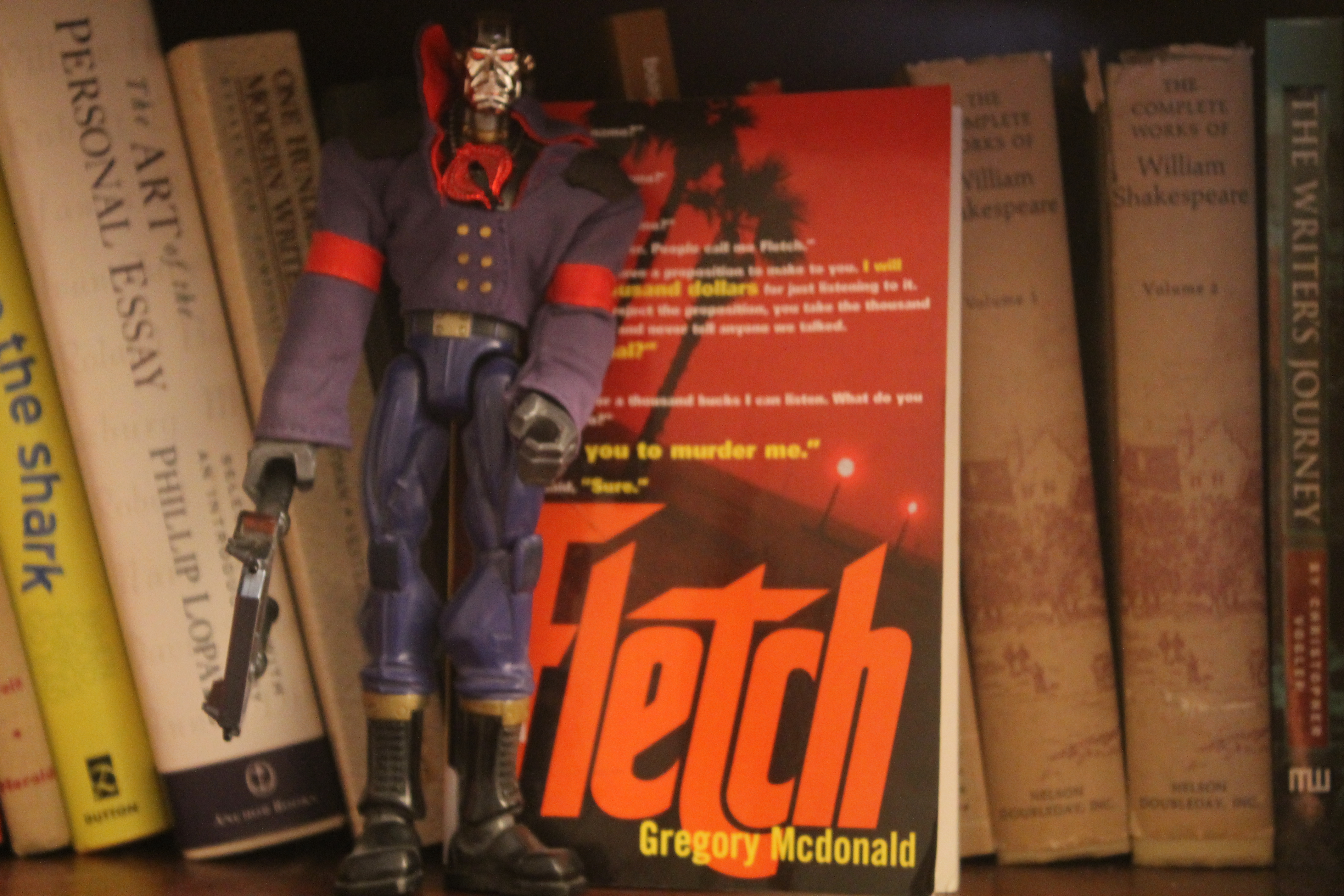
If you lived during the 80's, you'll remember Fletch.  Also, Destro.

If you lived during the 80’s, you’ll remember Fletch. Also, Destro.

The novel is a bit different. Make no mistake, on top of everything else, it is funny. But while the movies were zany funny, the novel could probably be described best as a dark comedy. The reader finds himself laughing at things that he probably should not laugh at in polite society.

The plot? Fletch’s real name is Irwin Maurice, or I.M. (I am) Fletcher. He’s an LA based reporter posing undercover as a bum, trying to trick various beach dwelling hoodlums into helping him find the supplier of a constant flow of drugs to the beach scene for a story he’s writing.

His cover is so good that he fools wealthy business executive Alan Stanwyck into thinking that he’s merely a degenerate drifter. Stanwyck picks up Fletch and makes him the following proposition, which I’ll post below so you can get an idea of the quick-draw, rapid fire pace at which McDonald writes:

What’s your name?”
“Fletch”
“What’s your full name?”
“Irwin. Irwin Fletcher. People call me Fletch.”
“Irwin Fletcher, I have a proposition to make to you. I will give you a thousand dollars for just listening to it. If you decide to reject the proposition, you take the thousand dollars, go away, and never tell anyone we talked.”
“Is it criminal?”
“Of course.”
“Fair enough. For a thousand bucks I can listen. What do you want me to do?”
“I want you to murder me.”
Fletch said, “Sure.”

Stanwyck claims to have terminal cancer and offers Fletch $50,000 to return to a week and shoot him in his study. He tells Fletch this will allow him to avoid suffering through a prolonged, agonizing death and as it will appear like a burglary gone bad, his wife will obtain a hefty insurance payment. Fletch may be a degenerate (he is haunted by his two ex-wives’ divorce lawyers throughout the novel) but he’s no dummy. Refusing to take Stanwyck at his word, he sets out on an investigation to find out whether or not Stanwyck is telling the truth. By posing as various people (insurance investigators, lawyers, “old long lost friends,” etc.) he manages to trick the people in Stanwyck’s life to give up the dirt. In the process, he even discovers the source of drugs on the beach along the way.

I really enjoyed this book. If you’ve seen the movie, you haven’t experienced the full story. It amazes me that in such a short novel, McDonald manages to provide the reader with a rich, in-depth experience. Rarely do I read a novel and want to read the series, but I think I might actually do it with this one. In case you are interested in the reading order for the Fletch novel series, I’ll post it below.

Note that while Fletch was McDonald’s first novel published introducing the Fletch character, he also published prequels, so Fletch is not the first novel in chronological order.

Reading Order for the Fletch Series of Novels by Gregory McDonald

Fletch Won

Fletch, Too

Fletch and the Widow Bradley

Fletch

Carioca Fletch

Confess, Fletch

Fletch’s Fortune

Fletch’s Moxie

Fletch and the Man Who

Son of Fletch

Fletch Reflected

McDonald was a newspaper reporter himself, so I imagine that he had an idea of the difficult life of a reporter that Fletch faced. It’s always interesting when authors write about environments they have personally experienced. I’m putting him next to Joseph Heller of Catch-22 fame as an author who can be funny and serious at the same time.

As always, Bookshelf Battlers, thank you for stopping by. Shameless plug – please follow this blog, and if you’re on Twitter, follow @bookshelfbattle I’ll keep writing reviews as long as somebody keeps reading them. May your days be filled with booktastic goodness.

Tagged , , , , , , , , , , , , , , ,

Barely Political – Key of Awesome – The Anti List – Must Read Books for the Summer

I love the Key of Awesome. If you’ve yet to see it, it’s a hilarious youtube channel where the people over at barely political (which also has a youtube channel) produce some funny song parodies. They also do something called “The Anti List” where, well, they basically make funny lists. They just made one lampooning a bunch of bestselling books turned movies/tv. Check it out. While you’re at it, look for their video”Booty Jam” on youtube as that is, in my opinion, their funniest music parody video. Please support these guys, check them out on youtube, follow their channels, etc. They’re always hilarious and it’s great to see such funny independent comedy.

Here’s the Anti List on Books:

Tagged , , , , , , ,