Tag Archives: reading

Hugh Howey’s Author Earnings Report

He’s self-publishing superstar Hugh Howey, whose Wool books about people living in underground silos have taken off like wildfire.  He published a report awhile ago (and alas, I’m playing catchup here) claiming, among other things, that books released from the Big Five Publishers tend to be priced higher and yet be reviewed more negatively than average:

Note the shortest bar in one graph correlates to the tallest in the other. Is it possible that price impacts a book’s rating? Think about two meals you might have: one is a steak dinner for $10; the other is a steak dinner that costs four times as much. An average experience from both meals could result in a 4-star for the $10 steak but a 1-star for the $40 steak. That’s because overall customer satisfaction is a ratio between value received and amount spent. As someone who reads both self-published and traditionally published works, I can tell you that it’s getting harder and harder to tell the difference between the two. Most readers don’t know and don’t care how the books they read are published. They just know if they liked the story and how much they paid. If they’re paying twice as much for traditionally published books, which experience will they rate higher? The one with better bang for the buck.

         – Hugh Howey, “The 7 K Report”, AuthorEarnings.com 

Read Hugh Howey’s Report Here

What say you, reader?  Personally, I think he might be on to something.  For a ten buck steak, I won’t be too annoyed if there’s a lot of fat and gristle.  For a forty buck steak, that had better be the most succulently juicy and tender, mouth watering, flavorful to die for steak I have ever tasted, or gosh darn it, someone’s going to get an ear full out of me!

Now, I tend to criticize everything, even when it is information I want to be accurate, such as Howey’s report.  It’s just my cynical mind at play.  Give me two differing points of view, and I can tell you in great detail how both sides are wrong and right at the same time.  It’s a gift.  Or a curse.  I haven’t decided yet.

My gut reaction says, – “Well, everyone knows the James Patterson (Or Insert Favorite Big Publishing Author Here) Steakhouse because it is hustling and bustling every night. Therefore, more people are in and out of that steakhouse, and therefore, just by the sheer volume of business that steakhouse does, that steakhouse is more likely to get more negative reviews just through the sheer law of averages that if more people are eating your steak, then the number of people who don’t like it will be on the rise.  Meanwhile, the nice folks at “Indie Author Hole in the Wall Steakhouse,” may have a very have a very tasty and reasonably priced steak, but the steakhouse is in a back alley, off the beaten path, and there’s very little walk-in traffic since it is not near a busy street.  Ergo, fewer people eating there=fewer people to say they didn’t like the steak.”

But then I catch myself and note that in fact, Howey’s report does claim to be taking statistics from bestsellers.  In other words, when he’s comparing Indie Authors to Big Publishers, he’s looking at Indies who have had some success, i.e., Indie Steakhouse Owners who have managed to put up a big neon sign on their back alley steak house that says, “COME ON IN, THE STEAK IS FINE!”

I don’t know.  I’m not a numbers person.  I’m just giving you my take on Howey’s report.  I could be wrong.  I could be right.  I don’t even know what I think about it so I don’t even know what I’m trying to say.

But personally, as a prospective self-publisher, I hope he’s right.

Unless the Big Five sign me up, in which case, I hope he’s wrong.

See that fence?  I’m playing both sides!

Tagged , , , , , , , , , , , , , ,

A Christmas Carol by Charles Dickens – Public Domain Copy

Ho ho ho, Merry Christmas Bookshelf Battlers!  ‘Tis the season to be ready!  (You are not supposed to read the word “ready” as in “being prepared” but “reedy” as in, being a person who likes to read.  Nevermind).

It has been tough keeping up the old Bookshelf Battle blog (follow along on twitter @bookshelfbattle ) lately.  I’ve been writing up a storm on a book idea I have and unfortunately I have limited time, so the little time I do get I’d rather spending working on that than posting here, though I wish I could do both.

It’s been ages since I’ve done a book review.  That’s sad, since that’s what this blog is all about.  But one goal I have is to also promote the classics, especially those in the public domain that belong to the ages.

So without further ado, here is a link to Project Gutenberg’s version of A Christmas Carol by Charles Dickens – the story of hard working Ebenezer Scrooge, an evil one-percenter who made his gold shillings off the backs of the poor, and was happy to do so until three liberal bleeding heart ghosts guilted him into spreading his loot around.

OK, so maybe the story doesn’t work well with modern terminology, but enjoy anyway!

http://www.gutenberg.org/ebooks/46

Tagged , , , , , , , , , , ,

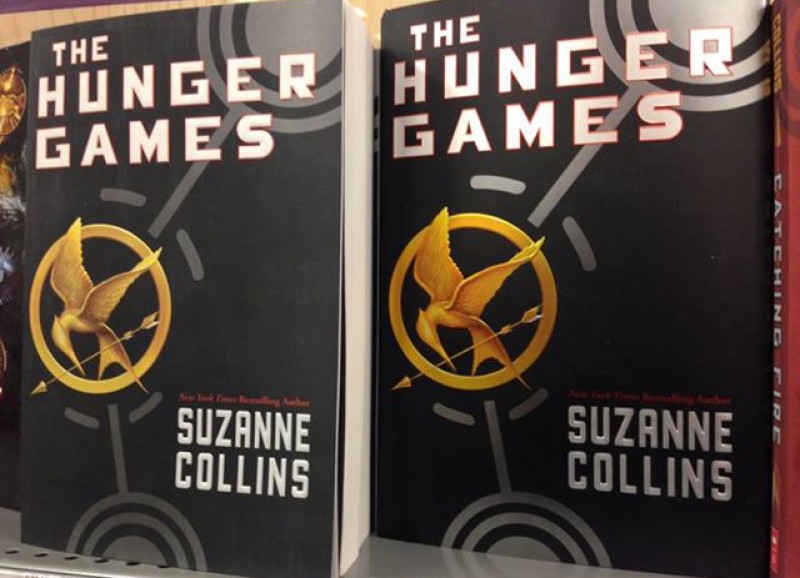
Movie Review – The Hunger Games Series Thus Far

Happy Sunday Bookshelf Battlers!  May the bookshelves be ever in your favor…

The Bookshelf Battler (that’s me, I’m just an important person who refers to himself in the third person) saw the latest installment of the blockbuster book based movie franchise, The Hunger Games:  Mockingjay:  Part 1 in an early Thursday night showing.  The place was packed.  People love these movies.

For those unfamiliar with the books and/or movies (I don’t know, maybe you’ve been too busy coal mining in District 12 to follow pop culture), the series takes place in the  chaotic future land of Panem,  where the the snobby rich evildoers who run “the Capitol” bask in luxurious lifestyles built on the backs of the poor laborers who toil away in the Districts.  No, it was not written by Occupy Wall Street.  The story  follows Katniss, played by Jennifer Lawrence in the role that made her career, as she battles the Capitol’s leader, the sinister President Snow (played by Donald Sutherland.  Yes, he’s still alive).

The series begins with the original Hunger Games in which the Capitol revels in watching an annual extreme reality TV show competition – i.e. The Hunger Games.   Every year, all the districts are required to cough up one young male and one young female to compete in a free-for-all, fight to the last person standing competition.

Here is a parody of my conversation with the world when I saw the first film in 2012:

WORLD:  Oh wow!  The Hunger Games is so awesome!  Go Katniss!  Wooo!  Yeah!

ME:  Umm…wait a minute.  Am I the only one who is disturbed by the fact that this is a movie about children murdering other children?

WORLD:  Wow!  Katniss has a burning fire dress!  What a great movie!  Woohoo!

ME:  How did  this even get published?  Did somebody just walk into a publisher’s office and say, “Yeah, hey listen, check it out, I’ve got this great idea for a novel.  It’s the future.  All these kids are thrown into a dome full of guns, machetes, and weapons and they are forced to shoot each other and hack each other to pieces.”

WORLD:  Woohoo!  Great movie!

ME:  I mean, isn’t this pretty much the The Running Man with kids?

WORLD:  Running what?  Shut up!  We’re trying to watch the movie!  Katniss is going to unleash a bunch of futuristic killer bees on some kids!

ME: The Running Man.  It was a very violent 1980’s movie starring Arnold Schwarzennegger and Jesse Ventura.  It was a futuristic game show where convicted criminals were forced to do battle.  Arnold was wrongfully convicted of a crime he didn’t commit and he had to battle his way out of an obstacle course filled with all kinds of evil psychopaths.  It’s like somebody went to Hollywood and said, “Let’s make The Running Man but with kids!”

WORLD:  Shut up.  Those guys were governors.  They weren’t in any movies.

cropped-hunger-games-bookshelf-battle.jpg

But I suppose once you get around the Lord of the Flies-esque nature of the Hunger Games, it isn’t that bad a series.  I noticed that in the sequel, Catching Fire, there is another Hunger Games battle royale in which grown up adult winners of the past games come back to compete.  I hope this means someone, somewhere said, “Hey wait a minute, let’s cool it on the child vs. child killing competitions.”

Eventually, as the series moves along, it becomes less about the competition and more about Katniss becoming a revolutionary freedom fighter, working to take down President Snow’s corrupt government.  In other words, it starts to become a sci-fi action fantasy and that’s a direction that’s easier to get behind.

In Mockingjay: Part I we finally see Katniss come into her own as a symbol of hope for the anti-Capitol uprising.  Lots of action, special effects, and so on.  Overall, it’s a great series of books and despite my above criticisms (what work is without flaws?) I still find them shelf-worthy.

Tagged , , , , , , , , , , , ,

Literary War Quote – 1984 by George Orwell

Bookshelf Battler here, reporting live from the Call of Duty: Advanced Warfare battlefront.  I have to hand it to this game.  Such ultimate realism – the sights, the sounds, the blasts, the getting shot twenty times and then hiding behind a corner until you get better – ok, so maybe the realism factor isn’t all that high but still it is an all around A+ game.

This week I’m celebrating this game with a tie-in to literary war quotes – mentions in literature about that most necessary (or unnecessary?) of all evils – war.  War.  Ungh.  Goo God yah huh – what’s it even good for?  Absolutely nothin.’

In 1984, (the book, not the year that happened thirty years ago – hey what do you know, Happy Anniversary 1984!) by George Orwell, a vivid portrait the ultimate police state is created, so much so that the novel gave rise to the phrase, “Big Brother is watching you.”

What did this book have to say about violence – as in organized violence ,or in other words, war?  Check it out:

“Those who abjure violence can only do so by others committing violence on their behalf.”  – George Orwell, 1984

Don’t be fooled by the catchy use of the word, “Battle” in the title of this blog.  I’m all for peace, happiness, and tranquility.  But George makes a good point.  Constant threats abound – both from criminal degenerates at home and terrorists abroad.  We are able to sit around and type on our blogs, drink our Mountain Dew, and play our video games because “rough men,” i.e. police and soldiers are taking up arms on our behalf and keeping the bad guys at bay.  Here’s what else George had to say on the subject:

“People sleep peacefully in their beds only because rough men stand ready to do violence on their behalf.”  – George Orwell, 1984

My opinion, police and military types often get a bad rap.  They’re often portrayed in pop culture  as savages, jerks, people on a power trip who just enjoy committing acts of violence and while I suppose there will always be a few bad apples in any bunch, we have to be honest with ourselves and realize that we are able to live peaceful lives because the government employs “rough men” (and hey – even “rough women!” to fight on our behalf.

This concept was further immortalized in the 1992 military courtroom drama film, A Few Good Men.  Remember the character Col. Nathan Jessup played by Jack Nicholson?  Here’s the direct quote of his infamous “You Can’t Handle the Truth!” speech:

“Son, we live in a world that has walls, and those walls have to be guarded by men with guns.  Who’s gonna do it?  You?  You, Lt. Weinburg?  I have a greater responsibility than you could possibly fathom.  You weep for Santiago and you curse the Marines.  You have that luxury.  You have the luxury of not knowing what I know – that Santiago’s death, while tragic, probably saved lives.  And my existence, while grotesque and incomprehensible to you, saves lives.  You don’t want the truth because deep down in places you don’t talk about at parties, you want me on that wall, you need me on that wall.  We use words like honor, code, loyalty.  We used these words as the backbone of a life spent defending something.  You use them as a punchline.  I have neither the time nor the inclination to explain myself to a man who rises and sleeps under the blanket of the very freedom that I provide and then questions the manner in which I provide it.  I would rather you just said thank you, and went on your way.  Otherwise, I suggest you pick up a weapon and stand a post.  Either way, I don’t give a damn what you think you are entitled to.”  – Jack Nicholson as Col. Nathan Jessup in A Few Good Men

Well, maybe this is not the best example since Jessup was the bad guy in the film but overall, the main point – if you feel the need to criticize police and the military for being “rough men,” try to also keep in mind that their “roughness” is very much needed.

And don’t forget – my Call of Duty character will be exploded 50 times tonight by frag grenades, many of which I tossed accidentally at my own feet, so that you can play peaceful video games like Mario Kart and Minecraft.

Full disclosure – I have to give props to NBC’s The Blacklist because Raymond “Red” Reddington used Orwell’s quote in this week’s episode.  When I heard it, I was like, “Thank you, James Spader!  There’s a blog post!”

In conclusion – don’t forget to subscribe to this blog and follow @bookshelfbattle.com on Twitter.

And if you’re a Walking Dead fan – stop by Sunday night to discuss the latest episode!  What is Carol going to do as a patient at the evil hospital, anyway?

Tagged , , , , , , , , , , , , , , , , , , , , , , , , , , , , , , , ,

Literary War Quotes

In honor of my latest obsession with Call of Duty, I’ve decided that this week will be a week of literary war quotes.  Throughout the week on bookshelfbattle.com there will be quotes from books, characters, and authors and each will provide a different perspective of war.

Here’s today’s quote:

“A small but noteworthy note. I’ve seen so many young men over the years who think they’re running at other young men. They are not. They are running at me.” – Death, the Narrator of The Book Thief by Markus Zusak.

Have you ever read The Book Thief?  I haven’t but have seen the film and enjoyed it.  The use of Death as the narrator was an original, unconventional idea that worked.  It was set during World War II, which was, after all, a very busy time for the Grim Reaper.  Essentially, what the author is trying to convey here is that soldiers often think they are going up against the opposing army but ultimately, they’re engaged in an activity that is just going to bring death upon them way too soon.

To state the obvious, war sucks.  This will be a constant theme of the literary war quotes we will explore.

Tune in tomorrow folks.  Same Bat Time.  Same Bat Channel.

Tagged , , , , , , , , , , , , , , , ,

Happy Halloween

Boo! (k) s

Happy Halloween, everyone.  The Bookshelf Battle month of Halloween literature has cruised along non-stop but alas, it must come to an end, for the Fall/Winter tradition of America is as follows:

  • October – Celebrate Death
  • November – Stuff face with game bird
  • December – Celebrate Jesus’ Birthday by Asking a Fat Man to Bring Us High-End Electronics that will be obsolete by Valentine’s Day

Seventeen days of Halloween literature posts – bringing you discussions of horror classics, zombie fiction, vampires, ghosts, ghouls, goblins, and more!

Plus, I tweeted Edgar Allan Poe’s “The Raven” in its entirety!  No one has ever been that a) awesome or b) stupid or c) had a desire to waste time in such a ridiculous manner before.  Check it out at #tweettheraven and as always feel free to follow me @bookshelfbattle

Alas, starting tomorrow I’ll have to leave the horror fiction fest behind but – is there really any good Thanksgiving fiction?  Hmmm…maybe I’ll have to divebomb straight into Christmas fiction.

After all, this is that odd time of year where you walk into the store to find a) half-off clearance on psycho zombie masks next to b) Rudolph and Santa Claus paraphernalia, wrapping paper, candy canes and so on.

Thanks for reading, fellow bookshelf battlers.  Until next time, this is the proprietor of an underappreciated book blog signing off.

Tagged , , , , , , , , , , , , , ,

Public Domain Horror Fiction – The Monkey’s Paw by W.W. Jacobs

Readers, if there’s one lesson you ever learn from this humble book blog, I hope it is this one:

Never make a deal with something or someone evil.

You scoff but you know it is true.  Ask a source of evil to make you win the lottery and you will…only to get hit by a bus on the way to cash in the ticket.  Evil has one of the twisted view of irony ever known.

So tonight, in bookshelfbattle.com ‘s ongoing Public Domain Horror Fiction Series, check out the short story, The Monkey’s Paw by W.W. Jacobs, first published in the early 1900’s.  Short summary – A couple and their adult son find a Monkey’s Paw from India.  Supposedly, it has the power to grant wishes.  Sadly, they learn the hard way that with their wishes comes evil irony.

https://www.gutenberg.org/files/12122/12122-h/12122-h.htm

“The other two wishes,” she replied rapidly. “We’ve only had one.”
“Was not that enough?” he demanded fiercely.
“No,” she cried, triumphantly; “we’ll have one more. Go down and get it quickly, and wish our boy alive again.”

– W.W. Jacobs, The Monkey’s Paw

Tagged , , , , , , , , , , , , , , , , , ,

Full Text of “The Masque of the Red Death” by Edgar Allan Poe

Bookshelfbattle.com ‘s Halloween Literature Extravaganza continues with the Full Text of Edgar Allan Poe’s 1842 short story – “The Masque of the Red Death” below.

When I have more time, I hope to provide some analysis of this, The Tell-Tale Heart and of course, The Raven.  Seeing that West Africa is currently suffering from an Ebola crisis that has the rest of the world experiencing anxiety, the story below is chillingly apropos.

Bonus points for using “apropos” in a sentence.

THE MASQUE OF THE RED DEATH

BY: EDGAR ALLAN POE

FIRST PUBLISHED – 1842

The “Red Death” had long devastated the country. No pestilence had ever been so fatal, or so hideous. Blood was its Avatar and its seal –the redness and the horror of blood. There were sharp pains, and sudden dizziness, and then profuse bleeding at the pores, with dissolution. The scarlet stains upon the body and especially upon the face of the victim, were the pest ban which shut him out from the aid and from the sympathy of his fellow-men. And the whole seizure, progress and termination of the disease, were the incidents of half an hour.

But the Prince Prospero was happy and dauntless and sagacious. When his dominions were half depopulated, he summoned to his presence a thousand hale and light-hearted friends from among the knights and dames of his court, and with these retired to the deep seclusion of one of his castellated abbeys. This was an extensive and magnificent structure, the creation of the prince’s own eccentric yet august taste. A strong and lofty wall girdled it in. This wall had gates of iron. The courtiers, having entered, brought furnaces and massy hammers and welded the bolts. They resolved to leave means neither of ingress or egress to the sudden impulses of despair or of frenzy from within. The abbey was amply provisioned. With such precautions the courtiers might bid defiance to contagion. The external world could take care of itself. In the meantime it was folly to grieve, or to think. The prince had provided all the appliances of pleasure. There were buffoons, there were improvisatori, there were ballet-dancers, there were musicians, there was Beauty, there was wine. All these and security were within. Without was the “Red Death.”

It was toward the close of the fifth or sixth month of his seclusion, and while the pestilence raged most furiously abroad, that the Prince Prospero entertained his thousand friends at a masked ball of the most unusual magnificence.

It was a voluptuous scene, that masquerade. But first let me tell of the rooms in which it was held. There were seven –an imperial suite. In many palaces, however, such suites form a long and straight vista, while the folding doors slide back nearly to the walls on either hand, so that the view of the whole extent is scarcely impeded. Here the case was very different; as might have been expected from the duke’s love of the bizarre. The apartments were so irregularly disposed that the vision embraced but little more than one at a time. There was a sharp turn at every twenty or thirty yards, and at each turn a novel effect. To the right and left, in the middle of each wall, a tall and narrow Gothic window looked out upon a closed corridor which pursued the windings of the suite. These windows were of stained glass whose color varied in accordance with the prevailing hue of the decorations of the chamber into which it opened. That at the eastern extremity was hung, for example, in blue –and vividly blue were its windows. The second chamber was purple in its ornaments and tapestries, and here the panes were purple. The third was green throughout, and so were the casements. The fourth was furnished and lighted with orange –the fifth with white –the sixth with violet. The seventh apartment was closely shrouded in black velvet tapestries that hung all over the ceiling and down the walls, falling in heavy folds upon a carpet of the same material and hue. But in this chamber only, the color of the windows failed to correspond with the decorations. The panes here were scarlet –a deep blood color. Now in no one of the seven apartments was there any lamp or candelabrum, amid the profusion of golden ornaments that lay scattered to and fro or depended from the roof. There was no light of any kind emanating from lamp or candle within the suite of chambers. But in the corridors that followed the suite, there stood, opposite to each window, a heavy tripod, bearing a brazier of fire that protected its rays through the tinted glass and so glaringly illumined the room. And thus were produced a multitude of gaudy and fantastic appearances. But in the western or black chamber the effect of the fire-light that streamed upon the dark hangings through the blood-tinted panes, was ghastly in the extreme, and produced so wild a look upon the countenances of those who entered, that there were few of the company bold enough to set foot within its precincts at all.

It was in this apartment, also, that there stood against the western wall, a gigantic clock of ebony. Its pendulum swung to and fro with a dull, heavy, monotonous clang; and when the minute-hand made the circuit of the face, and the hour was to be stricken, there came from the brazen lungs of the clock a sound which was clear and loud and deep and exceedingly musical, but of so peculiar a note and emphasis that, at each lapse of an hour, the musicians of the orchestra were constrained to pause, momentarily, in their performance, to hearken to the sound; and thus the waltzers perforce ceased their evolutions; and there was a brief disconcert of the whole gay company; and, while the chimes of the clock yet rang, it was observed that the giddiest grew pale, and the more aged and sedate passed their hands over their brows as if in confused reverie or meditation. But when the echoes had fully ceased, a light laughter at once pervaded the assembly; the musicians looked at each other and smiled as if at their own nervousness and folly, and made whispering vows, each to the other, that the next chiming of the clock should produce in them no similar emotion; and then, after the lapse of sixty minutes, (which embrace three thousand and six hundred seconds of the Time that flies,) there came yet another chiming of the clock, and then were the same disconcert and tremulousness and meditation as before.

But, in spite of these things, it was a gay and magnificent revel. The tastes of the duke were peculiar. He had a fine eye for colors and effects. He disregarded the decora of mere fashion. His plans were bold and fiery, and his conceptions glowed with barbaric lustre. There are some who would have thought him mad. His followers felt that he was not. It was necessary to hear and see and touch him to be sure that he was not.

He had directed, in great part, the movable embellishments of the seven chambers, upon occasion of this great fete; and it was his own guiding taste which had given character to the masqueraders. Be sure they were grotesque. There were much glare and glitter and piquancy and phantasm –much of what has been since seen in “Hernani.” There were arabesque figures with unsuited limbs and appointments. There were delirious fancies such as the madman fashions. There was much of the beautiful, much of the wanton, much of the bizarre, something of the terrible, and not a little of that which might have excited disgust. To and fro in the seven chambers there stalked, in fact, a multitude of dreams. And these –the dreams –writhed in and about, taking hue from the rooms, and causing the wild music of the orchestra to seem as the echo of their steps. And, anon, there strikes the ebony clock which stands in the hall of the velvet. And then, for a moment, all is still, and all is silent save the voice of the clock. The dreams are stiff-frozen as they stand. But the echoes of the chime die away –they have endured but an instant –and a light, half-subdued laughter floats after them as they depart. And now again the music swells, and the dreams live, and writhe to and fro more merrily than ever, taking hue from the many-tinted windows through which stream the rays from the tripods. But to the chamber which lies most westwardly of the seven, there are now none of the maskers who venture; for the night is waning away; and there flows a ruddier light through the blood-colored panes; and the blackness of the sable drapery appals; and to him whose foot falls upon the sable carpet, there comes from the near clock of ebony a muffled peal more solemnly emphatic than any which reaches their ears who indulge in the more remote gaieties of the other apartments.

But these other apartments were densely crowded, and in them beat feverishly the heart of life. And the revel went whirlingly on, until at length there commenced the sounding of midnight upon the clock. And then the music ceased, as I have told; and the evolutions of the waltzers were quieted; and there was an uneasy cessation of all things as before. But now there were twelve strokes to be sounded by the bell of the clock; and thus it happened, perhaps, that more of thought crept, with more of time, into the meditations of the thoughtful among those who revelled. And thus, too, it happened, perhaps, that before the last echoes of the last chime had utterly sunk into silence, there were many individuals in the crowd who had found leisure to become aware of the presence of a masked figure which had arrested the attention of no single individual before. And the rumor of this new presence having spread itself whisperingly around, there arose at length from the whole company a buzz, or murmur, expressive of disapprobation and surprise –then, finally, of terror, of horror, and of disgust.

In an assembly of phantasms such as I have painted, it may well be supposed that no ordinary appearance could have excited such sensation. In truth the masquerade license of the night was nearly unlimited; but the figure in question had out-Heroded Herod, and gone beyond the bounds of even the prince’s indefinite decorum. There are chords in the hearts of the most reckless which cannot be touched without emotion. Even with the utterly lost, to whom life and death are equally jests, there are matters of which no jest can be made. The whole company, indeed, seemed now deeply to feel that in the costume and bearing of the stranger neither wit nor propriety existed. The figure was tall and gaunt, and shrouded from head to foot in the habiliments of the grave. The mask which concealed the visage was made so nearly to resemble the countenance of a stiffened corpse that the closest scrutiny must have had difficulty in detecting the cheat. And yet all this might have been endured, if not approved, by the mad revellers around. But the mummer had gone so far as to assume the type of the Red Death. His vesture was dabbled in blood –and his broad brow, with all the features of the face, was besprinkled with the scarlet horror.

When the eyes of Prince Prospero fell upon this spectral image (which with a slow and solemn movement, as if more fully to sustain its role, stalked to and fro among the waltzers) he was seen to be convulsed, in the first moment with a strong shudder either of terror or distaste; but, in the next, his brow reddened with rage.

“Who dares?” he demanded hoarsely of the courtiers who stood near him –“who dares insult us with this blasphemous mockery? Seize him and unmask him –that we may know whom we have to hang at sunrise, from the battlements!”

It was in the eastern or blue chamber in which stood the Prince Prospero as he uttered these words. They rang throughout the seven rooms loudly and clearly –for the prince was a bold and robust man, and the music had become hushed at the waving of his hand.

It was in the blue room where stood the prince, with a group of pale courtiers by his side. At first, as he spoke, there was a slight rushing movement of this group in the direction of the intruder, who at the moment was also near at hand, and now, with deliberate and stately step, made closer approach to the speaker. But from a certain nameless awe with which the mad assumptions of the mummer had inspired the whole party, there were found none who put forth hand to seize him; so that, unimpeded, he passed within a yard of the prince’s person; and, while the vast assembly, as if with one impulse, shrank from the centres of the rooms to the walls, he made his way uninterruptedly, but with the same solemn and measured step which had distinguished him from the first, through the blue chamber to the purple –through the purple to the green –through the green to the orange –through this again to the white –and even thence to the violet, ere a decided movement had been made to arrest him. It was then, however, that the Prince Prospero, maddening with rage and the shame of his own momentary cowardice, rushed hurriedly through the six chambers, while none followed him on account of a deadly terror that had seized upon all. He bore aloft a drawn dagger, and had approached, in rapid impetuosity, to within three or four feet of the retreating figure, when the latter, having attained the extremity of the velvet apartment, turned suddenly and confronted his pursuer. There was a sharp cry –and the dagger dropped gleaming upon the sable carpet, upon which, instantly afterwards, fell prostrate in death the Prince Prospero. Then, summoning the wild courage of despair, a throng of the revellers at once threw themselves into the black apartment, and, seizing the mummer, whose tall figure stood erect and motionless within the shadow of the ebony clock, gasped in unutterable horror at finding the grave-cerements and corpse-like mask which they handled with so violent a rudeness, untenanted by any tangible form.

And now was acknowledged the presence of the Red Death. He had come like a thief in the night. And one by one dropped the revellers in the blood-bedewed halls of their revel, and died each in the despairing posture of his fall. And the life of the ebony clock went out with that of the last of the gay. And the flames of the tripods expired. And Darkness and Decay and the Red Death held illimitable dominion over all.

Tagged , , , , , , , , , , , ,

Text of “The Tell-Tale Heart” by Edgar Allan Poe

Not to make this a Poe-fest, but he was the Father of American Gothic Horror, after all.  Bookshelfbattle.com ‘s Halloween festivities continue with the full text of The Tell-Tale Heart by Edgar Allen Poe in its entirety:

THE TELL-TALE HEART

BY: EDGAR ALLAN POE

1843 

TRUE! –nervous –very, very dreadfully nervous I had been and am; but why will you say that I am mad? The disease had sharpened my senses –not destroyed –not dulled them. Above all was the sense of hearing acute. I heard all things in the heaven and in the earth. I heard many things in hell. How, then, am I mad? Hearken! and observe how healthily –how calmly I can tell you the whole story.

It is impossible to say how first the idea entered my brain; but once conceived, it haunted me day and night. Object there was none. Passion there was none. I loved the old man. He had never wronged me. He had never given me insult. For his gold I had no desire. I think it was his eye! yes, it was this! He had the eye of a vulture –a pale blue eye, with a film over it. Whenever it fell upon me, my blood ran cold; and so by degrees –very gradually –I made up my mind to take the life of the old man, and thus rid myself of the eye forever.

Now this is the point. You fancy me mad. Madmen know nothing. But you should have seen me. You should have seen how wisely I proceeded –with what caution –with what foresight –with what dissimulation I went to work! I was never kinder to the old man than during the whole week before I killed him. And every night, about midnight, I turned the latch of his door and opened it –oh so gently! And then, when I had made an opening sufficient for my head, I put in a dark lantern, all closed, closed, that no light shone out, and then I thrust in my head. Oh, you would have laughed to see how cunningly I thrust it in! I moved it slowly –very, very slowly, so that I might not disturb the old man’s sleep. It took me an hour to place my whole head within the opening so far that I could see him as he lay upon his bed. Ha! would a madman have been so wise as this, And then, when my head was well in the room, I undid the lantern cautiously-oh, so cautiously –cautiously (for the hinges creaked) –I undid it just so much that a single thin ray fell upon the vulture eye. And this I did for seven long nights –every night just at midnight –but I found the eye always closed; and so it was impossible to do the work; for it was not the old man who vexed me, but his Evil Eye. And every morning, when the day broke, I went boldly into the chamber, and spoke courageously to him, calling him by name in a hearty tone, and inquiring how he has passed the night. So you see he would have been a very profound old man, indeed, to suspect that every night, just at twelve, I looked in upon him while he slept.

Upon the eighth night I was more than usually cautious in opening the door. A watch’s minute hand moves more quickly than did mine. Never before that night had I felt the extent of my own powers –of my sagacity. I could scarcely contain my feelings of triumph. To think that there I was, opening the door, little by little, and he not even to dream of my secret deeds or thoughts. I fairly chuckled at the idea; and perhaps he heard me; for he moved on the bed suddenly, as if startled. Now you may think that I drew back –but no. His room was as black as pitch with the thick darkness, (for the shutters were close fastened, through fear of robbers,) and so I knew that he could not see the opening of the door, and I kept pushing it on steadily, steadily.

I had my head in, and was about to open the lantern, when my thumb slipped upon the tin fastening, and the old man sprang up in bed, crying out –“Who’s there?”

I kept quite still and said nothing. For a whole hour I did not move a muscle, and in the meantime I did not hear him lie down. He was still sitting up in the bed listening; –just as I have done, night after night, hearkening to the death watches in the wall.

Presently I heard a slight groan, and I knew it was the groan of mortal terror. It was not a groan of pain or of grief –oh, no! –it was the low stifled sound that arises from the bottom of the soul when overcharged with awe. I knew the sound well. Many a night, just at midnight, when all the world slept, it has welled up from my own bosom, deepening, with its dreadful echo, the terrors that distracted me. I say I knew it well. I knew what the old man felt, and pitied him, although I chuckled at heart. I knew that he had been lying awake ever since the first slight noise, when he had turned in the bed. His fears had been ever since growing upon him. He had been trying to fancy them causeless, but could not. He had been saying to himself –“It is nothing but the wind in the chimney –it is only a mouse crossing the floor,” or “It is merely a cricket which has made a single chirp.” Yes, he had been trying to comfort himself with these suppositions: but he had found all in vain. All in vain; because Death, in approaching him had stalked with his black shadow before him, and enveloped the victim. And it was the mournful influence of the unperceived shadow that caused him to feel –although he neither saw nor heard –to feel the presence of my head within the room.

When I had waited a long time, very patiently, without hearing him lie down, I resolved to open a little –a very, very little crevice in the lantern. So I opened it –you cannot imagine how stealthily, stealthily –until, at length a simple dim ray, like the thread of the spider, shot from out the crevice and fell full upon the vulture eye.

It was open –wide, wide open –and I grew furious as I gazed upon it. I saw it with perfect distinctness –all a dull blue, with a hideous veil over it that chilled the very marrow in my bones; but I could see nothing else of the old man’s face or person: for I had directed the ray as if by instinct, precisely upon the damned spot.

And have I not told you that what you mistake for madness is but over-acuteness of the sense? –now, I say, there came to my ears a low, dull, quick sound, such as a watch makes when enveloped in cotton. I knew that sound well, too. It was the beating of the old man’s heart. It increased my fury, as the beating of a drum stimulates the soldier into courage.

But even yet I refrained and kept still. I scarcely breathed. I held the lantern motionless. I tried how steadily I could maintain the ray upon the eve. Meantime the hellish tattoo of the heart increased. It grew quicker and quicker, and louder and louder every instant. The old man’s terror must have been extreme! It grew louder, I say, louder every moment! –do you mark me well I have told you that I am nervous: so I am. And now at the dead hour of the night, amid the dreadful silence of that old house, so strange a noise as this excited me to uncontrollable terror. Yet, for some minutes longer I refrained and stood still. But the beating grew louder, louder! I thought the heart must burst. And now a new anxiety seized me –the sound would be heard by a neighbour! The old man’s hour had come! With a loud yell, I threw open the lantern and leaped into the room. He shrieked once –once only. In an instant I dragged him to the floor, and pulled the heavy bed over him. I then smiled gaily, to find the deed so far done. But, for many minutes, the heart beat on with a muffled sound. This, however, did not vex me; it would not be heard through the wall. At length it ceased. The old man was dead. I removed the bed and examined the corpse. Yes, he was stone, stone dead. I placed my hand upon the heart and held it there many minutes. There was no pulsation. He was stone dead. His eve would trouble me no more.

If still you think me mad, you will think so no longer when I describe the wise precautions I took for the concealment of the body. The night waned, and I worked hastily, but in silence. First of all I dismembered the corpse. I cut off the head and the arms and the legs.

I then took up three planks from the flooring of the chamber, and deposited all between the scantlings. I then replaced the boards so cleverly, so cunningly, that no human eye –not even his –could have detected any thing wrong. There was nothing to wash out –no stain of any kind –no blood-spot whatever. I had been too wary for that. A tub had caught all –ha! ha!

When I had made an end of these labors, it was four o’clock –still dark as midnight. As the bell sounded the hour, there came a knocking at the street door. I went down to open it with a light heart, –for what had I now to fear? There entered three men, who introduced themselves, with perfect suavity, as officers of the police. A shriek had been heard by a neighbour during the night; suspicion of foul play had been aroused; information had been lodged at the police office, and they (the officers) had been deputed to search the premises.

I smiled, –for what had I to fear? I bade the gentlemen welcome. The shriek, I said, was my own in a dream. The old man, I mentioned, was absent in the country. I took my visitors all over the house. I bade them search –search well. I led them, at length, to his chamber. I showed them his treasures, secure, undisturbed. In the enthusiasm of my confidence, I brought chairs into the room, and desired them here to rest from their fatigues, while I myself, in the wild audacity of my perfect triumph, placed my own seat upon the very spot beneath which reposed the corpse of the victim.

The officers were satisfied. My manner had convinced them. I was singularly at ease. They sat, and while I answered cheerily, they chatted of familiar things. But, ere long, I felt myself getting pale and wished them gone. My head ached, and I fancied a ringing in my ears: but still they sat and still chatted. The ringing became more distinct: –It continued and became more distinct: I talked more freely to get rid of the feeling: but it continued and gained definiteness –until, at length, I found that the noise was not within my ears.

No doubt I now grew very pale; –but I talked more fluently, and with a heightened voice. Yet the sound increased –and what could I do? It was a low, dull, quick sound –much such a sound as a watch makes when enveloped in cotton. I gasped for breath –and yet the officers heard it not. I talked more quickly –more vehemently; but the noise steadily increased. I arose and argued about trifles, in a high key and with violent gesticulations; but the noise steadily increased. Why would they not be gone? I paced the floor to and fro with heavy strides, as if excited to fury by the observations of the men –but the noise steadily increased. Oh God! what could I do? I foamed –I raved –I swore! I swung the chair upon which I had been sitting, and grated it upon the boards, but the noise arose over all and continually increased. It grew louder –louder –louder! And still the men chatted pleasantly, and smiled. Was it possible they heard not? Almighty God! –no, no! They heard! –they suspected! –they knew! –they were making a mockery of my horror!-this I thought, and this I think. But anything was better than this agony! Anything was more tolerable than this derision! I could bear those hypocritical smiles no longer! I felt that I must scream or die! and now –again! –hark! louder! louder! louder! louder!

“Villains!” I shrieked, “dissemble no more! I admit the deed! –tear up the planks! here, here! –It is the beating of his hideous heart!”

Tagged , , , , , , , , , , ,

Public Domain Horror Fiction – Dr. Jekyll and Mr. Hyde

Calm and content one moment, a ball of rage the next – hasn’t everyone felt this way at one time or another?  The Strange Case of Dr. Jekyll and Mr. Hyde by Robert Louis Stevenson is a tale of conflicting emotions run amock.  It’s a story of how anger can boil under the surface of any otherwise seemingly reasonable man.

Not only that, but it is totally the precursor to The Incredible Hulk.

Enjoy this version brought to you by Project Gutenberg:

http://www.gutenberg.org/ebooks/42

“With every day, and from both sides of my intelligence, the moral and the intellectual, I thus drew steadily nearer to the truth, by whose partial discovery I have been doomed to such a dreadful shipwreck: that man is not truly one, but truly two.” – Robert Louis Stevenson, The Strange Case of Dr. Jekyll and Mr. Hyde.

Bookshelf Battlers, thank you for joining in the discussion.  The Public Domain Horror Fiction posts have really started a nice surge of viewer stats, so please feel free to share with friends.  And don’t forget my twitter hashtag – #tweettheraven where I’ll be posting Edgar Allan Poe’s The Raven all month.  Follow @bookshelfbattle for more booktastic news.

Tagged , , , , , , , , ,