Tag Archives: book bloggers

Self Publishing – Thoughts?

I find myself intrigued lately about the idea of self publishing.  It amazes me that the technology is there to write a book, edit it, package it up and distribute it online through Amazon, iBooks, Smashwords, wherever.  My NanoWriMo book, originally started a few weeks ago as a fun hobby, has become a preoccupation – something I’ve been laboring away at and I really don’t want to give it up.

First of all, it is a long way away from being in readable form.  And obviously, I’d like to try the get an agent and find a traditional publisher route first.

But I have to admit, the self publishing possibility is like a security blanket for me.  The idea that if the inevitable rejections come in, I could, at the very least put the book out there and who knows what happens after that but at least I’d be able to cross a big life’s goal off the ole bucket list.  If only 5 people read it, so be it.  At least it didn’t collect dust.

Does anyone have any self publishing success stories?  Any self publishing nightmares?  Any thoughts, tips, comments, etc.?  It is a topic I’d love to learn more about so please feel free to share.

Some questions of the top of my head:

1)  Where to find a good editor?  Someone who can read through the book, correct errors, give me ideas on how to make it better.

2)  Where to find a cover artist?  I feel like covers have so little to do with the book and yet they can make or break the book.  They can make the book awesome, make readers go, “Wow, I need to read that!” or they can make a good book look cheap, like it was produced by some fly by night operation if they aren’t produced well.

3)  Suppose I wanted to build a fan site for the book.  Where could I find some artists to draw some quality pictures of different characters to post on the site?

4)  Promotions – any ideas?

Thanks in advance,

Bookshelf Battler

Tagged , , , , , , , , , , , , ,

A Christmas Carol by Charles Dickens – Public Domain Copy

Ho ho ho, Merry Christmas Bookshelf Battlers!  ‘Tis the season to be ready!  (You are not supposed to read the word “ready” as in “being prepared” but “reedy” as in, being a person who likes to read.  Nevermind).

It has been tough keeping up the old Bookshelf Battle blog (follow along on twitter @bookshelfbattle ) lately.  I’ve been writing up a storm on a book idea I have and unfortunately I have limited time, so the little time I do get I’d rather spending working on that than posting here, though I wish I could do both.

It’s been ages since I’ve done a book review.  That’s sad, since that’s what this blog is all about.  But one goal I have is to also promote the classics, especially those in the public domain that belong to the ages.

So without further ado, here is a link to Project Gutenberg’s version of A Christmas Carol by Charles Dickens – the story of hard working Ebenezer Scrooge, an evil one-percenter who made his gold shillings off the backs of the poor, and was happy to do so until three liberal bleeding heart ghosts guilted him into spreading his loot around.

OK, so maybe the story doesn’t work well with modern terminology, but enjoy anyway!

http://www.gutenberg.org/ebooks/46

Tagged , , , , , , , , , , ,

Happy Thanksgiving!

I’ve racked my brains and I can’t think of a good example of a work of Thanksgiving literature – not a book, a short story, a poem, nothing.  Someone mention one in the comment section and tell me I’m wrong.  I love Thanksgiving, but while Christmas has inspired a slew of tales about people either saving, learning the meaning of, or trying to get home in time for Christmas, there just aren’t as many tales about Thanksgiving.

After all, what would be the characters’ motivation?

CHARACTER 1:  We have to get home in time for Thanksgiving!

CHARACTER 2:  Why?  Will the world come to an end?

CHARACTER 1:  No!  But we’ll eat late!

So rather than wow you with Thanksgiving literature, I’ve decided to share some of the things I’m thankful this year.  I began this blog in March and started blogging semi-regularly in August.  Since then:

  • Several fellow WordPressers have subscribed.  (You should too if you haven’t already.
  • Over 1700 Twits have followed me on Twitter.  (And why haven’t you yet?  @bookshelfbattle
  • I’ve been inspired by NaNoWriMo (National Novel Writing Month) to jot down twenty-thousand words.  I won’t make the 50,000 goal, but that’s 20,000 more words than I had.
  • I haven’t done as many book reviews as I’d hoped (yes, I know, THIS IS A BOOK REVIEW BLOG)  but I’ve inspired to read more books than I usually did pre-blog.
  • I’ve almost written 100 posts.  Anyone with ideas for the 100th post feel free to share.

So ultimately, Bookshelf Battlers, I’m thankful for all of you.  Keep following, re-tweeting, and giving me those sweet, sweet web hits.  Click on this site, then don’t be stingy with those clicks, click a few more times.  I’m looking forward to a 2015 full of booktastic good cheer and many more literary discussions of a booktacular nature.

And I promise – I’ll do an actual book review.  (Fingers crossed behind back).

Tagged , , , , , , , , , , , ,

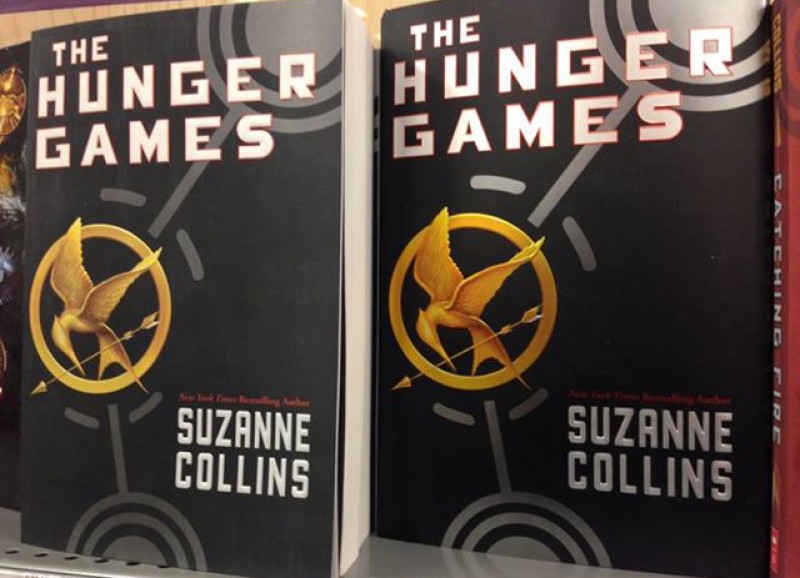
Movie Review – The Hunger Games Series Thus Far

Happy Sunday Bookshelf Battlers!  May the bookshelves be ever in your favor…

The Bookshelf Battler (that’s me, I’m just an important person who refers to himself in the third person) saw the latest installment of the blockbuster book based movie franchise, The Hunger Games:  Mockingjay:  Part 1 in an early Thursday night showing.  The place was packed.  People love these movies.

For those unfamiliar with the books and/or movies (I don’t know, maybe you’ve been too busy coal mining in District 12 to follow pop culture), the series takes place in the  chaotic future land of Panem,  where the the snobby rich evildoers who run “the Capitol” bask in luxurious lifestyles built on the backs of the poor laborers who toil away in the Districts.  No, it was not written by Occupy Wall Street.  The story  follows Katniss, played by Jennifer Lawrence in the role that made her career, as she battles the Capitol’s leader, the sinister President Snow (played by Donald Sutherland.  Yes, he’s still alive).

The series begins with the original Hunger Games in which the Capitol revels in watching an annual extreme reality TV show competition – i.e. The Hunger Games.   Every year, all the districts are required to cough up one young male and one young female to compete in a free-for-all, fight to the last person standing competition.

Here is a parody of my conversation with the world when I saw the first film in 2012:

WORLD:  Oh wow!  The Hunger Games is so awesome!  Go Katniss!  Wooo!  Yeah!

ME:  Umm…wait a minute.  Am I the only one who is disturbed by the fact that this is a movie about children murdering other children?

WORLD:  Wow!  Katniss has a burning fire dress!  What a great movie!  Woohoo!

ME:  How did  this even get published?  Did somebody just walk into a publisher’s office and say, “Yeah, hey listen, check it out, I’ve got this great idea for a novel.  It’s the future.  All these kids are thrown into a dome full of guns, machetes, and weapons and they are forced to shoot each other and hack each other to pieces.”

WORLD:  Woohoo!  Great movie!

ME:  I mean, isn’t this pretty much the The Running Man with kids?

WORLD:  Running what?  Shut up!  We’re trying to watch the movie!  Katniss is going to unleash a bunch of futuristic killer bees on some kids!

ME: The Running Man.  It was a very violent 1980’s movie starring Arnold Schwarzennegger and Jesse Ventura.  It was a futuristic game show where convicted criminals were forced to do battle.  Arnold was wrongfully convicted of a crime he didn’t commit and he had to battle his way out of an obstacle course filled with all kinds of evil psychopaths.  It’s like somebody went to Hollywood and said, “Let’s make The Running Man but with kids!”

WORLD:  Shut up.  Those guys were governors.  They weren’t in any movies.

cropped-hunger-games-bookshelf-battle.jpg

But I suppose once you get around the Lord of the Flies-esque nature of the Hunger Games, it isn’t that bad a series.  I noticed that in the sequel, Catching Fire, there is another Hunger Games battle royale in which grown up adult winners of the past games come back to compete.  I hope this means someone, somewhere said, “Hey wait a minute, let’s cool it on the child vs. child killing competitions.”

Eventually, as the series moves along, it becomes less about the competition and more about Katniss becoming a revolutionary freedom fighter, working to take down President Snow’s corrupt government.  In other words, it starts to become a sci-fi action fantasy and that’s a direction that’s easier to get behind.

In Mockingjay: Part I we finally see Katniss come into her own as a symbol of hope for the anti-Capitol uprising.  Lots of action, special effects, and so on.  Overall, it’s a great series of books and despite my above criticisms (what work is without flaws?) I still find them shelf-worthy.

Tagged , , , , , , , , , , , ,

Movie Review – Science, Space Exploration and Interstellar (2014)

WARNING:  There are spoilers in this post that stretch the boundaries of space and time.  For every hour you spend reading this, you may actually be receiving seven years of spoilers!

THE BOOKSHELF FROM THE INTERSTELLAR MOVIE

As promised, I’m back with a review of the film Interstellar starring Matthew McConaughey and Anne Hathaway.  Here’s a fun anonomaly:  the other day I posted the text of “Do Not Go Gentle Into That Goodnight” by Dylan Thomas, a poem that features prominently in that film.

There’s a scene at the end that involves messages being sent through space in time via a bookshelf and well, because this blog’s name is “Bookshelf Battle” and I had a post about Interstellar, I saw a surge in web traffic from people googling things like “bookshelf and interstellar” or “what’s the deal with the bookshelf in interstellar?” or similar searches.  Totally coincidental.  I would never purposely try to move traffic to my site by mentioning “bookshelf” and “interstellar” a bunch of times on my site because honestly, what would be the point of going on all day about the bookshelf from the Interstellar movie?  Frankly, it would be ridiculous to keep going on and on about the bookshelf in the Interstellar and to mention the bookshelf from the Interstellar movie would just be a sad attempt to drive up web hits – so believe you me this will be the last time that I’ll mention the bookshelf from the Interstellar movie.

Bookshelf.  Bookshelf.  Bookshelf.  Interstellar.  Interstellar.  Interstellar.

A CONCEIVABLE FUTURE

I’ve noticed a trend in modern science fiction – namely, to introduce inventions that aren’t around today but to do so in a conceivable manner.  The science fiction of the past dreamed of a day with flying cars and people walking around in funny looking aluminum suits.  For some reason, people in the 1950’s thought that aluminum clothing would be very popular by now.

Interstellar presents technology that we don’t have yet, but said technology is relatable given the way it is presented.  For example, the film features robots with artificial intelligence, but they look like walking/talking ATM machines, not metallic humanoids ala Terminator.

Meanwhile, the ship used looks essentially like a larger version of the Space Shuttle rather than the U.S.S. Enterprise.

The premise of the film?  The Earth is on the way out.  Centuries of abuse and excess have withered the planet’s resources, caused widespread blight and famine, and ruined the economy.  McConaughey plays Cooper, a former engineer and NASA test pilot who only briefly dipped his toe into a space exploration career when the world went into a decline.  His community is relatively stable and he eeks out a living as a farmer, living with his two kids, Murph and Tom, and his father-in-law.  His wife died from an ailment that normally would have been treated in better times.

Cooper isn’t a big fan of the farm life – he regrets never having had the chance to explore space and laments that civilization collapsed before he could do so.  Cooper’s father-in-law, played by John Lithgow, is the yin to Cooper’s yang, lecturing him about how “the world is not enough for him” and how that kind of thinking led to the downfall of the human race – i.e. so many people on a planet with a limited supply of resources and each person is never happy with what they have – they always want more.

There’s probably a lesson for world leaders to think about when considering how to best protect and care for the environment.  Also, Cooper training for a career that he never got to have is certainly a problem that many of today’s college graduates can relate to.

A timeframe of when the movie takes place is not provided, though I got the impression it takes places at a time when today’s millenials have become the grandparents, so maybe 2050-2060 or so?  Just a guess.


THE SCIENCE OF SPACE EXPLORATION

Long story short, Dr. Brand, played by Michael Caine, recruits Cooper to use his underutilized pilot skills to go on a desperate mission – fly through a recently discovered wormhole and find a new, habitable planet for the human race.  The humans will probably be good to the new planet for a year or two then proceed to mine and drill the crap out of it all in the name of cheaper iPads and dollar discount Wal-Mart merchandise but that goes beyond the parameters of the film.

He teams up with Anne Hathaway, Dr. Brand’s daughter, who is, herself, another Dr. Brand.  Also, there are two miscellaneous astronauts whose names I neglected to learn because they buy the farm early in the film.

If  you’re a nerd such as myself, you’ve probably thought a lot about space travel.  Though we often think about space travel beyond the moon as being impossible, it isn’t so much impossible as it is improbable.  In a myriad of science fiction movies, Hollywood has portrayed two different ways.  Let’s discuss them along with why they are unlikely:

  • WARP SPEED – Han Solo punches a button and all the stars around the Millenium Falcon stretch out in lines as the ship he won in an intergalactic card game wizzes through them.  The problem?  It would be extremely difficult to drive a ship that fast and not crash into something – a star, an asteroid, a piece of space garbage, something.  The ship would need incredibly accurate sensoring mechanisms and an advanced auto pilot that could maneveur at high-speeds because humans have yet to manage getting out of the grocery store parking lot without bumping into something let alone get around obstacles at mind-bending speeds.


  • HYPERSLEEP – Ripley in Aliens preserves herself in a pod that keeps her body in the same physical shape over the course of a long, multi-year journey.  The ship goes on auto-pilot and drives at a normal pace while the occupants of the ship take a nice, long nap.  The characters in Interstellar actually utilize this technology in the film.  A machine that can actually preserve a body and prevent it from aging would be remarkable, and would have many medical applications in addition to the obvious use in space-exploration but until society figures out a way to not make people wait in an ER waiting room for six hours, there is probably not going to be any headway in such a device anytime soon.

Rather than focus on warp speed or hypersleep technologies, Interstellar takes a look at another means of space travel that has heretofore been unused by Hollywood – the wormhole.  As the film explains, scientists believe that worm holes have the possibly to bend points in space such that a tunnel can be created between them.  (At one point, a character draws a line between two points on a piece of paper, then bends the paper so that the two points meet to illustrate how a worm hole makes it possible to go from one point to another without travelling the long distance of the “straight line” in between.

All of this is theoretical but the movie’s allure is taking all of these highly theoretical concepts and imagining – what if someone actually managed to physically follow through with them?

I applaud the film’s producers for taking all of these hard-boiled, difficult to grasp concepts, typically the stuff that makes the average high school student’s eyes glaze over and fall asleep in science class, and portray them in a very real and tangible manner.

SPACE AND TIME

Also at issue in the film is the concept of differences in the passage of time – i.e. that it is possible for time to move differently at one point than it does at another.  Cooper struggles with making the ultimate sacrifice – namely, that while he is in space, his children are aging and may eventually even surpass him.  At one point, the crew reaches a planet and Cooper is faced with the difficult realization that for every hour he spends on the surface, seven years will pass on Earth.   True to form, at the start of a brief mission to a water logged planet, Murph is just a kid but after the mission, she’s all grown up and played by Jessica Chastain.  Talk about the cat being in the cradle.

INTERSTELLAR AND THE BOOKSHELF AT THE END

I said I wouldn’t mention Interstellar and the bookshelf at the end of the movie and well, I’m not going to, not only to not utilize a cheap method of driving up my web traffic but also because I haven’t decided if this was the film’s “jump the shark” moment or if it was highly creative and imaginative.  You watch.  You decide for yourself.

PARTING THOUGHTS

I’m a big supporter of space exploration but I am a lowly nerd with a book blog so really, my opinion doesn’t amount to a hill of beans.  For me, it was sad to see the Space Shuttle program scrapped in recent years and it boggles my mind that we are paying the Russians millions of dollars to launch our American astronauts into space, especially at a time when the Russians haven’t exactly been playing nice with their neighbors lately.

I think there’s a lot that could be learned from not only localized space exploration (i.e. around the Moon and just above Earth’s orbit) but also deep exploration – i.e. let’s go to Mars!  Hell, if we’re willing to spend the money and are able to find astronauts willing to make the ultimate sacrifice, a mission to fly for ten or twenty years out into space to report findings back to Earth is not impossible.  Improbable, yes but not impossible.

I do get it – the economy is terrible, people can’t find jobs, there are all kinds of wars and turmoil going on in the world and in light of all that it seems selfish to toy around with space.  But as Cooper points out in the film, space exploration technology also usually gives rise to technology that helps out everyday life on Earth, such as the MRI machine.  Perhaps there are discoveries to be made by exploration of planets within our own solar system that could improve the quality of our life.

Or, perhaps Stephen Hawking has a point, namely that maybe there is alien life out there, but maybe we don’t want to know them.  Maybe there are nice aliens who will share all their technology with us and make our lives better.  Or maybe they’ll invade our planet and make us their slaves.

Who knows?  All I know is the film filled me with a sense of wonder about all the possibilities that space exploration has to offer.  Brilliant and uplifting, there was only one part of it that made me sad – that in the future, there will be so many amazing inventions and discoveries and alas, they’ll probably arrive long after I’m gone and I won’t be able to see any of them.

Oh well.  People in 1801 would have marvelled at the iPad, so at least we’ve got that going for us.

Tagged , , , , , , , , , , , , , , , , , , , , , , , , , , ,

Interstellar and “Do Not Go Gentle Into That Good Night”

I saw Interstellar tonight and overall found it very moving and enjoyable.  As soon as I figure out what the hell happened, I’ll give it an actual review.  In the meantime, I wanted to share the text of the poem that featured prominently throughout the film:

DO NOT GO GENTLE INTO THAT GOOD NIGHT

BY: Dylan Thomas

Do not go gentle into that good night,
Old age should burn and rave at close of day;
Rage, rage against the dying of the light.

Though wise men at their end know dark is right,
Because their words had forked no lightning they
Do not go gentle into that good night.

Good men, the last wave by, crying how bright
Their frail deeds might have danced in a green bay,
Rage, rage against the dying of the light.

Wild men who caught and sang the sun in flight,
And learn, too late, they grieved it on its way,
Do not go gentle into that good night.

Grave men, near death, who see with blinding sight
Blind eyes could blaze like meteors and be gay,
Rage, rage against the dying of the light.

And you, my father, there on the sad height,
Curse, bless, me now with your fierce tears, I pray.
Do not go gentle into that good night.
Rage, rage against the dying of the light.

If you’re one of the 3-5 regular readers of this blog not including my Aunt Gertrude, you might remember I provided some analysis of this poem earlier this year.  Check it out by clicking here.

At its heart, the poem is about clinging to life even when death is imminent, but the lesson applies to encourage readers to keep trying to achieve goals even when thing appear bleak and unlikely.  The poem fits in the film – the characters face the imminent demise of Planet Earth, yet try to achieve the unlikely goal of finding a new planet for the human race to live on.  The astronauts/main characters have the unlikely task of exploring parts of space heretofore never visited by man and though there’s a high probability of death, they push on anyway.

Thanks Hollywood, for incorporating a classic poem in your latest film.

Tagged , , , , , , , , , , , , , , , , , , ,

Literary War Quote – 1984 by George Orwell

Bookshelf Battler here, reporting live from the Call of Duty: Advanced Warfare battlefront.  I have to hand it to this game.  Such ultimate realism – the sights, the sounds, the blasts, the getting shot twenty times and then hiding behind a corner until you get better – ok, so maybe the realism factor isn’t all that high but still it is an all around A+ game.

This week I’m celebrating this game with a tie-in to literary war quotes – mentions in literature about that most necessary (or unnecessary?) of all evils – war.  War.  Ungh.  Goo God yah huh – what’s it even good for?  Absolutely nothin.’

In 1984, (the book, not the year that happened thirty years ago – hey what do you know, Happy Anniversary 1984!) by George Orwell, a vivid portrait the ultimate police state is created, so much so that the novel gave rise to the phrase, “Big Brother is watching you.”

What did this book have to say about violence – as in organized violence ,or in other words, war?  Check it out:

“Those who abjure violence can only do so by others committing violence on their behalf.”  – George Orwell, 1984

Don’t be fooled by the catchy use of the word, “Battle” in the title of this blog.  I’m all for peace, happiness, and tranquility.  But George makes a good point.  Constant threats abound – both from criminal degenerates at home and terrorists abroad.  We are able to sit around and type on our blogs, drink our Mountain Dew, and play our video games because “rough men,” i.e. police and soldiers are taking up arms on our behalf and keeping the bad guys at bay.  Here’s what else George had to say on the subject:

“People sleep peacefully in their beds only because rough men stand ready to do violence on their behalf.”  – George Orwell, 1984

My opinion, police and military types often get a bad rap.  They’re often portrayed in pop culture  as savages, jerks, people on a power trip who just enjoy committing acts of violence and while I suppose there will always be a few bad apples in any bunch, we have to be honest with ourselves and realize that we are able to live peaceful lives because the government employs “rough men” (and hey – even “rough women!” to fight on our behalf.

This concept was further immortalized in the 1992 military courtroom drama film, A Few Good Men.  Remember the character Col. Nathan Jessup played by Jack Nicholson?  Here’s the direct quote of his infamous “You Can’t Handle the Truth!” speech:

“Son, we live in a world that has walls, and those walls have to be guarded by men with guns.  Who’s gonna do it?  You?  You, Lt. Weinburg?  I have a greater responsibility than you could possibly fathom.  You weep for Santiago and you curse the Marines.  You have that luxury.  You have the luxury of not knowing what I know – that Santiago’s death, while tragic, probably saved lives.  And my existence, while grotesque and incomprehensible to you, saves lives.  You don’t want the truth because deep down in places you don’t talk about at parties, you want me on that wall, you need me on that wall.  We use words like honor, code, loyalty.  We used these words as the backbone of a life spent defending something.  You use them as a punchline.  I have neither the time nor the inclination to explain myself to a man who rises and sleeps under the blanket of the very freedom that I provide and then questions the manner in which I provide it.  I would rather you just said thank you, and went on your way.  Otherwise, I suggest you pick up a weapon and stand a post.  Either way, I don’t give a damn what you think you are entitled to.”  – Jack Nicholson as Col. Nathan Jessup in A Few Good Men

Well, maybe this is not the best example since Jessup was the bad guy in the film but overall, the main point – if you feel the need to criticize police and the military for being “rough men,” try to also keep in mind that their “roughness” is very much needed.

And don’t forget – my Call of Duty character will be exploded 50 times tonight by frag grenades, many of which I tossed accidentally at my own feet, so that you can play peaceful video games like Mario Kart and Minecraft.

Full disclosure – I have to give props to NBC’s The Blacklist because Raymond “Red” Reddington used Orwell’s quote in this week’s episode.  When I heard it, I was like, “Thank you, James Spader!  There’s a blog post!”

In conclusion – don’t forget to subscribe to this blog and follow @bookshelfbattle.com on Twitter.

And if you’re a Walking Dead fan – stop by Sunday night to discuss the latest episode!  What is Carol going to do as a patient at the evil hospital, anyway?

Tagged , , , , , , , , , , , , , , , , , , , , , , , , , , , , , , , ,

Literary War Quotes – A Farewell to Arms

Bookshelf Battler here, reporting live from the Call of Duty home base.  I am working on my fighting skills and have perfect a move where I run my character into a wall for thirty seconds until another player stealthily sneaks up behind me and either a) rudely shoots me in the back b) knifes me in the back c) lobs a grenade at me or d) a combination of a, b, and c.

All part of my genius plan to wear the enemy down.  Once the opposing forces are exhausted from constantly throttling me, I’ll strike!  (And run into the wall for an entire minute before I figure out how to turn around).

Are you playing Call of Duty: Advanced Warfare?  Take a break to read today’s literary war quote:

“If people bring so much courage to this world the world has to kill them to break them, so of course it kills them. The world breaks every one and afterward many are strong at the broken places. But those that will not break it kills. It kills the very good and the very gentle and the very brave impartially. If you are none of these you can be sure it will kill you too but there will be no special hurry.”  – Ernest Hemingway, A Farewell to Arms

Ernest Hemingway’s 1929 novel, A Farewell to Arms is a classic love story set against the backdrop of World War I.  Heartbreaking and perhaps even depressing, it pulls no punches in illustrating the plight of those who fight.

What about the above quote?  Essentially, Hemingway is saying that the world is such a harsh place that sooner or later it brings down everyone – pessimist and optimist alike.  Is that true?  Is there anyone who ever manages to get through life without being dragged down by some of the crueler aspects of the world?

Press the pause button on your remote control and share your thoughts in the comment section!  As always, thanks for dropping by and don’t forget to follow @bookshelfbattle on Twitter.

Tagged , , , , , , , , , , , , , , , , , , , ,

Author Douglas Adams on Elections and Voting

Happy Election Day!

We here at bookshelfbattle.com (and by “we” I haven’t decided whether I am referring to the royal “we” or to the mouse in my pocket) are non-political.  Whether you are Republican, Democrat, Independent, or if you belong to one of those odd parties that believes we should turn the government over to space aliens and/or robots, all we want to do is to discuss something that transcends party lines – the written word.  Also, we want your clicks – your sweet, sweet web page clicks.  So while you’re already here, don’t be a slacker – click on an extra button or two.

Have you ever read The Hitchhiker’s Guide to the Galaxy by Douglas Adams?  It is by far one of the funniest novels ever written, and it is a fairly short and easy read, so there’s no excuse to not check it out.  Honestly, you should be ashamed of yourself for not reading it already.  Go read it.  I won’t bother to get into the plot because I intend to have a review of this book coming soon.

Adams wrote a number of sequels set in the Hitchhiker universe.  Here’s a quote from one of them that provides some proverbial food for thought:

“The major problem-one of the major problems, for there are several – one of the many major problems with governing people is that of whom you get to do it; or rather who manages to get people to let them do it to them.  To summarize:  it is a well-known fact that those people who must want to rule people are, ipso facto, those least suited to do it.  To summarize the summary:  anyone who is capable of getting themselves made President should on no account be allowed to do the job.”  – Douglas Adams, The Restaurant at the End of the Universe.

Of course, Adams was discussing the intergalactic politics of his fictional universe, but it still applies to today’s politics.  In my opinion, today’s political contests have basically become glorified beauty contests where the person who talks the fastest, promises the most, or looks the best wins.  Abraham Lincoln would never win an election today because the media would be all like, “Who cares if he’s the Great Emancipator?  Have you seen his craggy face?!”

Sure, there are many politicians who run because they want to do good deeds and believe their ideas are just and true.  On the other hand, there are a lot of politicians who just want to see their names on signs and get lots of fame and applause.

There are many intelligent people who would be great leaders who shy away from the entire process because their intelligence tells them that they might as well ignore politics altogether rather than get involved and have the media pepper them with questions like, “How many times did you pick your nose in third grade?  Nose-picker Gate!  Film at Eleven!”

In conclusion, whether you are a Republican, Democrat, Independent, or Friends of the Space Aliens Party – enjoy watching tonight’s election results.  May the candidates that suit your personal agendas be victorious and as always, may you crack open a book and share your literary wisdom on bookshelfbattle.com

Tagged , , , , , , , , , , , , , , , , , , , , , , , , ,

Literary War Quotes

In honor of my latest obsession with Call of Duty, I’ve decided that this week will be a week of literary war quotes.  Throughout the week on bookshelfbattle.com there will be quotes from books, characters, and authors and each will provide a different perspective of war.

Here’s today’s quote:

“A small but noteworthy note. I’ve seen so many young men over the years who think they’re running at other young men. They are not. They are running at me.” – Death, the Narrator of The Book Thief by Markus Zusak.

Have you ever read The Book Thief?  I haven’t but have seen the film and enjoyed it.  The use of Death as the narrator was an original, unconventional idea that worked.  It was set during World War II, which was, after all, a very busy time for the Grim Reaper.  Essentially, what the author is trying to convey here is that soldiers often think they are going up against the opposing army but ultimately, they’re engaged in an activity that is just going to bring death upon them way too soon.

To state the obvious, war sucks.  This will be a constant theme of the literary war quotes we will explore.

Tune in tomorrow folks.  Same Bat Time.  Same Bat Channel.

Tagged , , , , , , , , , , , , , , , ,