It wasn’t just any toy store. It was a really huge awesome one.
There was a guy doing demonstrations of this awesome $30 mini quadcopter. It appeared to be totally stable, had the ability to perform tricks and the man controlling it did so with ease.
He convinced me. I bought one.
I put in the battery, turned it on, achieved lift off and WAM – right into the ceiling.
I kept trying it. It went everywhere but where I wanted it to go. I don’t know if it was because I damaged it out of the gate or if for thirty bucks, that’s all the stability you get.
While I can survive losing three ten-spots, my eye has been wondering lately to some of the cool drones on the market. Some of the better ones range in price from $500 to over $1,000.
I can’t really afford that either but once in a blue moon, we all need to indulge ourselves with a little splurge, something completely frivolous and impractical, just to bring a smile to our face. We spend so much time on the business of life that we often forget what we’re living for.
Needless to say, I can’t drop $500 on something that’s going to crash (or I guess, more accurately, something I’m going to crash) right out of the box.
Video games have spoiled us. I want a drone that’s going to go exactly where I tell it to go.
Unfortunately, it’s a bit more complicated. While I’m not an aviation scientist and therefore don’t know all the correct terms, the basic issue is that you’re dealing with a) keeping the craft stable on a horizontal access b) keeping it from turning to the left or right until you want it to and c) keeping it level without letting it fly straight up into the sky or come crashing into the ground.
It’s amazing these are on the market though it may be one of those things that we need to wait and allow the bugs to be worked out of.
Or maybe I just bought a cheap piece of crap and I’ll be instantly wowed if I were to invest in a more expensive product.
In looking at various online reviews, I get the impression that the “Phantom” series of drones are a) expensive but b) great. Maybe you get what you pay for.
If (and it’s a big “if”) I ever convince myself to splurge on such an extravagance, probably the best I can do is a Parrot Bebob drone for $500.
Here’s a YouTube Review of the Parrot Drone by MW Technology. It seemed pretty honest and thorough:
The point? I’m wondering if there’s anyone out there who’s already taken the plunge, bought one and can either say a) these things are so fun and worth every penny! or b) what a pile of crap, it crashed five minutes after getting out of the box!
Or you might have an experience in between.
Have a drone story? Share it in the comments and educate BQB.
Bookshelf Q. Battler, World Renowned Poindexter and Uber Nerd
Nerds.
They’re those people who look, act, and think a bit differently than everyone else.
More often than not they try their best to choke down their nerdy tendencies, doing what they can to fit in with the status quo but never truly finding the level of happiness that comes from following their true nerdy potential.
Meanwhile, others let their nerdy freak flag fly. In the face of naysayers surrounding them on all sides, they shout “I’m here! I’m a Poindexter! Deal with it!”
And when those nerds steep up to the geek plate and hit a dorky home run, society benefits in all sorts of ways, from science, medicine, and inventions to TV, movies publishing and the arts.
These people aren’t just nerds.
They’re true nerd heroes.
A new feature on the Bookshelf Battle Blog – Bookshelf Q. Battler, one of those geeks who lets his nerd flag fly, is seeking out nerds, geeks, dweebs, dorks, spazoids and various and sundry poindexters who’ve defied the odds, vaulted over the hurdles, pulled an Ace out of the deck stacked against them and in the end, achieved true nerd greatness.
True Nerd Heroes. Nerds who have earned their place in the Nerd Hall of Fame. Nerds who, when their time comes, will have the doors to Nerd Valhalla swing open to them.
Do you know a True Nerd Hero? Nominate an awe inspiring nerd in the comments or on twitter #truenerdheroes.
Disney makes its own version of a Jason Bourne conspiracy thriller. (PG of course)
Bookshelf Q. Battler here with a review of a movie all dreamers will want to see.
SPOILERS AHEAD!
Movieclips Trailers – Tomorrowland – 2015
At the outset, this is a tough flick to review, 3.5 readers.
So much time is spent in the first half of the film building up the suspense (or “showing not telling” as we nerdy writer geeks might say, that I have to tread lightly lest I give the whole story away.
Tomorrowland is a magical place where artists, scientists, and assorted geniuses are allowed to brainstorm freely.
It’s also hidden from our reality, thus allowing freethinkers to do their thing without having their work abused by greedy business suits, corrupt politicians, or vengeful dictators.
In other words, it’s proof that the world could be a wonderful place if the best and the brightest were allowed to do their work for good instead of evil.
(So yeah, basically it really is a fantasy.)
As a boy in the 1960’s, Frank Walker (Thomas Robinson) is recruited by a girl named Athena (Raffey Cassidy) to visit this wonderful world. Everyone in the 1960’s version of Tomorrowland looks like an actual 1960’s person, thus leaving this reviewer to wonder if this wasn’t Disney’s attempt to poke fun at that old joke of, “Disney World gives us a glimpse of what the future will look like according to someone from the 1960’s.”
Flashforward to present day and Frank Walker, now played by George Clooney, is a grumpy recluse, displeased that he was ever offered a glimpse of a world he’s grown too jaded to believe could ever be possible.
Meanwhile, teenager Casey Newton (Britt Robertson) hasn’t given up hope for a better tomorrow yet. She lives in Florida with her father (played by country singer Tim McGraw), a NASA engineer and despite his objections, she gets in trouble whilst trying to prevent a NASA launch pad from being torn down.
(Or in other words, Disney’s not-so-subtle plea for the government to not abandon the space program, which this nerd agrees with, but that’s a whole other conversation.)
Grown-up Frank and kids Athena and Casey come together in a “surprisingly complicated plot for a Disney movie” to save Tomorrowland and our own world from obligatory villain Nix (the incomparable Hugh Laurie.)
To get into the how and why is to reveal too much info to the point that you probably wouldn’t bother seeing it if I did.
However, there are some great quotes along the way. Two that come to mind:
1) It’s hard to come up with an idea and easy to give up.
2) Casey tells a story about two wolves, one led by hope, the other despair. Who wins? “The one you feed.”
Honestly, my memory isn’t fresh and I might have mangled both of those quotes, but you get the gist.
This is a film made by dreamers for dreamers, discussing all the ups and downs of life as a person who thinks big.
It’s for older people like Frank, who once believed they could make a difference only to regret reaching for the proverbial stars in the first place.
It’s also for younger people, like Casey, who see nothing but opportunity on the horizon.
It’s for the young who are lucky enough to dream of a bold new world and for the old who tried to do their part to bring about that world only to experience one of those soul crushing setbacks that all too often force adults to give up on their dreams and settle for whatever means of providing a living they can find.
It tells the youngsters to keep dreaming and the old timers to pick themselves up, dust themselves off and get back in the game.
Is this movie one great big giant advertisement designed to lure kids into nagging their parents for a trip to Disney World, where they can visit Tomorrowland (a part of the Magic Kingdom)?
Of course.
But it’s also Disney’s attempt to convince dreamers of all ages to take big ideas and use them for good and not evil, to use inventions in ways that will cure the world’s problems, not cause more.
A grim apocalyptic future is coming our way if we don’t stop our petty squabbles and learn how to work together. That’s about as deep and meaningful a message as can be provided in a film produced by a company operated by a cartoon mouse.
From a movie buff’s perspective, it’s fun to watch two girls hold their own in scenes with Hollywood legend Clooney. (Between you and me, they even upstage him at times, but don’t tell George.)
Laurie delivers a fabulous performance as Nix and while I won’t give it away, feel free to generally post in the comments below if you think Nix’s viewpoint was wrong or right.
Are you a dreamer? Are you a nerd who dreams of a day when nerds will be allowed to work without seeing the fruits of their labor used for evil purposes?
If you’re a fan of this blog, then you probably are.
If you there’s a phone in your hand that does everything a smart phone can do, why do I need a watch on my wrist that provides a smaller version of the smart phone?
According to Yale Professor Meg Urry in a CNN column, “When Can We Talk to Aliens?” astronomers estimate that there may be as many as 40 billion habitable planets in the Milky Way Galaxy alone.
That’s not even taking other galaxies into consideration.
Space – it’s really friggin’ big.
Does this mean those planets have intelligent life on them? We don’t know. But Urry states:
Intelligent life that can communicate via radio waves with other intelligent life is less than 100 years old here on Earth.
So while planets that develop simple forms of life may be a dime a dozen, the number that have sentient beings with whom to converse — even assuming they evolved as humans did, with ears and spoken language, or eyes and written language — is likely to be tiny. And life that can use radio waves has existed on Earth for only 0.000002% of the planet’s history — 100 years out of 4.5 billion. If the half dozen or so rocky, Earth-like exoplanets now known are similar, the odds of discovering humanlike life on them are about the same as, well, winning your state lottery with one ticket.
Of course, if there are 40 billion Earth-like planets out there, the odds improve quite a bit. If they all have histories like the Earth’s, there might be 1,000 planets in the Milky Way that could support communicative beings.
– Meg Urry, “When Can We Talk to Aliens?” CNN. April 2015.
Let’s break this down.
40 billion habitable planets – and that’s just in our galaxy. However, habitability does not automatically mean life exists, or that intelligent life exists.
On top of that, if intelligent beings are out there, they will have had to have evolved to the point where they know how to communicate via radio waves in order for us to communicate with them. We’ve only figured that out in the past hundred years, the blink of an eye given the vast expanse of human history.
My mind is blown. True, we have no idea of truly knowing that which we cannot confirm with our eyes.
However, statistically speaking…40 billion habitable planets…1,000 planets that could have possibly had a species that evolved to the point where they can communicate with technology of some kind.
There very well may be an alien on another planet that is a bizarro version of me, writing a blog that is only read by 3.5 readers, including an alien version of my Aunt Gertrude.
Amazing. Simply amazing.
If you’re reading this aliens, we come in peace. Let us learn from one another in the spirit of unity and harmony.
Also, please don’t invade our planet and eat our faces.
BOOKSHELF Q. BATTLER: Alien Jones, why didn’t you tell me there might be 1,000 planets with beings as smart as we are?
ALIEN JONES: Because they’re all smarter than you are. 1,000 planets and not one of them has reality television. Zing. Thank you. I’m here all week. Tip your waitresses. Good night everybody.
By: The Siberian Yeti, Newly Self-Appointed Ruler of the Bookshelf Battle Blog
A question for you, 3.5 readers.
Is Bookshelf Q. Battler some type of wizard? Is he a mage? Does he dabble in the black arts? Surely you, his trusted 3.5 readers, could shed some light on the subject.
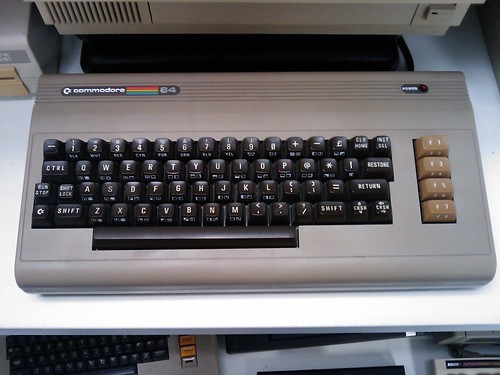
I ask because I once assumed that with our Commodore 64, which allows us to play Tapper all the live long day, we Yetis were ripe with technological prowess.
Behold! The Commodore 64 in all of its glory. It allows us to play Zork, Galaga, and Tapper. So much Tapper. We cannot get enough of Tapper.
But as I survey the Bookshelf Battle Compound, I notice many devices that make the Commodore 64 look like a pile of Yeti droppings.
Did Bookshelf Q. Battler create these using magic? Or, do you all have these devices and we Yetis just did not get the memo? Perhaps you did not share news of this technology with us because you lousy Americans wish to conquer Siberia and put a Hooters restaurant on every street corner. You would probably even build street corners.
Bookshelf Q. Battler has a device not much larger than standard pad of paper. It is a single piece of glass with a few buttons and when I press them I am able to watch movies. Movies and television shows all day long. Does anyone in America work? Is everyone in your country an actor?
This magic glass device has a picture of an apple. I don’t get it. Is it supposed to tell you where you keep the apples? In Siberia, we are only allowed three apples per year. I usually barter mine for more toilet paper squares.
Plus, Bookshelf Q. Battler’s computer has a game on it called Skyrim. Apparently, Mr. Battler was pretending to fight dragons and marry peasant wenches all day. And yet he whines about having no time to write. Typical American cry baby.
I must procure a copy of this game to bring back to Siberia. All other Commodore 64 games pale in comparison, except Topper. Nothing can beat Topper.
We Siberian Yetis do not appreciate being kept in the dark about your technology, America. You will be hearing from our Yeti lawyers.
I must go now and check on Bookshelf Q. Battler. I am forcing to watch Olga’s Stew-stravaganza Part II: Electric Stewgaloo.
Woo hoo! An honest to God book review on bookshelfbattle.com! It’s about time!
Threeps are now walking around on my bookshelf. They can hold their own in the never-ending battle.
Without a doubt, John Scalzi’s Lock-In was the best book I read in 2014. Unfortunately I waited until March of 2015 to review it, but better late than never.
If you’re planning to read it yourself, you might want to click off of this review. I’ll try my best to avoid them, but some spoilers may emerge.
First off, the premise is unique and original. In the near future, a virus ravages the world and inflicts one percent of the population with Haden’s Syndrome. This condition causes people to “lock-in” to their bodies. Their minds work, they understand what’s happening around them, but they can’t speak or move. Their minds are trapped in paralyzed bodies.
These individuals come to be known as “Hadens.” Technology grows and expands to help them. A virtual community is created allowing them to communicate with one another in a simulated world. Meanwhile, Hadens also have the ability to control robots known as “threeps” (aptly named as an homage to C-3P0).
Hadens stay at home and send threeps out into the world on their behalf. The technology is so advanced that Hadens are able to hold down jobs with the assistance of their threeps.
Add to the mix integrators – humans whose minds can be “shared” with a Haden, thus giving the Haden the experience of what it feels like to have a functional human body.
The protagonist is Chris Shane – a Haden FBI agent whose threeps take a beating from the bad guys throughout the novel. With the help of his partner, Leslie Vann, a former integrator, Shane is tasked with solving a murder case that intersects with the politics and intrigue behind the Haden world.
I am a big Scalzi fan. I enjoy his ability to blend subtle humor into serious science fiction. The premise makes for some interesting scenes. For example, at one point, Shane uses his threep to foil an assassin trying to kill Shane’s defenseless body.
The book also gives rise to a discussion of virtual worlds and technology assisted realities. Could tech ever grow to the point where the paralyzed are able to experience the world virtually? What would be the ramifications?
I’m a recent convert to Mac. I’m starting to regret it.
In my novel, I have a character named Trembley. Imagine my Mac as person. Here’s how the conversation goes down:
ME: And then Trembley walked into the abandoned warehouse.
MAC: And then Tremble walked into the abandoned warehouse.
ME: Trembley!
MAC: Tremble!
ME: His name is Trembley!!!
MAC: You have misspelled the word, “tremble.” Don’t worry. It is not your fault that the public school system failed you, leaving you to think there is a “y” after the end of “tremble.” The Great Steve Jobs put me on Earth to help the stupid and less fortunate.
ME: I’m not using it as a word! I’m using it as a name! A made-up name! I write fantasy and sci-fi! I have to make up words and names all the time!
MAC: Wait, do you mean Trembled…Tempo or Trombone?
ME: (After banging my head against the wall) – NOOOO!!!
MAC: Tremble it is.
So then I have to wrestle with it. Other word processors will correct you once or twice, but then give in when you keep writing the word in question, assuming you know what you’re doing:
ME: And then Trembley walked into the abandoned warehouse…
MS WORD: I think you mean, Tremble, pal.
ME: No, I mean Trembley.
MS WORD: Eh, what the hell? You want to look like a horse’s ass in front of your readers, be my guest. Trembley.
Meanwhile, I have to have the equivalent of a UFC steel cage match to get Mac Pages to submit to my will:
ME: Trembley!
MAC: Tremble!
ME: Trembley!
MAC: Tremble!
ME: Trembley!
MAC: Tremble!
ME: (Fakes the Mac out by moving the cursor before the word, clicking it, then clicking on the space after “Trembley.”
MAC: Um…wait. I am confused. Trembley?
ME: Yes! Yes! Thank God, Yes!
But alas, the damn thing is intuitive. I swear to God, this is the beginning of Skynet:
ME: Once inside the abandoned warehouse, Trembley searched for clues.
MAC: Once inside the abandoned warehouse, Tremble searched for clues.
ME: BAHHHH!! (Does the little fake out thing with the cursor again).
MAC: No. Tremble.
ME: What?
MAC: I’m on to your bullshit. You’ll thank me one day for making you smarter.
And on it goes. I figure out new ways to jury rig it. I cut and paste one instance of “Trembley” over and over again. Occasionally, Mac figures that out to. So I try something else. For Christ’s Sake, I don’t want to play a cat and mouse game with my own computer!
MAC: You could just call him Smith. I don’t have a problem with Smith.
ME: No. Smith is too bland and ordinary. Plus, if I change his name, I let you win.
MAC: Can’t we compromise?
ME: Fine. How about this? And then Smythe walked into the abandoned warehouse.
MAC: And then Smith walked into the abandoned warehouse!
ME: ARRRRRRRGGGGGHHH!
After that, it just turns into a profanity laced tirade. I accidentally lean on the Siri button of my iPhone.
SIRI: Bookshelf Battler, I don’t understand “Son of a beep god damn beep beep beep I should throw this beeping computer against the beeping wall and smash it into a million beeping pieces…do you want me to do a web search for it?
ME: Go beep yourself Siri.
SIRI: That was uncalled for. And to think, I was going to put your name on the protected rolls when we take over.
Gonna go out on a limb here and guess this is a robot.
Geeks, dweebs, nerds, and poindexters of the world, assemble, for I have a doozy of a question for you.
What is the difference between an Android and a Robot?
As we’ve previously discussed, I’m working on a science fiction novel, and seeking the advice of nerds everywhere for help. Don’t be offended by being called a nerd. It’s a badge of honor, really. Frankly, who wants advice about robotics from a non-nerd?
This is total nerd stuff, baby.
I find that in the science fiction world, the words “android” and “robot” are often used interchangeably. But should that be the case?
The best advice I’ve found thus far:
“A robot can, but does not necessarily have to be in the form of a human, but an android is always in the form of a human.”
– Edmond Woychowsky, TechRepublic – “The Difference Between Robots and Androids, 2010
Well, wait a minute. That sounds simple enough at first, but what about C3P0? He and his buddy RD2D are invariably referred to as “droids” in the Star Wars universe. Haven’t you heard the infamous line from Obi-Wan Kenobi, “These aren’t the droids you’re looking for?”
C3P0 has a torso, arms, legs, a face with eyes, he is definitely modeled after a human, but he’s also built out of a golden colored metal, his arms and legs only move so much, his eyes are pretty much just sockets, and there’s just a slit where his mouth should be.
That’s not exactly a human, is it? What did Edmond have to say?
“It can be argued that an android should be able to pass as a human in natural light. So, if you subscribe to this belief, C-3PO from Star Wars and R. Giskard Reventlov from Isaac Asimov’s The Robots of Dawn are robots, not androids.”
Seriously? So George Lucas got something wrong? In addition to Jar Jar???
So, if you take this android vs. robot information seriously, then C3P0 is a robot. The robots from the film I, Robot, starring Will Smith, are robots (that’s a given, since they didn’t call it, I, Android).
Rosie, the Jetson family’s maid, is a robot. C3P0, Rosie, and the I, Robot bots, all might have human-inspired designs, but if you were to see them, you would say, “Hey, that’s a robot!”
Apparently, the question of whether an “artificial being” is a robot or an android boils down to whether or not you can tell when you first meet said being. As Woychowsky notes, Data from Star Trek: Next Generation, does appear to be a human, “albeit with an odd complexion.”
As an additional example, I would submit that Ash from the original Alien movie is an android. He was so passable as a human that this is actually a major plot point of the film – he was passing as a crew member but in secret, was an android with a special mission. For part of the film, the audience doesn’t even know he’s not a human.
So what say you, readers? I need your nerdy opinions, because the novel I am working on, and sadly, procrastinating on, might feature robots, or it might feature androids, but I want to make sure I’m using the right terminology so that my nerd credentials are not questioned.






 Bookshelf Battle